
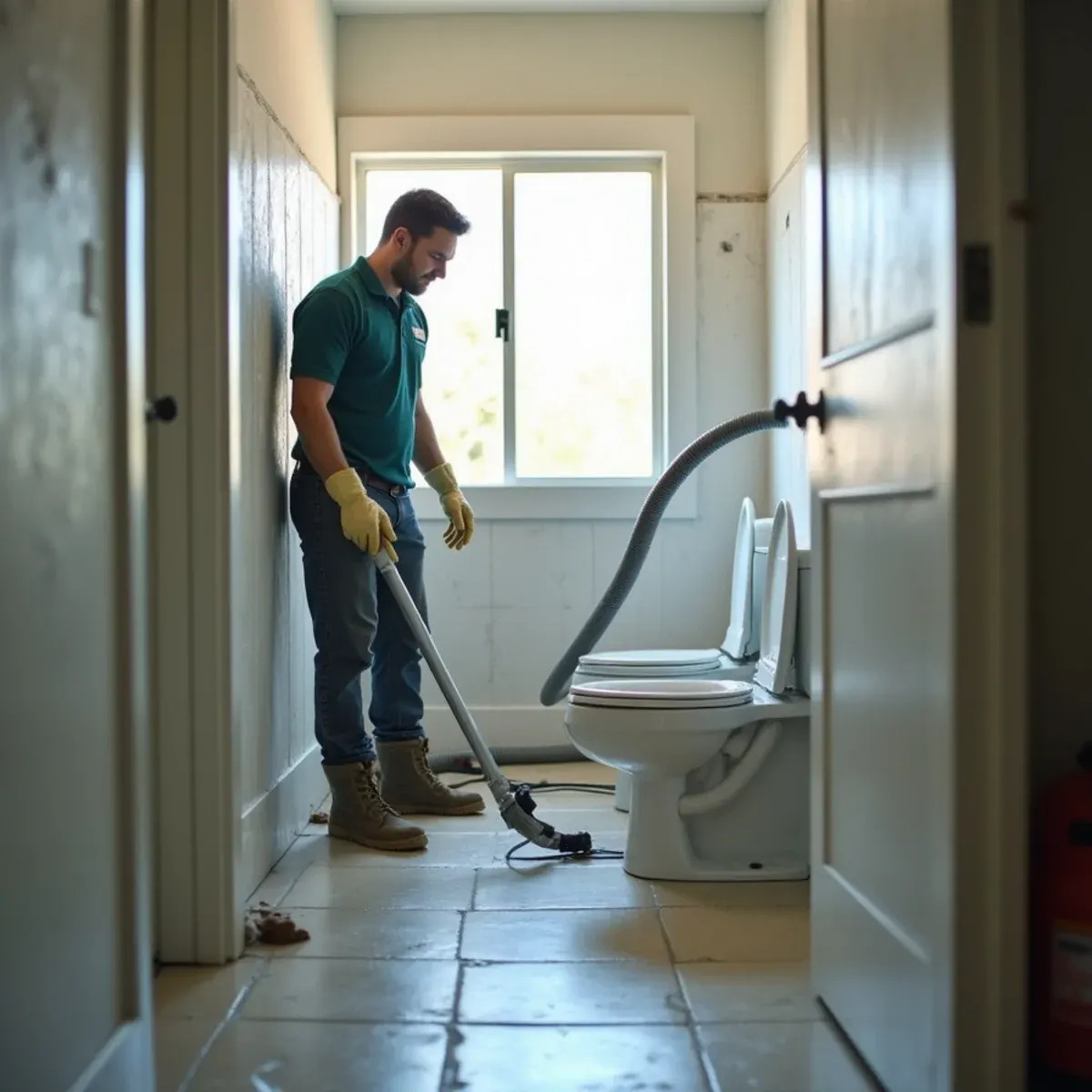
A toilet overflows in a house near the Plaza and there's no puddle to find. Old Towne Orange is close to a square mile of 1880s through 1920s homes on raised foundations, and their floors let water through. It follows the seam where the closet flange meets the boards, drips into the crawl space, and soaks dirt for a week without leaving a mark upstairs. The homeowner thinks they caught it with towels. What we find under the joists usually says otherwise.
The rest of Orange behaves nothing like that. El Modena and Santiago Hills are postwar slab tract, where the same overflow spreads sideways into the hall and under the vanity toe kick. Orange Park Acres puts half-acre equestrian lots and long private lines between the house and the street, which gives roots plenty of chances. And around Chapman, converted rentals mean multiple tenants and a slower first phone call. One city, four completely different versions of this job.
What Orange Changes About Toilet Overflow
1Raised floors hide the real damage
In an Old Towne house, the bathroom floor is the last place the water stays. It follows the flange penetration and the baseboard seams into the crawl space, where it sits on dirt with no daylight and no airflow. If the source was a main-line backup, that soil is contaminated and the subfloor above it is porous. We inspect from below before we write a scope.
2Original closet bends and corroded flanges
Century-old bathrooms in Orange have been remodeled two or three times, often with tile added over the original floor. That raises the finished surface above the flange and leaves the wax ring stretched. It seeps a little with every flush, so when a real overflow happens the path is already established. We check flange height and reset the ring before anything gets closed back up.
3Orange Park Acres runs are long
Half-acre lots mean the line from the house to the street can run a hundred feet or more under mature trees and irrigated pasture. Backups out there are almost always lateral blockages rather than fixture failures, which puts them in Category 3 from the start. Barns and secondary structures often share the same line, so we map the whole run instead of assuming.
How the Work Runs
The method is the same one we use on every toilet overflow job, documented to the IICRC S500:2025 standard. Here it is in short — the full toilet overflow cleanup process explains each stage in detail.
- Stop the water, stabilize the room
- Determine the category before scoping
- Extract, then remove only what must go
- Pull the toilet, inspect the flange
- Dry the subfloor and the ceiling below
- Disinfect to category, verify, reset
The Orange Background Worth Knowing
A slab leak announces itself eventually because concrete has nowhere to put the water. A crawl-space leak has somewhere to put it. Dirt absorbs a slow drip almost indefinitely, so the loss never produces the one thing homeowners watch for, which is water on a floor. Meanwhile the humidity under the house climbs, the fiberglass insulation between the joists soaks up moisture and sags, the subfloor picks up that moisture from below, and mold begins on the joists where it is invisible and undisturbed. Everything about this failure is built to stay quiet.
There is more on the housing stock, drainage and plumbing history of this city on our water damage restoration in Orange page.
Orange at a glance
- Dominant construction era
- 1888–1975
- Foundation type
- mixed on grade
- Supply piping found here
- original turn-of-century piping, galvanized steel, under-slab copper
- Drain line materials
- cast iron, clay
- Terrain and water table
- flat, moderate water table
- Most common local failure
- crawl-space leaks under raised-foundation historic homes, running for weeks because water drips into the dirt instead of pooling on a floor
- Highest-value local prevention
- an annual crawl-space inspection, which almost nobody does and which catches nearly everything early
What It Costs in Orange
We do not quote a number over the phone before seeing the property — anyone who does is guessing. The variables that actually move the price on a toilet overflow job are the category of the water, how far it traveled from the base, what your floor is built from, and they are broken down in full on the toilet overflow cleanup page. The assessment and the written estimate are free anywhere in Orange, day or night, with no obligation.
Toilet Overflow Questions from Orange Homeowners
Not automatically, and we'd rather they didn't. If it was clean bowl water caught quickly, old-growth floorboards often dry with mats and controlled airflow, though cupping can take weeks to relax. If it was a main-line backup, the answer changes — Category 3 water that has gone through the boards into the crawl space contaminates the underside, and hardwood over a contaminated subfloor is rarely salvageable. We tell you which one you have before anything gets pulled.
Clear water lowers the health risk, not the drying requirement. Clean water still soaks into carpet pad, particle board, and the cut edge of subfloor around the flange, and it still causes swelling and mold growth if it stays. What clean water does change is the scope: no containment, no PPE, usually no demolition. If it stayed on sealed tile and you got it up quickly, you may genuinely be fine. If it reached anything porous, it needs real drying.
Three checks. Did the water rise in the bowl without anyone flushing it? Does another fixture gurgle, drain slowly, or fill up when you run water elsewhere in the house? Is there visible soil or a sewer odor in what came out? Any one of those points at the main line. A stuck fill valve, by contrast, gives you clear water, a bowl that overflows steadily, and a tank you can hear running continuously.
Pick a dry day, open the hatch, and use a good flashlight. You are looking at the soil directly under the bathrooms, kitchen, and laundry for dark damp patches, at the insulation for sagging or fallen batts, and at the piers and foundation vents for rust or white staining. Trust your nose as much as your eyes. If the access is too tight or you would rather not go under, we will do the inspection and photograph what is down there.