
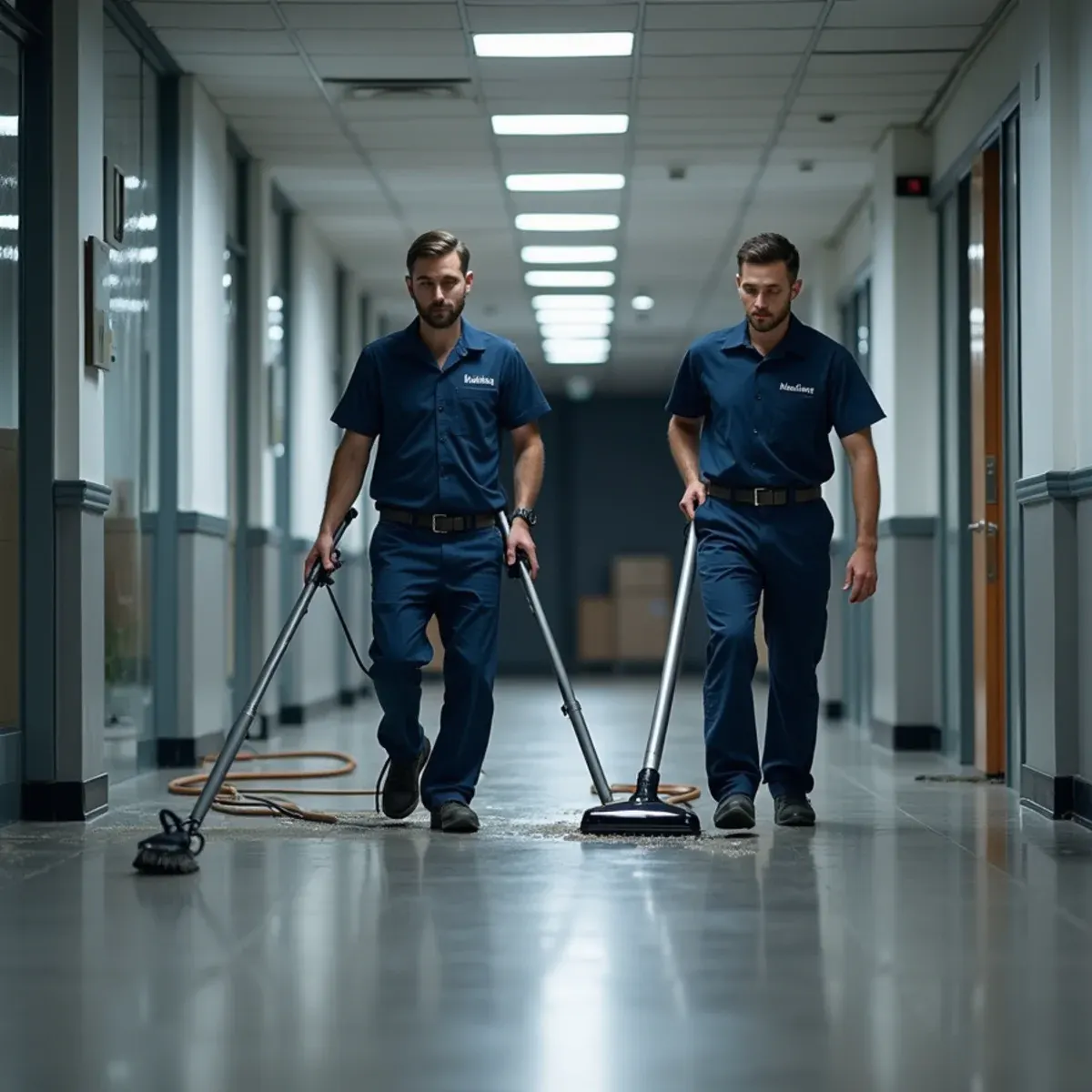
The commercial buildings ringing the Plaza traffic circle aren't business-park suites. They're 1900s brick and wood-frame storefronts with offices or apartments above the retail, shared party walls, and in places a raised floor over a crawl space instead of a slab. When a supply line lets go on the second floor along Glassell or Chapman, the water doesn't respect the lease lines. It crosses a party wall into the next tenant's stockroom, then drips into a crawl space where nobody sees it for days. By then the category has already moved.
The other half of commercial Orange is institutional, and it never closes. UCI Medical Center, St. Joseph and CHOC sit within a few minutes of each other, and Chapman University runs classrooms and labs through the middle of Old Towne. Drying a working patient floor is a containment problem before it is a drying problem: hard barriers, negative air, HEPA filtration, and a schedule built around the department that still has to operate next door. We stage most of that work overnight and document each area separately.
What Orange Changes About Commercial Restoration
1Party walls decide the containment plan
Old Towne storefronts share structural walls, and moisture moves through them long before it shows on the neighbor's paint. We read the adjacent tenant's side before we commit to a containment line, then set barriers so the shop next door keeps its doors open. Each suite gets its own moisture map and its own daily log, because each one is a separate lease and often a separate carrier.
2Hospital floors need hard barriers, not plastic
On the medical campuses along Chapman Avenue and The City Drive, a drying job runs under infection-control rules. That means rigid barriers, sealed penetrations, negative pressure verified rather than assumed, and HEPA scrubbers sized for the space. We coordinate the work window with facilities and infection prevention, and we plan for the department beside ours to keep admitting patients the whole time.
3Crawl spaces hide the loss for weeks
Raised-foundation buildings around the Plaza give water somewhere to disappear to. It soaks into dirt instead of pooling on a floor, so nobody calls until the smell reaches the sales floor. By that point S500:2025 category has usually degraded with time and contact, which changes the disposal, the clearance criteria, and the honest length of the schedule we can give you.
How the Work Runs
The method is the same one we use on every commercial restoration job, documented to the IICRC S500:2025 standard. Here it is in short — the full commercial water damage restoration process explains each stage in detail.
- Rapid assessment with a business continuity lens
- Coordinate with stakeholders
- After-hours mobilization
- Documentation at commercial standard
- Scaled drying and containment
- Phased reconstruction
The Orange Background Worth Knowing
A slab leak announces itself eventually because concrete has nowhere to put the water. A crawl-space leak has somewhere to put it. Dirt absorbs a slow drip almost indefinitely, so the loss never produces the one thing homeowners watch for, which is water on a floor. Meanwhile the humidity under the house climbs, the fiberglass insulation between the joists soaks up moisture and sags, the subfloor picks up that moisture from below, and mold begins on the joists where it is invisible and undisturbed. Everything about this failure is built to stay quiet.
There is more on the housing stock, drainage and plumbing history of this city on our water damage restoration in Orange page.
Orange at a glance
- Dominant construction era
- 1888–1975
- Foundation type
- mixed on grade
- Supply piping found here
- original turn-of-century piping, galvanized steel, under-slab copper
- Drain line materials
- cast iron, clay
- Terrain and water table
- flat, moderate water table
- Most common local failure
- crawl-space leaks under raised-foundation historic homes, running for weeks because water drips into the dirt instead of pooling on a floor
- Highest-value local prevention
- an annual crawl-space inspection, which almost nobody does and which catches nearly everything early
What It Costs in Orange
We do not quote a number over the phone before seeing the property — anyone who does is guessing. The variables that actually move the price on a commercial restoration job are square footage and ceiling height, occupancy and access constraints, building systems involved, and they are broken down in full on the commercial water damage restoration page. The assessment and the written estimate are free anywhere in Orange, day or night, with no obligation.
Commercial Restoration Questions from Orange Homeowners
Usually, yes, and it is worth the extra days. Old-growth baseboard, wainscot and original plaster can often be dried in place when readings support it, using cavity drying through discreet access points rather than open demolition. We document the readings that justify holding a material, so the adjuster sees why we went slower. If a material stays wet past the point S500 allows, we tell you plainly and remove it.
Yes, and for most commercial clients that is the default. Night and weekend crews cost somewhat more in labor and almost always cost far less than the revenue lost by closing during business hours.
Regularly. Multi-family losses are documented unit by unit with separate files, moisture mapping, and drying logs, which is what allows multiple owners, an HOA, and several carriers to resolve their portions cleanly.
Pick a dry day, open the hatch, and use a good flashlight. You are looking at the soil directly under the bathrooms, kitchen, and laundry for dark damp patches, at the insulation for sagging or fallen batts, and at the piers and foundation vents for rust or white staining. Trust your nose as much as your eyes. If the access is too tight or you would rather not go under, we will do the inspection and photograph what is down there.