
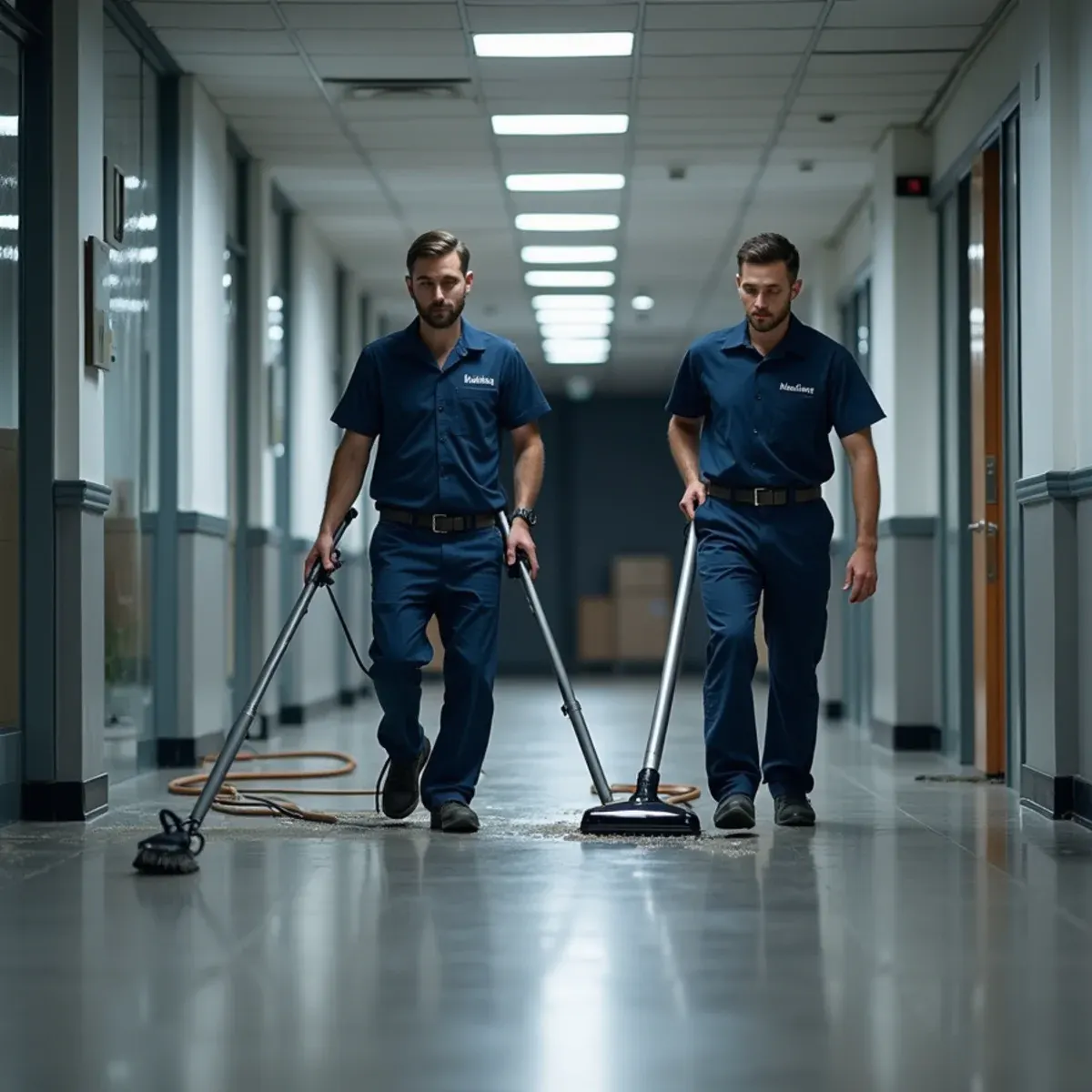
It is Friday evening on Pioneer Boulevard, the kitchen is full, and the floor sink starts coming back up. That call is the one we plan for in Artesia. This is a compact city of about 16,500 with one of the densest concentrations of independent retail and restaurants in the region, almost all of it in 1950s buildings that were never designed for commercial kitchen loads. Grease solidifies on the rough, corroded interior of old cast iron waste lines and narrows the pipe year after year until it backs up under load, which is always at the worst possible hour.
These are independent owners. There is no corporate reserve behind a three-week closure, and business interruption coverage depends on a documented timeline somebody else can verify. So we treat the reopening date as the deliverable. Extraction and sanitation first, because a drain backup is contaminated water and food-contact surfaces have to be cleaned and verified rather than simply dried. Then the drying, then a phased rebuild that gets the kitchen back into service before the dining room is finished.
What Artesia Changes About Commercial Restoration
1Grease-loaded cast iron backs up under load
Decades of grease bond to the corroded interior of these old waste lines and reduce the bore steadily. The line handles a slow night and fails on a busy one. Snaking punches a hole through the blockage and buys weeks. Hydro-jetting actually scours the pipe wall, and we recommend it before reconstruction closes access, so the same line does not fail again during your first month back open.
2Category 3 water in food service
A drain backup is contaminated under IICRC S500:2025, and that classification drives the work. Porous materials in the affected area come out, hard surfaces are cleaned and treated, and food-contact zones are verified before the kitchen returns to service. It is more work than a clean supply break, and cutting it short is how a reopened kitchen fails its next health inspection.
3A reopening date you can plan staff around
Independent owners on Pioneer Boulevard have to tell staff and suppliers something concrete. We give an honest date at the end of day one and phase the rebuild so the kitchen and a reduced dining area open first. We would rather quote twelve days and hit it than quote six and let it slip, because your business interruption claim depends on a timeline that holds up.
How the Work Runs
The method is the same one we use on every commercial restoration job, documented to the IICRC S500:2025 standard. Here it is in short — the full commercial water damage restoration process explains each stage in detail.
- Rapid assessment with a business continuity lens
- Coordinate with stakeholders
- After-hours mobilization
- Documentation at commercial standard
- Scaled drying and containment
- Phased reconstruction
The Artesia Background Worth Knowing
A commercial kitchen is one of the hardest things you can ask a building to accommodate. High water use, continuous drainage, grease loading, floor drains, and equipment connections that get added and modified over the years. When that kitchen is in a building from the 1950s with original cast-iron waste lines, the failure is a matter of time.
There is more on the housing stock, drainage and plumbing history of this city on our water damage restoration in Artesia page.
Artesia at a glance
- Dominant construction era
- 1950–1970
- Foundation type
- slab on grade
- Supply piping found here
- galvanized steel, copper
- Drain line materials
- cast iron
- Terrain and water table
- flat, moderate water table
- Most common local failure
- grease-loaded cast-iron waste lines restricting until a commercial kitchen backs up
- Highest-value local prevention
- hydro-jetting the waste line rather than snaking it, so the pipe wall actually gets cleaned
What It Costs in Artesia
We do not quote a number over the phone before seeing the property — anyone who does is guessing. The variables that actually move the price on a commercial restoration job are square footage and ceiling height, occupancy and access constraints, building systems involved, and they are broken down in full on the commercial water damage restoration page. The assessment and the written estimate are free anywhere in Artesia, day or night, with no obligation.
Commercial Restoration Questions from Artesia Homeowners
For a contained backup caught the same night, kitchens commonly return in under a week; if it ran across a dining room carpet or into a wall base, longer. The sequence is extraction, removal of porous materials, cleaning and sanitizing of all food-contact areas, then drying verified by meter. We also recommend hydro-jetting the waste line before we close anything back up, because the grease that caused it is still coating the pipe.
Yes, and for most commercial clients that is the default. Night and weekend crews cost somewhat more in labor and almost always cost far less than the revenue lost by closing during business hours.
Regularly. Multi-family losses are documented unit by unit with separate files, moisture mapping, and drying logs, which is what allows multiple owners, an HOA, and several carriers to resolve their portions cleanly.
Yes, and on Pioneer Boulevard that is usually how we schedule it. Overnight crews cost somewhat more in labor and almost always cost dramatically less than lost revenue from closing during operating hours.