
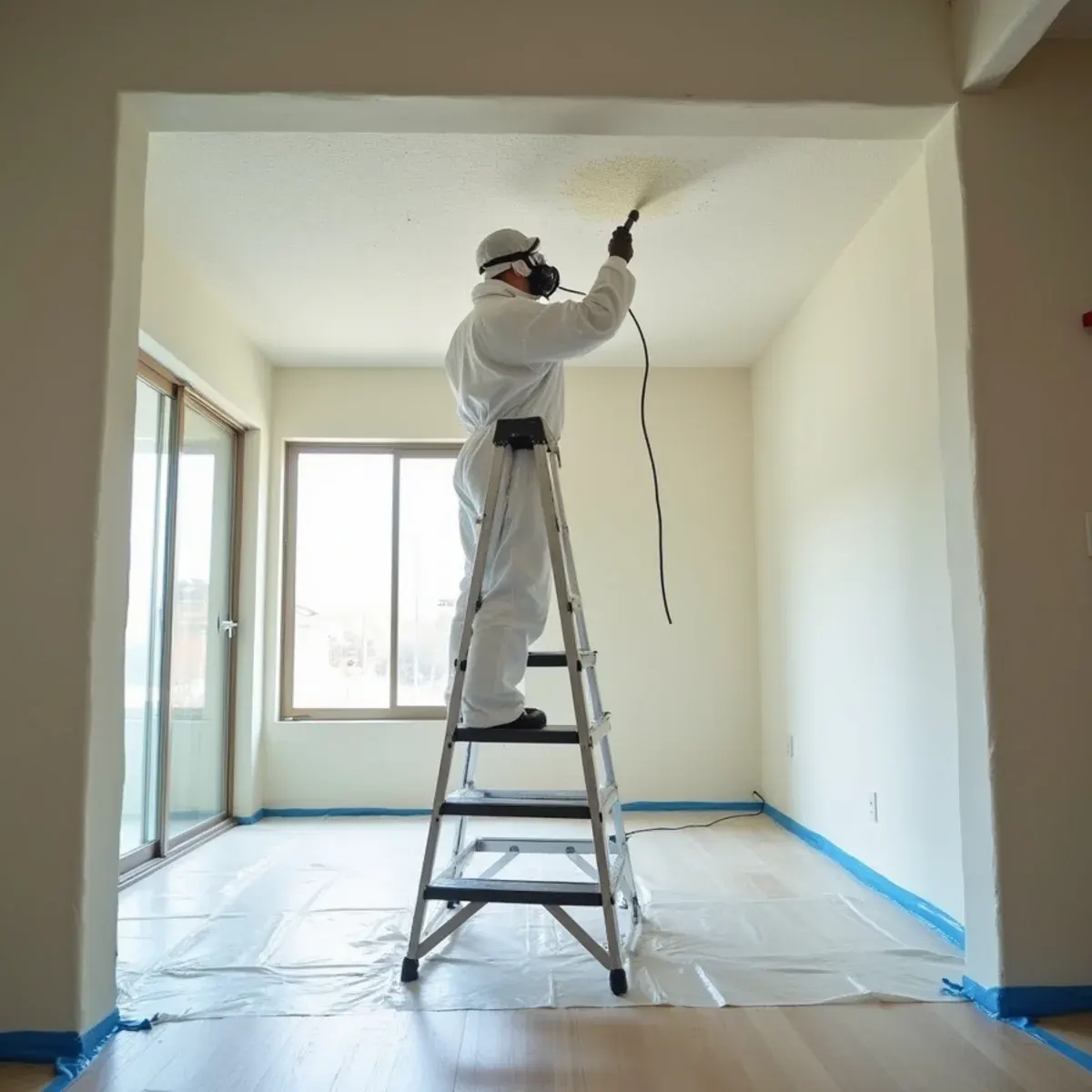
Roughly a square mile around the Plaza is one of the largest National Register historic districts in California, and the houses in it were built long before anyone regulated either material. A Craftsman off Glassell has paint from the 1910s under everything applied since, and the older the layer the higher the lead. Under the floor, the raised foundation hides the other half of the problem — pipe and duct insulation wrapped in the days when that wrap was air-cell asbestos, now dried out and shedding onto the dirt.
Orange is not only Old Towne, and the answer changes fast outside it. El Modena and Santiago Hills are postwar slab tract, where the concern narrows to ceiling texture, vinyl tile and mastic. Orange Park Acres runs half-acre equestrian lots with long private water lines and outbuildings, so a leak can drip into crawl-space dirt for weeks without ever making a puddle indoors — and the drying work that follows disturbs everything under there. Near Chapman and the medical campuses the buildings are institutional, and the survey requirements are stricter than any house.
What Orange Changes About Asbestos & Lead Testing
1Historic district repairs favor testing over replacement
Old Towne's review process pushes toward repairing original windows, siding and trim rather than swapping them. That is the right call for the building and the harder call for lead, because repair means sanding and scraping in place. Testing tells you which elements are hot and which are not, so containment goes where it is needed instead of over the whole exterior.
2Crawl-space pipe wrap under Old Towne floors
Under a raised foundation, old insulation is friable — it crumbles by hand. Anyone crawling under to chase a leak drags across it. We sample wrap and duct joints before drying equipment goes under a house near Almond or Chapman, because forcing air through a crawl space with damaged asbestos wrap in it is the fastest way to turn a small problem into a large one.
3Slab tracts and equestrian lots need less
East of Old Towne the picture simplifies. A 1960s El Modena slab house has no crawl space and no century of paint — usually it is ceiling texture and floor tile, two samples, done. Orange Park Acres barns and tack rooms sometimes surprise, since agricultural outbuildings held transite panel and asbestos roofing well past the residential norm. We look, but we do not invent scope.
How the Work Runs
The method is the same one we use on every asbestos & lead testing job, documented to the IICRC S500:2025 standard. Here it is in short — the full asbestos & lead paint testing process explains each stage in detail.
- Emergency stabilization without cutting
- Define exactly what gets disturbed
- A certified inspector takes the samples
- Independent laboratory analysis
- Lead assessment on painted surfaces
- Abatement, clearance, then restoration
The Orange Background Worth Knowing
A slab leak announces itself eventually because concrete has nowhere to put the water. A crawl-space leak has somewhere to put it. Dirt absorbs a slow drip almost indefinitely, so the loss never produces the one thing homeowners watch for, which is water on a floor. Meanwhile the humidity under the house climbs, the fiberglass insulation between the joists soaks up moisture and sags, the subfloor picks up that moisture from below, and mold begins on the joists where it is invisible and undisturbed. Everything about this failure is built to stay quiet.
There is more on the housing stock, drainage and plumbing history of this city on our water damage restoration in Orange page.
Orange at a glance
- Dominant construction era
- 1888–1975
- Foundation type
- mixed on grade
- Supply piping found here
- original turn-of-century piping, galvanized steel, under-slab copper
- Drain line materials
- cast iron, clay
- Terrain and water table
- flat, moderate water table
- Most common local failure
- crawl-space leaks under raised-foundation historic homes, running for weeks because water drips into the dirt instead of pooling on a floor
- Highest-value local prevention
- an annual crawl-space inspection, which almost nobody does and which catches nearly everything early
What It Costs in Orange
We do not quote a number over the phone before seeing the property — anyone who does is guessing. The variables that actually move the price on a asbestos & lead testing job are the number of distinct materials, how many samples each needs, how fast you need results, and they are broken down in full on the asbestos & lead paint testing page. The assessment and the written estimate are free anywhere in Orange, day or night, with no obligation.
Asbestos & Lead Testing Questions from Orange Homeowners
Not usually. Sampling and lab turnaround happen while the rest of the scope is still being drawn, and having results in hand tends to help — you can tell historic review what stays and what gets abated instead of guessing. Where a positive comes back on original siding or window sash, the containment plan can often be written to keep the original material in place and encapsulated rather than removed.
No, and that's the whole point of testing. Plenty of ceilings from that decade come back clean — the manufacturers were mixed, the formulas changed year to year, and two houses on the same street can give different results. What we can't do is assume either way. A 1974 ceiling is a suspect material, which means one sample and a lab report separates a routine repair from a regulated one. Guessing in either direction is the expensive choice.
Usually less than people fear, and we design around it. Extraction, containment and dehumidification all start on the first visit, because none of that disturbs a suspect material. Sampling happens the same day where we can get an inspector out, and rush lab analysis is available when the clock matters. What genuinely adds time is a positive result, since abatement, containment and clearance testing have to finish before we cut. We'll give you a realistic date rather than an optimistic one.
Pick a dry day, open the hatch, and use a good flashlight. You are looking at the soil directly under the bathrooms, kitchen, and laundry for dark damp patches, at the insulation for sagging or fallen batts, and at the piers and foundation vents for rust or white staining. Trust your nose as much as your eyes. If the access is too tight or you would rather not go under, we will do the inspection and photograph what is down there.