
You may have already been told no. A lot of restoration companies decline manufactured homes, and Stanton has one of the larger manufactured-home populations in this part of the county. We work on them. The reason they get declined is the same reason they need attention: a manufactured home has particleboard floor decking sitting on a belly wrap, and when a supply line under that floor lets go, the water has nowhere to go. It pools inside the wrap. It doesn't evaporate. It can sit there for months while the decking above it slowly turns to mush.
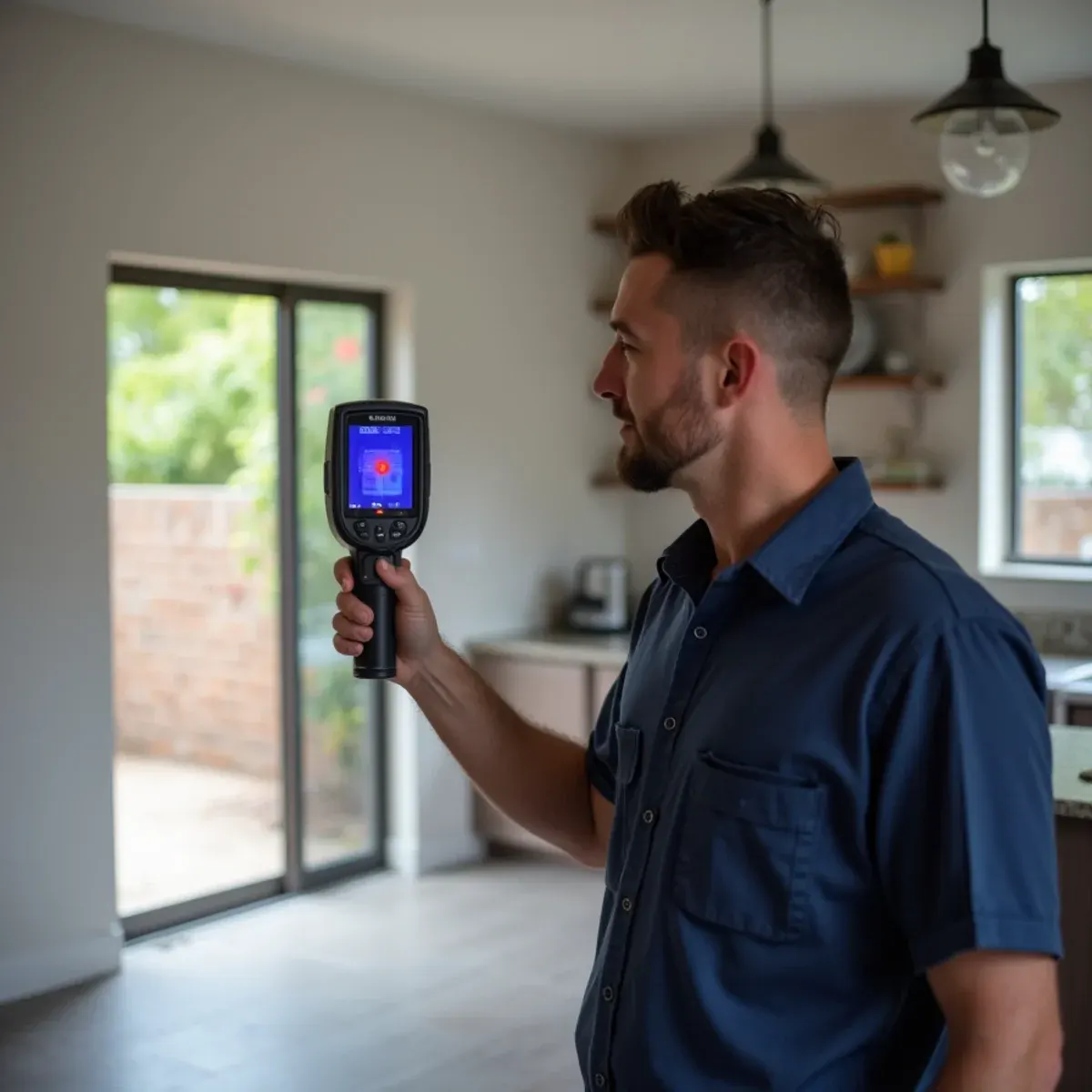
That failure mode changes the inspection. A thermal camera pointed at the floor from inside tells us something, but not enough — the wrap and the insulation between it and the decking blunt the picture. So we meter the decking directly, walk the floor for soft spots, and when the readings warrant it we get access underneath to see the wrap itself. Stanton also has a large stock of older apartments off the Beach Boulevard corridor and near Stanton Central Park, where the problem is different again: shared walls, aging galvanized, and tenants who report late.
What Stanton Changes About Inspection & Leak Detection
1Belly wrap inspection on manufactured homes
Water trapped between the decking and the wrap is invisible from inside until the floor gives. We check known failure points first — the water heater compartment, the washer connection, the line into each bath — and if readings suggest trapped water, the wrap needs to be opened and drained, not just dried from above. Nothing above that floor gets dry while the wrap is holding water.
2Soft spots are the only warning you get
Particleboard decking doesn't stain a ceiling or drip into a room. It softens. If a patch of floor near a toilet, tub or laundry area flexes underfoot in a way it didn't last year, treat that as a moisture problem until a meter says otherwise. That single observation is what brings most manufactured-home owners here to us in time to save the decking.
3Older apartments and mixed piping
Stanton is dense, and much of the multi-family stock predates 1975 with galvanized steel supply and cast-iron waste. Manufactured homes on the same street may run PEX or older poly. Two completely different systems, two different inspection approaches, sometimes on the same block. We ask what the building is before we decide how to scan it, and the report says which system we were looking at.
How the Work Runs
The method is the same one we use on every inspection & leak detection job, documented to the IICRC S500:2025 standard. Here it is in short — the full water damage inspection & leak detection process explains each stage in detail.
- Talk through the history
- Thermal imaging survey
- Confirm with moisture meters
- Supply-side isolation testing
- Written findings with images
- Options, not a sales pitch
The Stanton Background Worth Knowing
Mobile and manufactured homes need a genuinely different restoration approach, and the reason is what they are built from. The floor system is typically particleboard or OSB over a wood frame with insulation and a vapor barrier belly wrap underneath — and particleboard exposed to water swells, loses structural integrity, and does not recover. It cannot be dried back to serviceable the way plywood often can.
There is more on the housing stock, drainage and plumbing history of this city on our water damage restoration in Stanton page.
Stanton at a glance
- Dominant construction era
- 1950–1975
- Foundation type
- mixed on grade
- Supply piping found here
- galvanized steel, copper, manufactured-home PEX and poly
- Drain line materials
- cast iron
- Terrain and water table
- flat, moderate water table
- Most common local failure
- underfloor leaks in manufactured homes, sealed inside the belly wrap where they cannot evaporate
- Highest-value local prevention
- checking for soft spots underfoot, because a manufactured-home floor gives no other warning
What It Costs in Stanton
We do not quote a number over the phone before seeing the property — anyone who does is guessing. The variables that actually move the price on a inspection & leak detection job are standard moisture inspection — no charge, electronic slab leak location, pre-purchase moisture survey, and they are broken down in full on the water damage inspection & leak detection page. The assessment and the written estimate are free anywhere in Stanton, day or night, with no obligation.
Inspection & Leak Detection Questions from Stanton Homeowners
We will inspect it. And the honest answer on thermal is that it helps but it does not see through the wrap reliably — the insulation and the wrap itself flatten the signal. So we lead with moisture meter readings taken directly in the decking, a careful walk of the floor, and physical access underneath when the numbers point that way. That combination finds trapped underfloor water. Thermal alone would miss a lot of it.
The standard moisture inspection is — thermal imaging, moisture mapping, and written findings, with no obligation. Specialized services like electronic slab leak location, a full pre-purchase survey, or lab sampling carry a fee, and we tell you the number before we start.
Twenty to forty minutes for a targeted check of a specific concern. A comprehensive whole-home survey for a real estate transaction runs about ninety minutes to two hours.
Yes, and we say so explicitly because a lot of companies will not. Manufactured homes need a different approach — opening the belly wrap to dry the floor cavity, removing saturated insulation, and honestly assessing particleboard decking, which usually cannot be dried back to serviceable.