
Cerritos is early, and that's the opportunity. Cities built in the fifties are in the middle of their under-slab copper failures — we're pulling floors up in Lakewood and Rossmoor most months. The master-planned Cerritos tracts from the late sixties through the eighties are only now reaching the age where that same copper starts producing pinholes. Which means most homes here have not failed yet, and a documented baseline taken now is worth more than one taken after something goes wrong. That's an unusual thing to be able to say about a city, and it won't be true for much longer.
The building stock helps too. This city was planned deliberately, so the tracts are consistent and unusually well maintained, and there's a much higher proportion of two-story homes than in the neighborhoods across Coyote Creek. Two stories change the search. An upper-floor supply failure gets into the enclosed floor assembly and runs along the joist bays, sometimes twenty feet, before it finds a seam and drops through a ceiling in a room nowhere near the source. When we scan a Cerritos home we read the whole ceiling plane below, not the wet patch you called about.
What Cerritos Changes About Inspection & Leak Detection
1A baseline reading before anything fails
Moisture numbers only mean something in comparison. Readings taken on a dry house give you a reference for the whole property — slab, wet walls, ceilings below baths — that makes any future reading interpretable in minutes instead of arguable for weeks. In a city whose plumbing is just entering its failure window, that baseline has a decent chance of being useful within the next several years.
2Two-story assemblies move water sideways
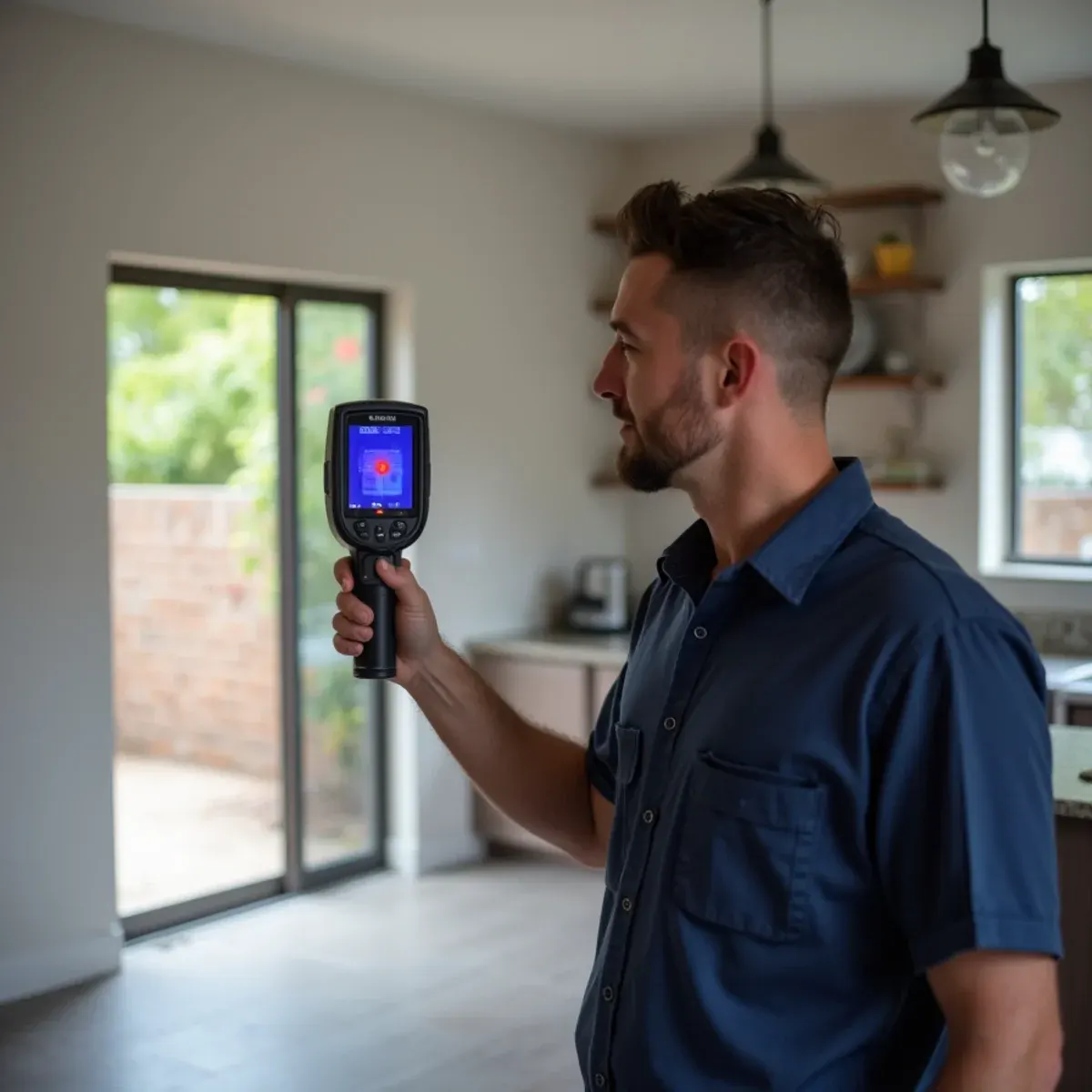
Water in an enclosed floor structure travels along joist bays until a penetration lets it drop. The stain on your ceiling marks the exit, not the entry. We grid the ceiling below with thermal imaging, meter the boundaries to establish the real wet footprint, and work back up to the fixture. Skipping that step is how people cut open the wrong ceiling.
3Consistent plans make comparison easy
Because the tracts were built to a limited set of plans, we know roughly where the wet walls and supply runs are before we walk in. That shortens the scan and makes findings from one house genuinely informative about the next one on the same plan. It also means when a specific fitting starts failing across a tract, the pattern shows up quickly and we can tell you about it.
How the Work Runs
The method is the same one we use on every inspection & leak detection job, documented to the IICRC S500:2025 standard. Here it is in short — the full water damage inspection & leak detection process explains each stage in detail.
- Talk through the history
- Thermal imaging survey
- Confirm with moisture meters
- Supply-side isolation testing
- Written findings with images
- Options, not a sales pitch
The Cerritos Background Worth Knowing
Cerritos has a considerably higher proportion of two-story homes than the single-story tract cities around it, and that changes the geometry of every water loss. A failure on the second floor does not stay there — it goes through the floor assembly into the ceiling below and spreads laterally across the joists before it drops.
There is more on the housing stock, drainage and plumbing history of this city on our water damage restoration in Cerritos page.
Cerritos at a glance
- Dominant construction era
- 1965–1985
- Foundation type
- slab on grade
- Supply piping found here
- under-slab copper
- Drain line materials
- cast iron, ABS
- Terrain and water table
- flat, moderate water table
- Most common local failure
- upper-floor failures that spread laterally through the enclosed floor assembly before dropping through a ceiling well away from the source
- Highest-value local prevention
- the annual meter test, since 1970s under-slab copper is only now entering its failure window here
What It Costs in Cerritos
We do not quote a number over the phone before seeing the property — anyone who does is guessing. The variables that actually move the price on a inspection & leak detection job are standard moisture inspection — no charge, electronic slab leak location, pre-purchase moisture survey, and they are broken down in full on the water damage inspection & leak detection page. The assessment and the written estimate are free anywhere in Cerritos, day or night, with no obligation.
Inspection & Leak Detection Questions from Cerritos Homeowners
It's well timed, actually. Under-slab copper from the seventies is entering the age range where pinholes start, and the value of scanning a house that hasn't failed is the baseline you get from it. We'll tell you honestly if everything reads normal — most do at this stage. What you keep is a documented set of readings for your slab, wet walls and ceilings, which makes any future change obvious rather than debatable.
The standard moisture inspection is — thermal imaging, moisture mapping, and written findings, with no obligation. Specialized services like electronic slab leak location, a full pre-purchase survey, or lab sampling carry a fee, and we tell you the number before we start.
Twenty to forty minutes for a targeted check of a specific concern. A comprehensive whole-home survey for a real estate transaction runs about ninety minutes to two hours.
Usually fifteen to twenty minutes. Cerritos borders Cypress across Coyote Creek, so it is one of our closest service areas and the 60-minute commitment applies fully.