
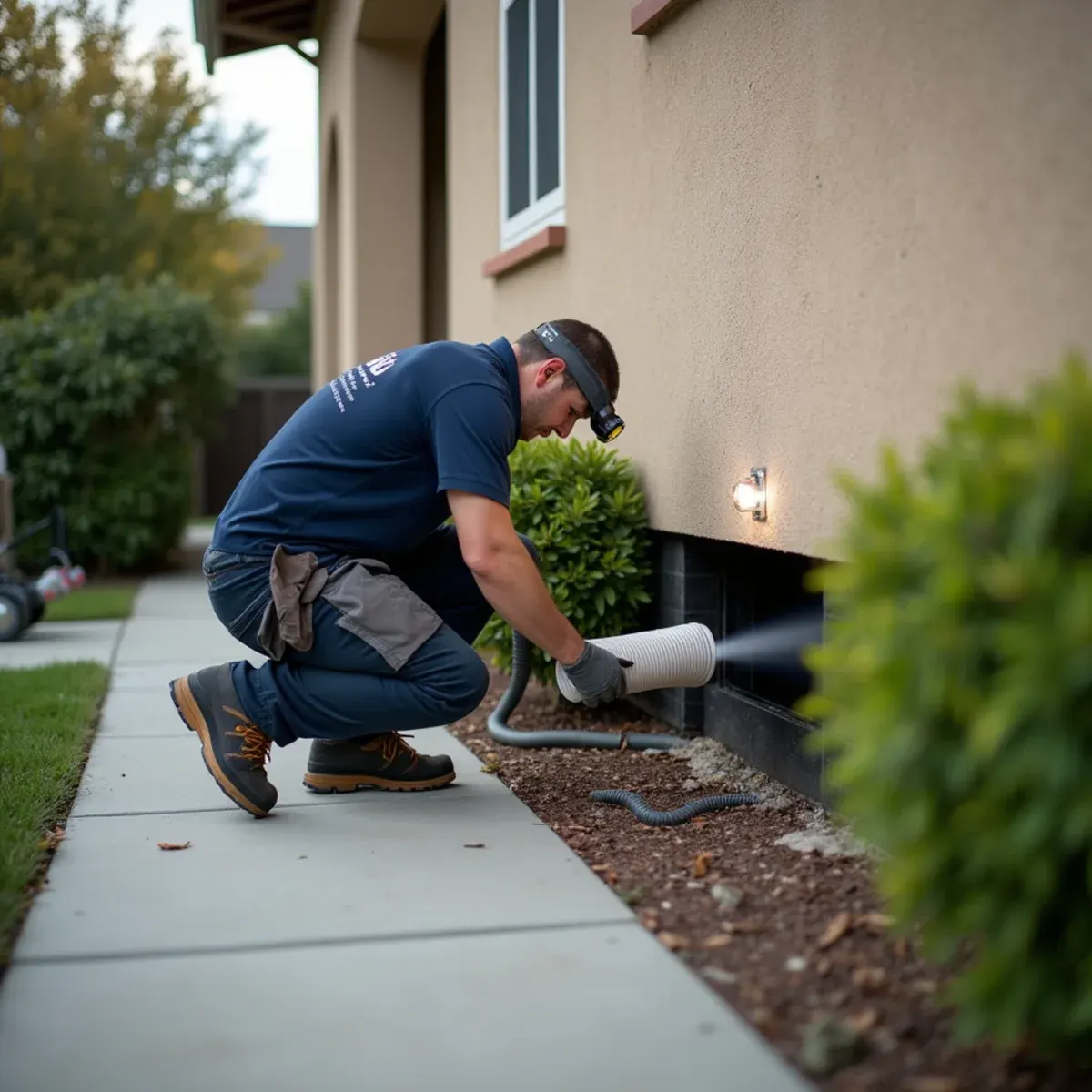
Most of what we do in Santa Fe Springs happens on a commercial floor, not under a house. This is one of the most industrial cities in this corner of Los Angeles County — oil-field history, then a warehouse, manufacturing and distribution base that dwarfs the residential footprint. The typical loss is a fire-sprinkler head letting go over an open-plan floor at two in the morning, water spreading across sealed concrete and into racked inventory long before anyone gets there to shut it down.
So crawl-space drying in the residential sense is rare here. The housing that exists is mostly 1950s through 1970s slab on grade, the same as the tracts around it, with additions and converted garages accounting for the few wood floors over dirt. On the commercial side there's a real equivalent: under-slab utility trenches, pipe chases, dock-level voids and raised-floor areas in office space, all of which hold water in ways an open warehouse floor does not.
What Santa Fe Springs Changes About Crawl Space Drying
1Sprinkler discharge covers ground fast
A single activated head puts out a large volume in a short time across a floor with no walls to stop it. By the time someone arrives, water is under pallets, into corrugated stock and along the base of racking. The drying plan starts with where the water went horizontally, then with what's trapped underneath, and only then with the air. Extraction speed decides how much inventory survives.
2Racking dictates the drying layout
You can't set equipment where the forklift lanes are, and you often can't move loaded racking at all. We build the airflow around the existing layout, duct into aisle ends, and stage dehumidification where it won't stop the operation. Where stock has to be pulled, we document it as we go so the inventory claim and the building claim don't get mixed together.
3Trenches and pipe chases stay wet
Under a warehouse slab, utility trenches and chases collect water and hold it against conduit and insulation. The visible floor dries in a day; the trench doesn't. We open covers, meter inside, and dry those voids as separate chambers. On buildings with raised office flooring we lift panels rather than assuming the plenum drained, because it usually didn't.
How the Work Runs
The method is the same one we use on every crawl space drying job, documented to the IICRC S500:2025 standard. Here it is in short — the full crawl space water damage & drying process explains each stage in detail.
- Get in and map the whole space
- Extract, then remove what is finished
- Build the crawl space into a chamber
- Dry the framing to a measured standard
- Deal with growth on the joists
- New barrier, insulation, encapsulation if warranted
The Santa Fe Springs Background Worth Knowing
The water sitting in a wet-pipe sprinkler system has been there for years. It is stagnant, it has been in contact with black steel and scale that whole time, and some systems carry corrosion inhibitors or antifreeze as well. When a head discharges, that is what lands on your floor and soaks into your product. Under IICRC S500:2025 water gets categorized on the evidence in front of us, and sprinkler discharge that has run across a warehouse floor almost never stays in Category 1. That decision drives what we dry in place, what comes out, and how the crew works.
There is more on the housing stock, drainage and plumbing history of this city on our water damage restoration in Santa Fe Springs page.
Santa Fe Springs at a glance
- Dominant construction era
- 1950–1975
- Foundation type
- slab on grade
- Supply piping found here
- galvanized steel, copper, commercial-grade systems
- Drain line materials
- cast iron, commercial waste lines
- Terrain and water table
- flat, moderate water table
- Most common local failure
- fire-sprinkler discharge and commercial supply failures across large open-plan warehouse and manufacturing floors
- Highest-value local prevention
- keeping current building access and shutoff information on file before an after-hours failure
What It Costs in Santa Fe Springs
We do not quote a number over the phone before seeing the property — anyone who does is guessing. The variables that actually move the price on a crawl space drying job are access and working height, how much of the footprint got wet, water category and soil contamination, and they are broken down in full on the crawl space water damage & drying page. The assessment and the written estimate are free anywhere in Santa Fe Springs, day or night, with no obligation.
Crawl Space Drying Questions from Santa Fe Springs Homeowners
Usually yes, in stages. We section the floor, contain the wet area, and build the drying layout around your forklift lanes so the rest of the building keeps working. What we need early is access to the affected racking and an honest count of what got wet, because saturated corrugated and paper stock drive both the timeline and the claim. We bill the building loss directly to your carrier and document contents separately.
Often you cannot tell from inside, which is the whole problem. Sub-area odor rises through plumbing penetrations and the baseboard line and reads like a wall or flooring issue. The check takes about twenty minutes: a technician under the house with a light and a moisture meter. If the framing meters dry and the barrier is intact, we tell you it is not the crawl space and go look somewhere else.
Sometimes, over months, and usually not completely. The vents give you passive air exchange, which only helps when outdoor air is drier than the space. On a marine layer morning here that air is above 80% relative humidity, so the vents are bringing moisture in. Meanwhile the wet soil keeps evaporating and the subfloor above keeps taking it up. Left alone, the common outcome is growth on the joists.
No. Water that has sat in a wet-pipe system for years picks up scale, rust and whatever inhibitors are in the system, and once it runs across a warehouse floor it collects everything on that floor too. We categorize on the evidence per IICRC S500:2025, and sprinkler discharge almost always lands past Category 1. That affects what gets dried in place, what gets removed, and what protective equipment the crew works in.