
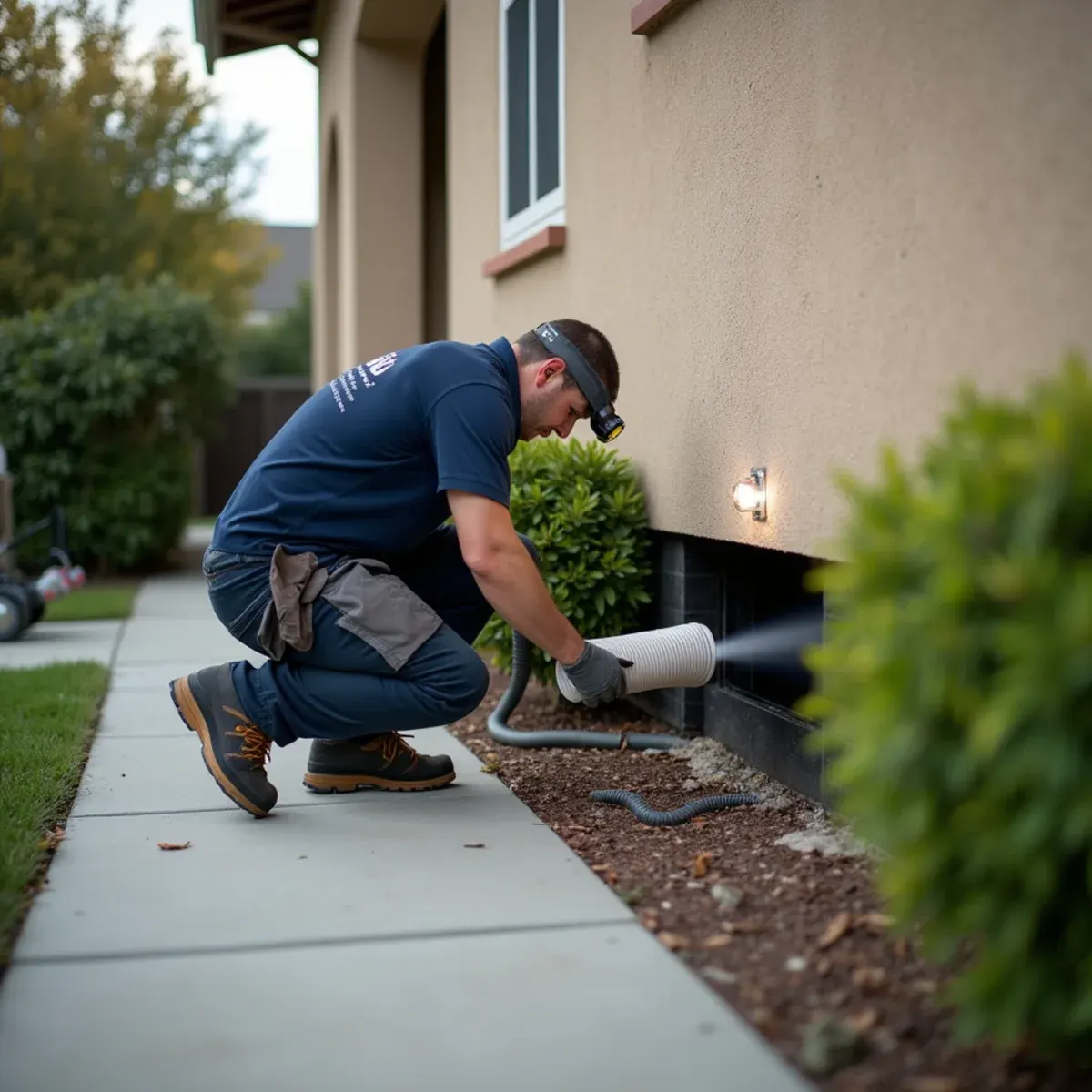
A Whittier homeowner near Greenleaf Avenue calls because the dining room floor has a soft spot and the whole house has smelled like a basement since the rains. That's a crawl-space call, and Uptown produces a lot of them. The city was founded by Quakers in 1887 and it shows in the housing: late-Victorian bay windows, Craftsman with deep porches, 1920s Spanish Revival under clay tile — nearly all of it on raised foundations with original-era systems still running through the joist bays.
Then the ground tilts. College Hills, subdivided in 1923, was the city's first planned hillside development, with steep grades and curving streets, and Friendly Hills and the Whittier Hills climb toward Turnbull Canyon behind it. Up there the water problem isn't a pipe — it's slope drainage pushing into the high side of a sub-area and running the length of it. East Whittier, by contrast, is conventional postwar slab where none of this applies. Three different jobs inside one city limit.
What Whittier Changes About Crawl Space Drying
1Uptown crawl spaces carry original-era systems
Under an Uptown house you'll typically find a century of layered work: original supply lines, retrofit drains, ducting laid straight on the dirt, and insulation added decades after the house was built. All of it holds water. Wet fiberglass comes out, ducting on the ground gets assessed rather than assumed, and the ground barrier is replaced instead of patched. Old houses reward doing it properly the first time.
2Hillside sub-areas take water from uphill
In College Hills and Friendly Hills the sub-area sits into the slope, so the uphill foundation wall is holding back saturated ground. Water enters at the high side, crosses the dirt, and soaks the joists along the way. Drying it without addressing the exterior — swales, area drains, the grade against that wall — gets you a repeat next winter. We walk the uphill side before we set equipment.
3Clay tile and deep porches limit access
Uptown's architecture makes getting in awkward. Access hatches sit under porches, behind foundation plantings, or inside closets on houses where nothing has been opened in years. Spanish Revival with clay tile roofs adds a separate caution: we stay off those roofs entirely rather than risk breaking tile that is expensive to match. We plan the entry route during the assessment so nothing gets forced later.
How the Work Runs
The method is the same one we use on every crawl space drying job, documented to the IICRC S500:2025 standard. Here it is in short — the full crawl space water damage & drying process explains each stage in detail.
- Get in and map the whole space
- Extract, then remove what is finished
- Build the crawl space into a chamber
- Dry the framing to a measured standard
- Deal with growth on the joists
- New barrier, insulation, encapsulation if warranted
The Whittier Background Worth Knowing
A leak under a raised foundation does not announce itself the way a slab leak does. There is no puddle on the floor and no warm spot underfoot, because the water drips down into the soil and stays there. What you get instead is a smell that is stronger in the morning, a board that feels slightly soft, and eventually a floor that has been quietly feeding fungal growth for months. By the time an Uptown homeowner calls us about a crawl space leak, the question is rarely how to dry it. It is how much of the joist and subfloor is still doing its job.
There is more on the housing stock, drainage and plumbing history of this city on our water damage restoration in Whittier page.
Whittier at a glance
- Dominant construction era
- 1890–1980
- Foundation type
- mixed on grade
- Supply piping found here
- original turn-of-century piping, galvanized steel, under-slab copper
- Drain line materials
- cast iron, clay
- Terrain and water table
- hillside-mixed, moderate water table
- Most common local failure
- raised-foundation crawl-space leaks in Uptown, and slope drainage failures in the hillside tracts
- Highest-value local prevention
- an annual crawl-space or slope-drain check, depending which Whittier you live in
What It Costs in Whittier
We do not quote a number over the phone before seeing the property — anyone who does is guessing. The variables that actually move the price on a crawl space drying job are access and working height, how much of the footprint got wet, water category and soil contamination, and they are broken down in full on the crawl space water damage & drying page. The assessment and the written estimate are free anywhere in Whittier, day or night, with no obligation.
Crawl Space Drying Questions from Whittier Homeowners
It depends on why it got wet. If a supply line failed and the soil was otherwise stable, drying, new insulation and a fresh ground vapor barrier are usually enough. If the space has smelled musty every winter for years — common on these hundred-year-old foundations — that's ground moisture evaporating continuously, and a sealed, encapsulated sub-area is what actually stops it. We take readings across a few days before recommending the more expensive option.
Often you cannot tell from inside, which is the whole problem. Sub-area odor rises through plumbing penetrations and the baseboard line and reads like a wall or flooring issue. The check takes about twenty minutes: a technician under the house with a light and a moisture meter. If the framing meters dry and the barrier is intact, we tell you it is not the crawl space and go look somewhere else.
Sometimes, over months, and usually not completely. The vents give you passive air exchange, which only helps when outdoor air is drier than the space. On a marine layer morning here that air is above 80% relative humidity, so the vents are bringing moisture in. Meanwhile the wet soil keeps evaporating and the subfloor above keeps taking it up. Left alone, the common outcome is growth on the joists.
It cuts both ways. A crawl space leak hides longer, because the water drips into soil instead of pooling on your floor, so it often runs for months and reaches the framing before anyone notices. The upside is real though: the plumbing is accessible, so locating and repairing it does not mean breaking concrete. On balance, detection is your weak point in Uptown, which is why an annual look under the house is worth doing.