
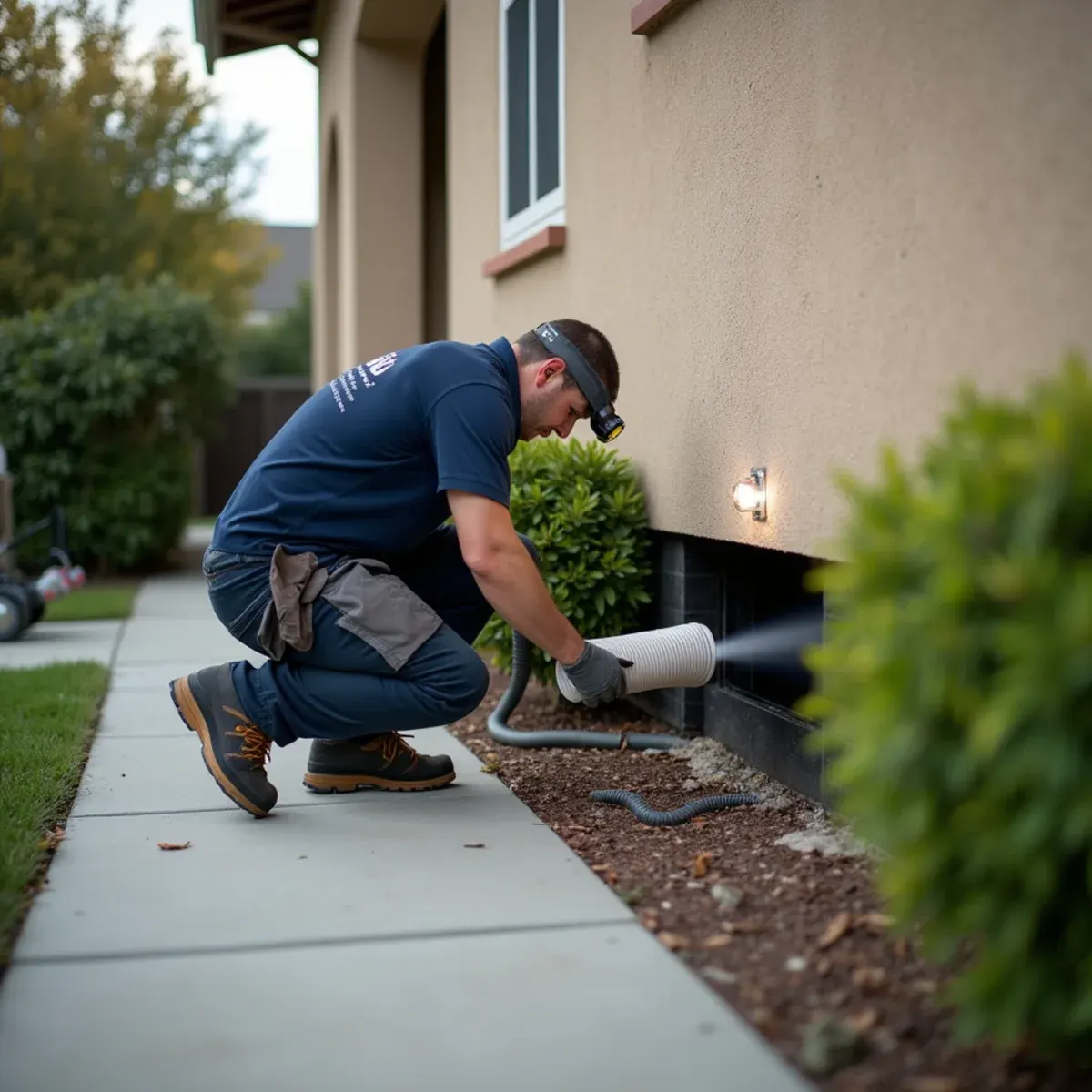
Pico Rivera sits on a strip of ground between two flood-control channels — the San Gabriel River on one side, the Rio Hondo on the other — and that position sets the rules for everything below your floor. The water table is shallow. During a long storm the ground here saturates faster than in the cities uphill, and it stays saturated well after the rain stops. Any wood floor over dirt in this city is drying against soil that's already full.
Most of it isn't wood over dirt, though. The city was built out from about 1945 to 1965, postwar tract on slab, and formed as one city in 1958 when Pico and Rivera merged. Crawl spaces are the exception: older Rivera-era houses that predate the tract wave, plus additions and converted garages framed over shallow voids. Those are the spaces where a wet winter shows up first, and where a torn ground vapor barrier does the most damage, because the moisture below never really goes away.
What Pico Rivera Changes About Crawl Space Drying
1A shallow water table fights the drying
Between the two channels, groundwater sits close enough to the surface that soil under a raised floor stays damp on its own. Dehumidification can pull the wood down to a stable reading, but it can't dry the earth. That's why the ground vapor barrier matters more here than almost anywhere else on our service map — without an intact one, readings climb again as soon as the equipment leaves.
2Sustained storms load the whole strip
Short storms drain. Multi-day storms don't. When rain runs for days, the ground across Pico Rivera saturates end to end and stops accepting anything, which is when water starts appearing at low doors, garage slopes and any shallow void under an addition. If you call us in the middle of a long system, we'll tell you honestly what can be stabilized now and what has to wait for the ground.
3Rivera-era houses hold the raised floors
The older housing that predates the postwar tracts is where actual crawl spaces turn up here — low clearance, dirt floors, insulation added long after the fact. Those bays hold water for weeks. The fiberglass comes out, the joists and subfloor get metered from below, and we sheet the ground before finishing, because leaving bare dirt in this city guarantees a repeat visit.
How the Work Runs
The method is the same one we use on every crawl space drying job, documented to the IICRC S500:2025 standard. Here it is in short — the full crawl space water damage & drying process explains each stage in detail.
- Get in and map the whole space
- Extract, then remove what is finished
- Build the crawl space into a chamber
- Dry the framing to a measured standard
- Deal with growth on the joists
- New barrier, insulation, encapsulation if warranted
The Pico Rivera Background Worth Knowing
On a hillside, storm water leaves. In Pico Rivera it soaks in, and when the soil is already near capacity it stops soaking in and simply stands. That is why a yard here can hold water two days after the rain stops while a yard up in the Whittier hills is dry by morning. The lawn is not draining badly. The ground underneath it is full. Once that happens, every path water can take toward your house becomes the path it takes: the garage threshold, the slider track, the gap where a patio slab has settled back toward the wall.
There is more on the housing stock, drainage and plumbing history of this city on our water damage restoration in Pico Rivera page.
Pico Rivera at a glance
- Dominant construction era
- 1945–1965
- Foundation type
- slab on grade
- Supply piping found here
- original galvanized steel, copper
- Drain line materials
- cast iron
- Terrain and water table
- flat, shallow water table
- Most common local failure
- ground saturating fast during sustained storms because the water table between two channels sits high
- Highest-value local prevention
- clearing area drains and confirming downspouts discharge well away from the foundation
What It Costs in Pico Rivera
We do not quote a number over the phone before seeing the property — anyone who does is guessing. The variables that actually move the price on a crawl space drying job are access and working height, how much of the footprint got wet, water category and soil contamination, and they are broken down in full on the crawl space water damage & drying page. The assessment and the written estimate are free anywhere in Pico Rivera, day or night, with no obligation.
Crawl Space Drying Questions from Pico Rivera Homeowners
The structure can, yes — the soil is a different question. We dry the joists, subfloor and framing to a stable moisture content and remove the saturated insulation, then separate the wood from the ground with a properly lapped and sealed vapor barrier. That barrier is what holds the result in a city with a water table this shallow. Skip it and the readings climb back within a season. On some houses full encapsulation is the honest recommendation.
Often you cannot tell from inside, which is the whole problem. Sub-area odor rises through plumbing penetrations and the baseboard line and reads like a wall or flooring issue. The check takes about twenty minutes: a technician under the house with a light and a moisture meter. If the framing meters dry and the barrier is intact, we tell you it is not the crawl space and go look somewhere else.
Sometimes, over months, and usually not completely. The vents give you passive air exchange, which only helps when outdoor air is drier than the space. On a marine layer morning here that air is above 80% relative humidity, so the vents are bringing moisture in. Meanwhile the wet soil keeps evaporating and the subfloor above keeps taking it up. Left alone, the common outcome is growth on the joists.
Not in the way people picture it. The channels are engineered, and what we actually see is a groundwater and surface drainage problem rather than a channel overtopping. Because the water table between the two runs high and the ground is flat, soil here reaches saturation faster than it does a few miles inland. Once it does, storm water stops soaking in and starts looking for the lowest opening in your house, which is almost always the garage.