
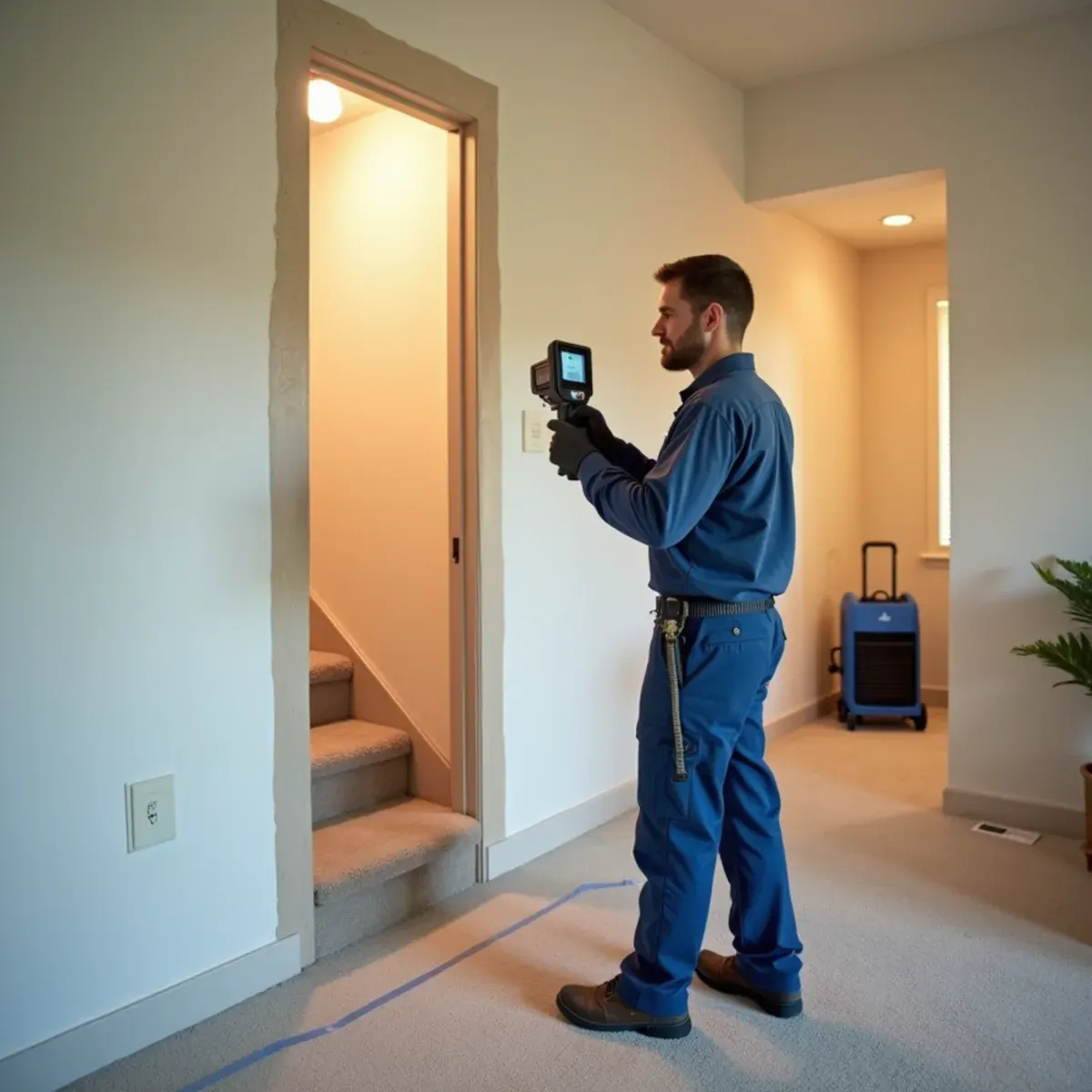
Straight answer first. A large share of Stanton homes do not have drywall in the sense the parent page describes. Manufactured and mobile homes here are finished in vinyl-over-gypsum panels held at the joints with batten strips, not taped and textured board. There is no seam to tape and no texture to blend. The damaged panel comes out whole, a new one goes in whole, and the battens cover the joints. The repair is faster and less messy than conventional work. Matching a pattern that has been out of production for thirty years is the part that is genuinely hard.
The bigger problem in those homes is rarely the wall itself. Water gets into the belly wrap under particleboard floor decking and sits there, sometimes for months, because nothing drains and nothing shows. By the time anyone calls, the bottom of the panels and the framing behind them have wicked it up from the floor. Stanton's older apartment stock is ordinary construction and gets the ordinary treatment: cut to a stud line, replace insulation, tape, texture, prime and paint. One dense city, two entirely different repairs, and we would rather sort that out before quoting.
What Stanton Changes About Drywall Repair
1Panel walls, batten strips, no tape
Vinyl-over-gypsum panels are thinner than conventional board and the vinyl face will not take joint compound or paint the way drywall does. Patching one in the middle of a panel looks exactly like a patch forever. We replace the full panel between battens instead, which is usually cheaper than trying to disguise a repair that will never disappear.
2Belly wrap keeps the wall base wet
In a manufactured home the underfloor cavity is sealed by a belly wrap that holds water rather than letting it drain. Wall panels sitting on that floor wick moisture up from the bottom edge long after the leak is fixed. Replacing panels without opening and drying the belly means the new ones are damp within weeks. We deal with the underfloor first.
3Older apartments get conventional work
Stanton is dense, and the apartment stock from the fifties through the seventies is stick framed with real gypsum board. Those jobs run the standard way, with the cut taken to a stud line and a seam height that finishes cleanly, insulation replaced, then tape, texture and a stain-blocking primer. We do not apply mobile-home shortcuts to conventional walls or the reverse.
How the Work Runs
The method is the same one we use on every drywall repair job, documented to the IICRC S500:2025 standard. Here it is in short — the full drywall water damage repair process explains each stage in detail.
- Meter the wall first
- Decide dry-in-place or remove
- Open the cavity, not the wall
- Cut to a stud and a seam line
- Clear the cavity and dry the framing
- Tape, texture, prime, paint
The Stanton Background Worth Knowing
Mobile and manufactured homes need a genuinely different restoration approach, and the reason is what they are built from. The floor system is typically particleboard or OSB over a wood frame with insulation and a vapor barrier belly wrap underneath — and particleboard exposed to water swells, loses structural integrity, and does not recover. It cannot be dried back to serviceable the way plywood often can.
There is more on the housing stock, drainage and plumbing history of this city on our water damage restoration in Stanton page.
Stanton at a glance
- Dominant construction era
- 1950–1975
- Foundation type
- mixed on grade
- Supply piping found here
- galvanized steel, copper, manufactured-home PEX and poly
- Drain line materials
- cast iron
- Terrain and water table
- flat, moderate water table
- Most common local failure
- underfloor leaks in manufactured homes, sealed inside the belly wrap where they cannot evaporate
- Highest-value local prevention
- checking for soft spots underfoot, because a manufactured-home floor gives no other warning
What It Costs in Stanton
We do not quote a number over the phone before seeing the property — anyone who does is guessing. The variables that actually move the price on a drywall repair job are how much board comes out, cut height and seam count, texture type and match difficulty, and they are broken down in full on the drywall water damage repair page. The assessment and the written estimate are free anywhere in Stanton, day or night, with no obligation.
Drywall Repair Questions from Stanton Homeowners
Be prepared for an honest answer. Original vinyl-over-gypsum patterns from the seventies and eighties are largely discontinued, so an exact match is often not available. Three options usually exist. Replace the damaged panel with the closest current pattern and accept a visible difference. Replace every panel on that wall so the room reads consistently. Or move a matching panel from a closet or a hidden area into the visible spot and put the new pattern where nobody looks.
No, and that assumption is why a lot of walls come out that did not need to. Gypsum board that got clean water, still reads firm under thumb pressure, and is coming down in moisture content day over day can usually be dried in place through the cavity. What forces removal is contaminated water, a core that has softened or swelled, visible growth on the paper, or insulation behind it that holds moisture against the board. We take readings before we answer that question.
Usually two feet or four feet above the floor, measured level across the whole run rather than following the stain. Board comes in four-foot widths, so a cut at either height lands the new seam where a factory edge would sit, which is far easier to hide than a seam floating mid-wall. The cut also has to end at the center of a stud on each side, so the patch has something to fasten to. Cutting to the shape of the damage looks thrifty and finishes badly.
Yes, and we say so explicitly because a lot of companies will not. Manufactured homes need a different approach — opening the belly wrap to dry the floor cavity, removing saturated insulation, and honestly assessing particleboard decking, which usually cannot be dried back to serviceable.