
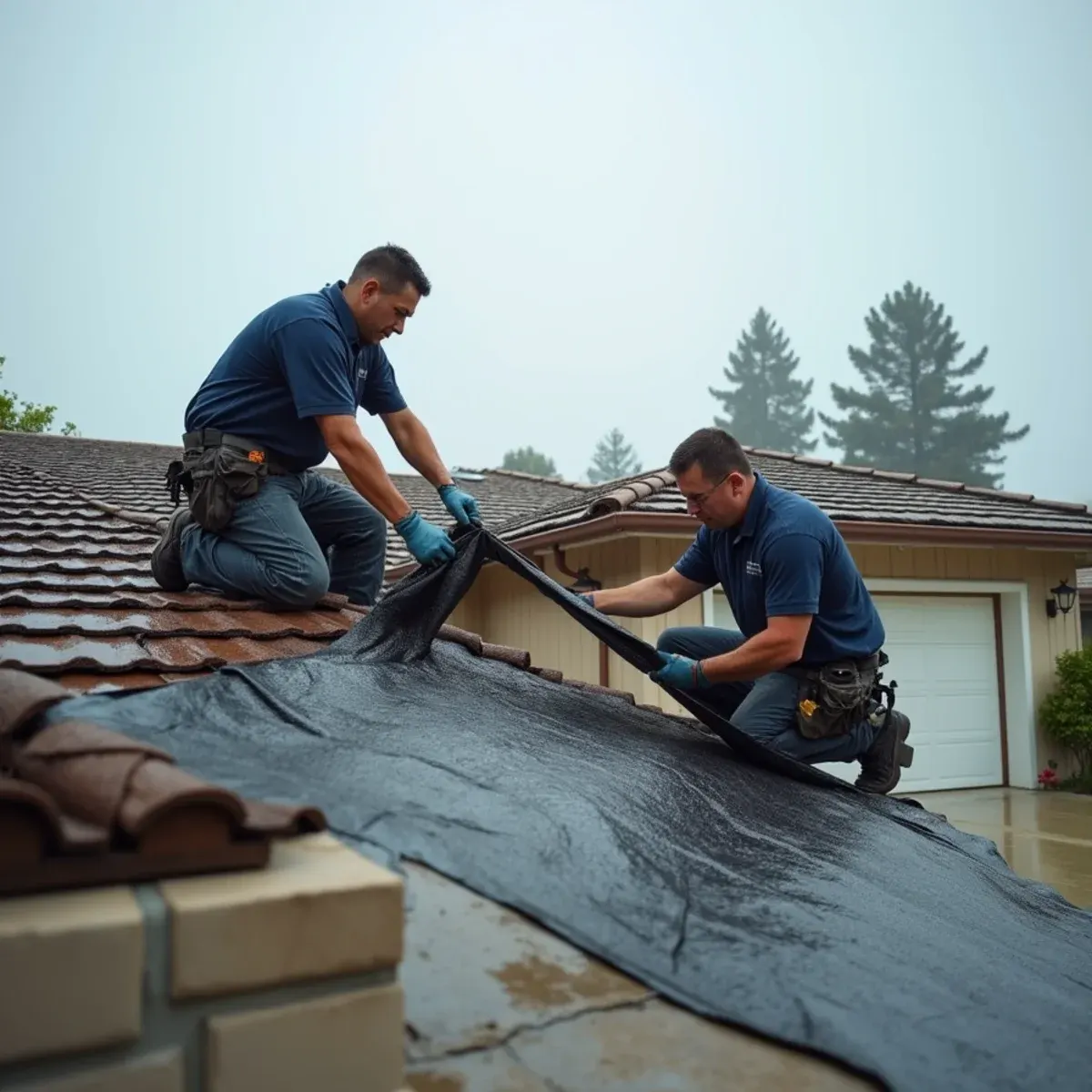
Most Villa Park calls start the same way: a large house, a complicated roof, and a homeowner who can't tell from the ground where the water is coming in. That's not carelessness. A custom home on a half-acre lot often has three or four roof planes, multiple valleys, skylights, chimneys and a patio cover tied into the main structure. Each of those is a penetration, and penetrations are where storm water gets in. Finding which one failed takes time on the roof, in the rain, with the wind still up.
This is the smallest city in Orange County — around 5,800 people, essentially all single-family, with one small shopping center by City Hall and the library. There's no industrial base and very little multi-family, so during a regional storm the call volume here is small compared with the cities around it. That works in your favor. The complication is the canopy. Mature oaks, sycamores and eucalyptus on half-acre lots drop limbs in wind, and a limb through a roof is the loss we tarp most often here.
What Villa Park Changes About Storm Damage
1More roof planes, more failure points
The custom floor plans here have roof geometry a tract house doesn't: cricket saddles behind chimneys, valleys where wings meet, dead-flat patio tie-ins. Water finds the one detail that got built a little short. We chase the leak by wetting from above and watching from the attic rather than guessing, because on a roof this size a wrong guess means a tarp over the wrong plane and another night of water.
2Limb strikes and same-night board-up
Villa Park's canopy is the oldest asset on most of these lots and the biggest storm risk. A limb through sheathing opens a hole that keeps taking water for as long as the system lasts. We carry board-up material and tarp on storm calls so the opening gets closed the same visit. Removing the limb safely comes first — we don't pull a branch that's holding the roof together.
3Irrigation, area drains and long runs
Half-acre lots here run extensive irrigation and long area-drain lines out to the street. Those lines silt up over years and nobody notices until a storm overwhelms them. When we're on site we'll tell you if a drain is running or backing up. Separating irrigation from the domestic meter matters too, because it lets a leak test mean something once the storm has passed.
How the Work Runs
The method is the same one we use on every storm damage job, documented to the IICRC S500:2025 standard. Here it is in short — the full storm damage restoration process explains each stage in detail.
- Emergency tarping and board-up
- Water diversion and extraction
- Full damage documentation
- Interior mitigation
- Structural drying to standard
- Permanent repairs
The Villa Park Background Worth Knowing
In a tract, the plumbing sits where it sat in the last four houses we worked on. In Villa Park it is wherever the plan put it in 1974, and there is rarely a drawing left to consult. That is why locating a leak here can take longer than a homeowner expects. Water from a pinhole travels the path of least resistance under the slab and surfaces wherever the soil and the concrete let it, which on a plan this size can be an entire room away from the break. Guessing at the wet spot is how people end up cutting the wrong floor.
There is more on the housing stock, drainage and plumbing history of this city on our water damage restoration in Villa Park page.
Villa Park at a glance
- Dominant construction era
- 1962–1985
- Foundation type
- slab on grade
- Supply piping found here
- under-slab copper
- Drain line materials
- cast iron, ABS
- Terrain and water table
- rolling, moderate water table
- Most common local failure
- long under-slab runs in large custom floor plans, where a leak can sit far from any fixture and take longer to locate
- Highest-value local prevention
- separating irrigation from the domestic meter so a leak test actually means something
What It Costs in Villa Park
We do not quote a number over the phone before seeing the property — anyone who does is guessing. The variables that actually move the price on a storm damage job are size of the opening and duration of intrusion, emergency mitigation scope, how many rooms the water reached, and they are broken down in full on the storm damage restoration page. The assessment and the written estimate are free anywhere in Villa Park, day or night, with no obligation.
Storm Damage Questions from Villa Park Homeowners
Yes, that's what emergency stabilization is. We first assess whether the limb is bearing on the opening, because pulling it can enlarge the hole. Then we close the opening with sheathing and tarp, tarp the surrounding plane, and get extraction started underneath. Full repair waits for daylight and an adjuster. On a wind night we work in call order, so tell us on the phone that the roof is actually open — that moves you up.
During. Emergency tarping and board-up happen in the rain — that is the entire point of them. We triage by severity, so active intrusion into occupied living space goes to the front of the queue.
Sudden wind and rain damage is generally covered, including the resulting interior water damage. What gets excluded is damage from a roof that had already failed or from deferred maintenance, and flooding from water that came across the ground, which needs separate flood insurance.
Start by taking irrigation out of the equation, because on a half-acre lot it is the largest variable you have. Shut the controller off for a full day, then read the meter twice with nothing running in the house. If the leak indicator is still moving, the loss is on the domestic side and worth locating. If it stops, you have a landscape valve or lateral line problem, which is a different and much cheaper trade.