
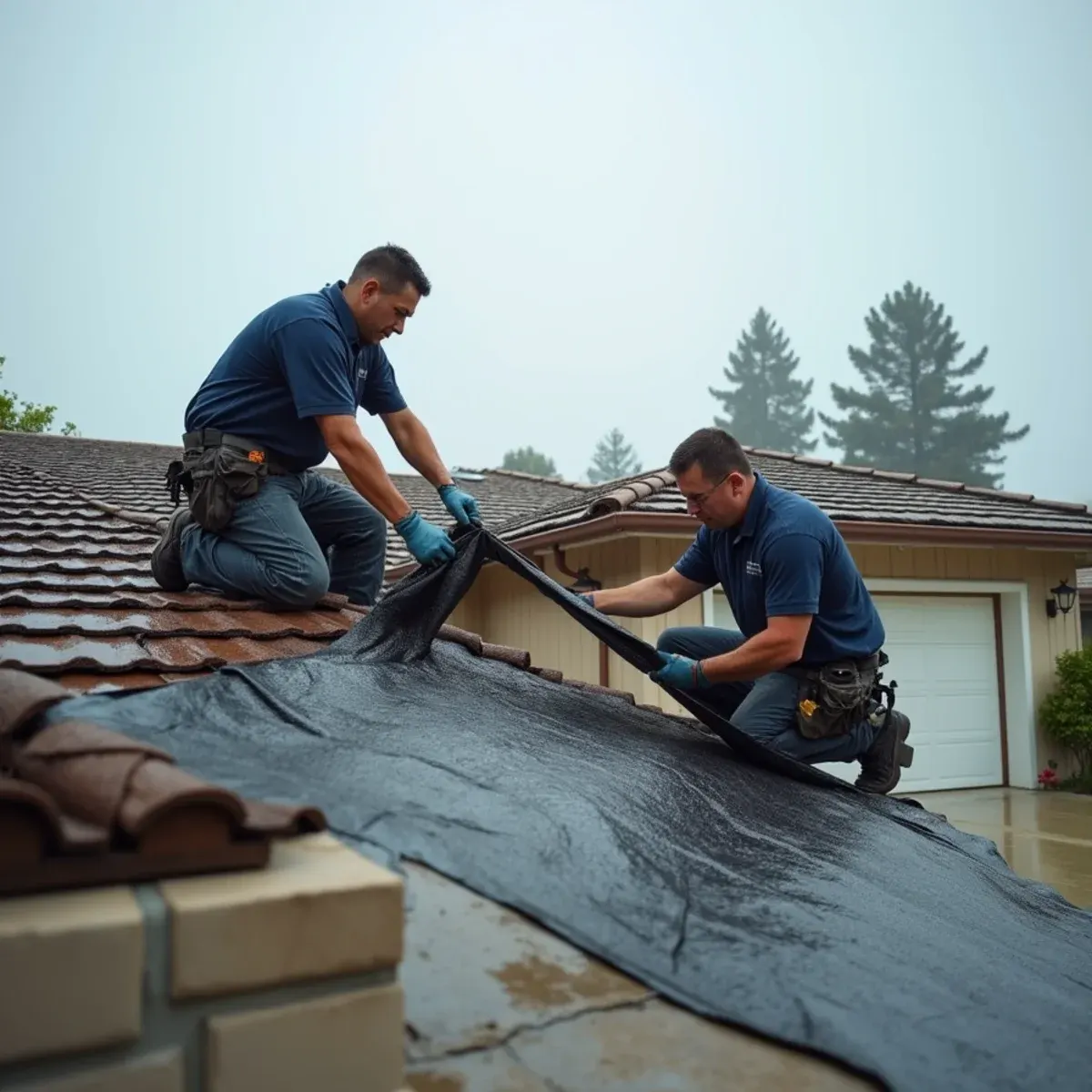
Carson has an unusually large mobile home park population alongside its postwar tract housing, and manufactured homes fail differently in a storm than stick-built houses do. The roofs are low-slope metal or membrane over a shallow cavity with minimal insulation. When wind lifts a seam or a coating cracks, water enters and travels laterally across the ceiling panel before it shows up anywhere. Below the floor, the belly wrap that's supposed to keep moisture out will hold water in for months once it gets past — particleboard decking first, then the joists.
The conventional stock is 1950s to 1970s slab tract on flat ground with a shallow water table, so lots saturate quickly during sustained rain and low driveways feed garages. Refineries and logistics operations sit immediately adjacent to housing in Dominguez and along the Del Amo corridor, which matters for what's in the water once it has crossed a street. Cal State Dominguez Hills and Dignity Health Sports Park anchor the north side. We're about twenty-two minutes west of Cypress and dispatch as conditions allow.
What Carson Changes About Storm Damage
1Belly wrap holds water, not out
The polyethylene belly board under a manufactured home is there to keep road spray and pests out. Once storm water gets in, that same membrane traps it against the particleboard decking. Treat any soft spot in your floor as moisture until a meter says otherwise. Drying it properly means opening and draining the belly, not running a fan in the hallway and hoping for the best.
2Metal roof seams and coatings
Most park homes here have had a roof coating applied at some point, and coatings age in Southern California sun until they craze and lift. Wind during an atmospheric river gets under a raised seam or a vent flashing and drives water in. Because the ceiling cavity is shallow, water spreads sideways and appears ten feet from the entry point. Recoating before the season is cheaper than one interior claim.
3Park-wide events and access
When a system hits, a mobile home park often produces several losses at once, on private streets with narrow access and utility runs we don't want to cut. We coordinate with park management for access and power, and we're careful about where equipment and cords go. Expect us to stage from a common area rather than parking a truck at your steps.
How the Work Runs
The method is the same one we use on every storm damage job, documented to the IICRC S500:2025 standard. Here it is in short — the full storm damage restoration process explains each stage in detail.
- Emergency tarping and board-up
- Water diversion and extraction
- Full damage documentation
- Interior mitigation
- Structural drying to standard
- Permanent repairs
The Carson Background Worth Knowing
Manufactured homes are built with the floor deck, usually particleboard or OSB, sitting on a steel frame, with batt insulation below it and a vapor barrier belly wrap stapled underneath to hold everything in place. Supply lines run through that cavity. When one leaks, the water does not run out onto the ground where you would see it. The belly wrap catches and holds it, the insulation soaks it up, and you now have a sealed reservoir under your floor with no path to evaporate. It can sit there for months before anything shows upstairs.
There is more on the housing stock, drainage and plumbing history of this city on our water damage restoration in Carson page.
Carson at a glance
- Dominant construction era
- 1950–1975
- Foundation type
- slab on grade
- Supply piping found here
- galvanized steel, under-slab copper, manufactured-home supply lines
- Drain line materials
- cast iron
- Terrain and water table
- flat, shallow water table
- Most common local failure
- manufactured-home underfloor leaks trapped in the belly wrap, alongside conventional 1960s slab failures
- Highest-value local prevention
- treating any soft spot in a manufactured-home floor as moisture until a meter proves otherwise
What It Costs in Carson
We do not quote a number over the phone before seeing the property — anyone who does is guessing. The variables that actually move the price on a storm damage job are size of the opening and duration of intrusion, emergency mitigation scope, how many rooms the water reached, and they are broken down in full on the storm damage restoration page. The assessment and the written estimate are free anywhere in Carson, day or night, with no obligation.
Storm Damage Questions from Carson Homeowners
Could be either, and the meter settles it. In a manufactured home, storm water that entered at the roof or through a wall runs down into the floor cavity and sits on the belly wrap, softening particleboard decking from below. Age alone softens decking too, but usually slowly and fairly evenly. We probe and meter from underneath, which tells us whether the moisture is active and how far it has spread before anyone cuts a floor.
During. Emergency tarping and board-up happen in the rain — that is the entire point of them. We triage by severity, so active intrusion into occupied living space goes to the front of the queue.
Sudden wind and rain damage is generally covered, including the resulting interior water damage. What gets excluded is damage from a roof that had already failed or from deferred maintenance, and flooding from water that came across the ground, which needs separate flood insurance.
By locating it rather than arguing about it. The dividing line is the connection point where the park's service meets your home. Upstream of that is the park's responsibility, downstream is yours. We open the belly wrap where water is pooling, trace the wet path back to its source, and photograph what we find with the connection in frame. That documentation settles the question. Guessing from where the wet spot showed up inside is unreliable, because water travels along the frame first.