
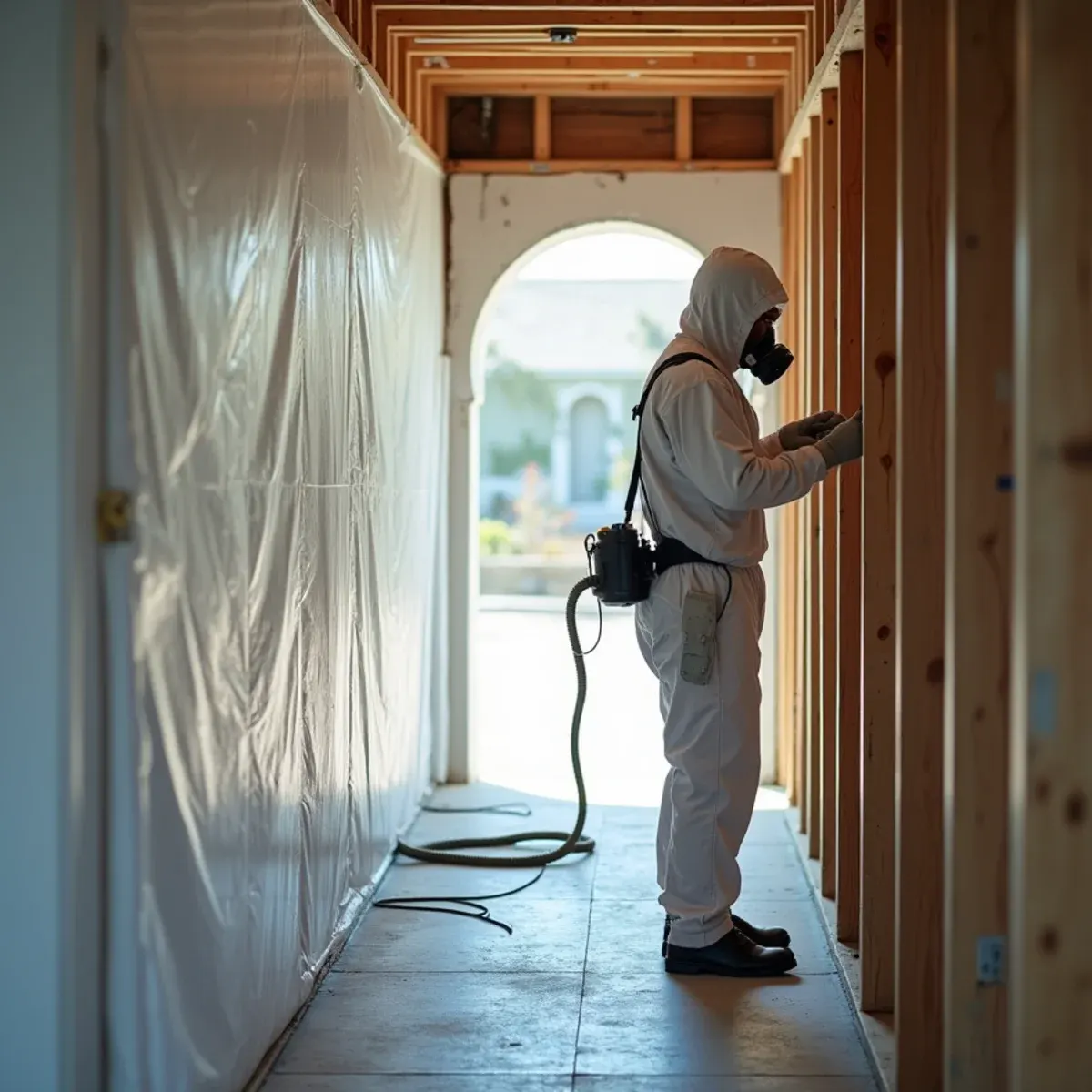
Plenty of restoration companies will not work on a manufactured home. We do, and Stanton is where that matters most. This city carries one of the largest manufactured-home populations in the area alongside a dense stock of older apartments. A mobile home hides water in a way a stick-built house cannot. The floor is particleboard decking over insulation, and under all of it is a belly wrap, a sealed plastic membrane. A supply line leaks, the insulation soaks, and the wrap holds the water there. It cannot evaporate.
Months can pass. The first sign is usually a floor that gives slightly underfoot near the tub or under the kitchen sink, or an odor that gets stronger on warm days. By then the decking has swelled and the insulation is a wet mat. Drying that from inside the home accomplishes nothing, because the wet material is sealed below the floor you are standing on. The wrap has to be opened from underneath, the soaked insulation pulled out, the ruined decking cut back to sound material, and the leak fixed before anything goes back in.
What Stanton Changes About Mold Remediation
1The belly wrap has to open
In a manufactured home, wet insulation sits sealed between the floor decking and the plastic belly wrap. Nothing dries through it. Air movers inside the home just push air across a floor that is dry on top and soaked underneath. The wrap gets opened from below, saturated insulation comes out, ruined decking is cut back to sound material, and the wrap is repaired afterward.
2Soft floors are the only warning
Manufactured-home floors do not stain or drip the way a stick-built ceiling does. What you get is a spot that gives slightly underfoot near a tub, a toilet or a sink base. By then the particleboard has been wet long enough to swell. Anyone in a Stanton mobile home park should walk their floor barefoot every few months and pay attention to what feels different.
3Older apartments along Beach Boulevard
Stanton is one of the densest cities in this part of the county, with a large stock of aging apartments running on galvanized and early copper. Those buildings share walls and plumbing, so a leak in one unit is frequently a mold problem in the next. Tenants often report late for fear of the response. Earlier reporting keeps the removal smaller for everyone in the building.
How the Work Runs
The method is the same one we use on every mold remediation job, documented to the IICRC S500:2025 standard. Here it is in short — the full mold remediation & removal process explains each stage in detail.
- Inspection and moisture source identification
- Testing where it is warranted
- Containment and negative pressure
- Removal of contaminated material
- HEPA cleaning and antimicrobial application
- Verification before containment comes down
The Stanton Background Worth Knowing
Mobile and manufactured homes need a genuinely different restoration approach, and the reason is what they are built from. The floor system is typically particleboard or OSB over a wood frame with insulation and a vapor barrier belly wrap underneath — and particleboard exposed to water swells, loses structural integrity, and does not recover. It cannot be dried back to serviceable the way plywood often can.
There is more on the housing stock, drainage and plumbing history of this city on our water damage restoration in Stanton page.
Stanton at a glance
- Dominant construction era
- 1950–1975
- Foundation type
- mixed on grade
- Supply piping found here
- galvanized steel, copper, manufactured-home PEX and poly
- Drain line materials
- cast iron
- Terrain and water table
- flat, moderate water table
- Most common local failure
- underfloor leaks in manufactured homes, sealed inside the belly wrap where they cannot evaporate
- Highest-value local prevention
- checking for soft spots underfoot, because a manufactured-home floor gives no other warning
What It Costs in Stanton
We do not quote a number over the phone before seeing the property — anyone who does is guessing. The variables that actually move the price on a mold remediation job are square footage of affected material, where it is, containment complexity, and they are broken down in full on the mold remediation & removal page. The assessment and the written estimate are free anywhere in Stanton, day or night, with no obligation.
Mold Remediation Questions from Stanton Homeowners
Treat it as one until a meter says otherwise. A soft floor in a manufactured home almost always means the particleboard decking has been wet long enough to swell, and if the decking is wet, the insulation underneath it inside the belly wrap is wetter. That material cannot dry on its own, because the wrap seals it. We would open a small section from below, read the insulation and decking, and show you what is there before scoping anything.
On a hard, non-porous surface like tile or glass, bleach handles surface growth. On drywall, wood, or anything porous it does not — the water content soaks in and can feed further growth while the chlorine stays on the surface. Porous material with real growth needs to be removed, not treated.
Usually not for visible growth with an obvious cause — you can see the problem and the work would be identical regardless of species. Testing is worthwhile when there is odor but nothing visible, when you need documentation for a claim or dispute, or when you want independent verification that the job was done right.
Yes, and we say so explicitly because a lot of companies will not. Manufactured homes need a different approach — opening the belly wrap to dry the floor cavity, removing saturated insulation, and honestly assessing particleboard decking, which usually cannot be dried back to serviceable.