
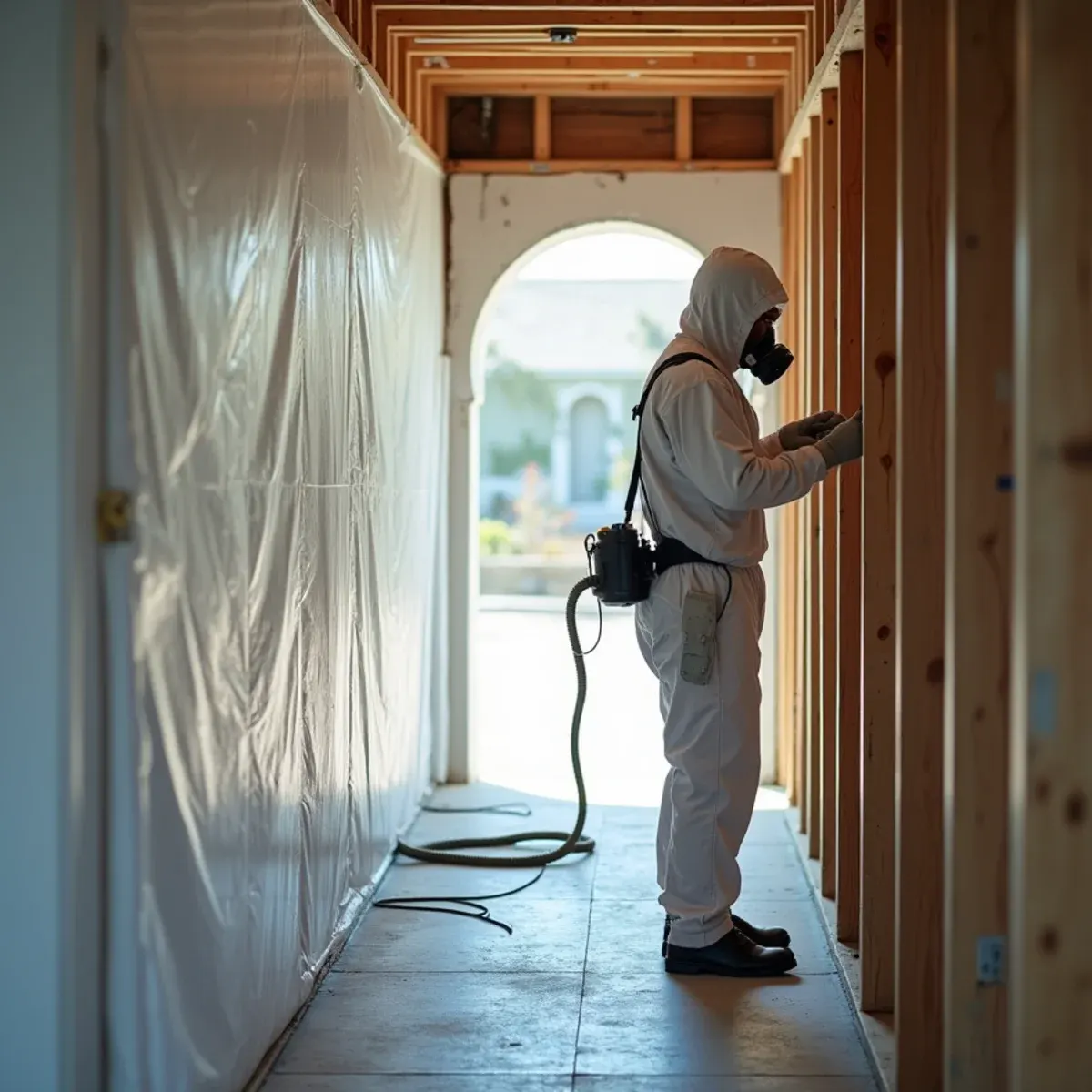
Here is the thing about mold in Garden Grove: a good share of the calls we take have no plumbing failure behind them at all. These homes went up between 1950 and 1970 for a household of four with one bath fan that may or may not still work. Many now hold two or three generations, or two families. Showers run from five in the morning until eleven at night. Cooking is heavy and constant. That is a moisture load nobody ventilated a 1955 tract house to carry.
So the growth shows up in predictable places. The ceiling above a shower. The corner of an exterior bedroom wall behind a dresser. The inside of a north-facing closet. Tearing that out and repainting buys you a season. Correcting the source means the exhaust fan, the duct it runs into, the window that never opens, the furniture pressed flat against a cold wall. We will do the removal properly, with containment and HEPA cleaning, but we will also be honest with you. If the humidity load does not change, neither does the outcome.
What Garden Grove Changes About Mold Remediation
1Occupancy load, not a burst pipe
Plumbing and ventilation designed for a 1955 household is carrying a 2026 one in a lot of these homes. Several showers a day, heavy daily cooking, laundry running most evenings. That is a humidity load, and humidity alone grows mold on cold exterior corners, closet walls and shower ceilings with no leak anywhere in the house. The answer is ventilation and air movement, not another coat of paint.
2Bath fans that vent into the attic
We find this constantly in Garden Grove: a working bathroom fan whose duct ends in the attic instead of outside. Every shower dumps that moisture over the ceiling insulation, which is why growth turns up on a bedroom ceiling nowhere near the bathroom. Correcting the source in that case means following the duct out to daylight, not simply replacing a tired fan motor.
3Wear items on a shorter clock
Angle stops, toilet supply risers and washing machine hoses wear by cycle count, not by calendar. In a household running three or four times the fixture cycles these homes were built for, the standard replacement intervals are too long. Hoses at five years without exception, and angle stops replaced whenever a fixture gets serviced. That one habit prevents most of the sudden losses we see here.
How the Work Runs
The method is the same one we use on every mold remediation job, documented to the IICRC S500:2025 standard. Here it is in short — the full mold remediation & removal process explains each stage in detail.
- Inspection and moisture source identification
- Testing where it is warranted
- Containment and negative pressure
- Removal of contaminated material
- HEPA cleaning and antimicrobial application
- Verification before containment comes down
The Garden Grove Background Worth Knowing
A 1958 tract home was plumbed for a family of four with one bathroom in regular use, one washing machine, and a single water heater sized to match. Many Garden Grove homes today support considerably more than that, and the plumbing feels it.
There is more on the housing stock, drainage and plumbing history of this city on our water damage restoration in Garden Grove page.
Garden Grove at a glance
- Dominant construction era
- 1950–1970
- Foundation type
- slab on grade
- Supply piping found here
- galvanized steel, under-slab copper
- Drain line materials
- cast iron, clay
- Terrain and water table
- flat, moderate water table
- Most common local failure
- accelerated wear on angle stops, supply risers and washing machine hoses from far higher fixture cycle counts
- Highest-value local prevention
- shorter replacement intervals on every wear item — hoses at five years without exception
What It Costs in Garden Grove
We do not quote a number over the phone before seeing the property — anyone who does is guessing. The variables that actually move the price on a mold remediation job are square footage of affected material, where it is, containment complexity, and they are broken down in full on the mold remediation & removal page. The assessment and the written estimate are free anywhere in Garden Grove, day or night, with no obligation.
Mold Remediation Questions from Garden Grove Homeowners
Because paint is not a fix and the ceiling is not really the problem. With a full household, that bathroom produces far more moisture than the fan was ever sized to move, and in many of these houses the duct ends in the attic rather than outside, so it just relocates the humidity. We will clean and remove what is contaminated, but the lasting change is a fan that genuinely exhausts outdoors and runs well after each shower.
On a hard, non-porous surface like tile or glass, bleach handles surface growth. On drywall, wood, or anything porous it does not — the water content soaks in and can feed further growth while the chlorine stays on the surface. Porous material with real growth needs to be removed, not treated.
Usually not for visible growth with an obvious cause — you can see the problem and the work would be identical regardless of species. Testing is worthwhile when there is odor but nothing visible, when you need documentation for a claim or dispute, or when you want independent verification that the job was done right.
Yes, all five ZIP codes — 92840, 92841, 92843, 92844, and 92845 — for both residential and commercial properties. Response time runs about twenty-five to thirty-five minutes depending on where in the city.