
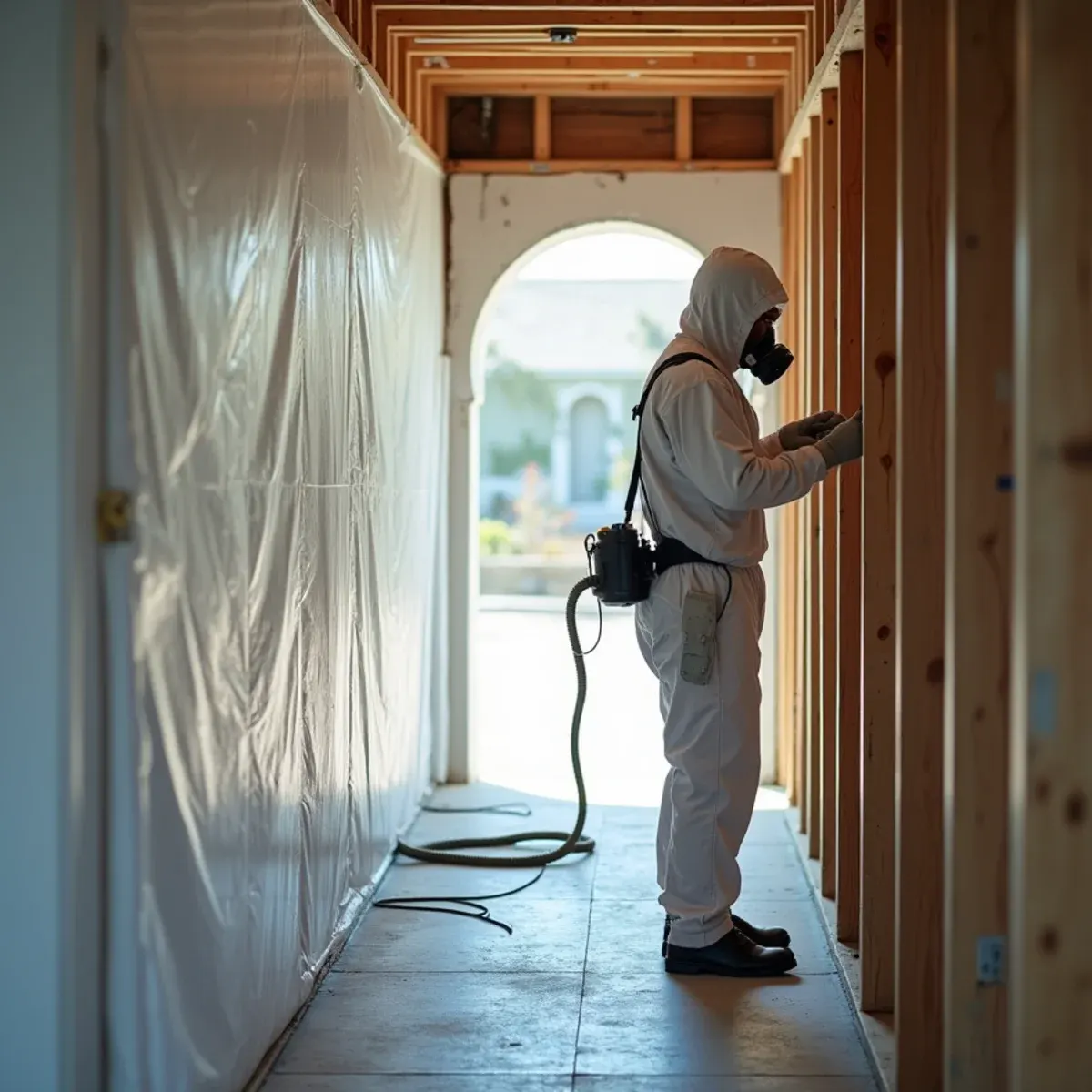
Carson has an unusually large mobile home park population, and that shapes a big share of our mold work here. Manufactured homes use particleboard floor decking over joists with a belly wrap underneath, and that wrap is designed to keep things out — which means when a supply line or a drain leaks above it, the water has nowhere to drain and nowhere to evaporate. It pools in the wrap and sits against the underside of the decking. Particleboard drinks it up. By the time a floor feels soft underfoot, the decking is already compromised and growth is established across an area much wider than the soft spot.
The rest of the city is postwar and 1960s-to-1970s slab tract through Scottsdale, Carson Park and Victoria, incorporated in 1968 on former ranch, oil-field and industrial land, with refinery and logistics operations immediately adjacent. The water table here is shallow, which matters for slab moisture. Two housing types, two inspection approaches. We're about twenty-two minutes west in Cypress and dispatch as fast as conditions allow, day or night.
What Carson Changes About Mold Remediation
1Belly wrap holds water out of sight
In a manufactured home the underfloor wrap keeps leaked water contained against the decking instead of letting it drop to the ground. Nothing shows from below and nothing shows from above until the particleboard swells. We open the wrap to inspect and drain, take readings across the decking, and determine how far the contamination actually runs before we commit to a removal scope.
2Particleboard decking rarely dries back
Wood-based panel decking that has been saturated tends to lose structural integrity even when the moisture number eventually comes down. We're honest about that. Where readings and physical condition support drying in place, we dry. Where the panel has swollen and lost bond, replacement is the correct call under S500:2025, and pretending otherwise just puts a soft floor back under your feet.
3Working inside a mobile home park
Space between coaches is tight, equipment has to be staged carefully, and park management usually needs to be in the loop before we run negative air or open a skirting section. We handle that coordination early. Skirting and ground conditions matter too — a coach sitting over damp ground with sealed skirting collects vapor underneath the same way a closed crawl space does.
How the Work Runs
The method is the same one we use on every mold remediation job, documented to the IICRC S500:2025 standard. Here it is in short — the full mold remediation & removal process explains each stage in detail.
- Inspection and moisture source identification
- Testing where it is warranted
- Containment and negative pressure
- Removal of contaminated material
- HEPA cleaning and antimicrobial application
- Verification before containment comes down
The Carson Background Worth Knowing
Manufactured homes are built with the floor deck, usually particleboard or OSB, sitting on a steel frame, with batt insulation below it and a vapor barrier belly wrap stapled underneath to hold everything in place. Supply lines run through that cavity. When one leaks, the water does not run out onto the ground where you would see it. The belly wrap catches and holds it, the insulation soaks it up, and you now have a sealed reservoir under your floor with no path to evaporate. It can sit there for months before anything shows upstairs.
There is more on the housing stock, drainage and plumbing history of this city on our water damage restoration in Carson page.
Carson at a glance
- Dominant construction era
- 1950–1975
- Foundation type
- slab on grade
- Supply piping found here
- galvanized steel, under-slab copper, manufactured-home supply lines
- Drain line materials
- cast iron
- Terrain and water table
- flat, shallow water table
- Most common local failure
- manufactured-home underfloor leaks trapped in the belly wrap, alongside conventional 1960s slab failures
- Highest-value local prevention
- treating any soft spot in a manufactured-home floor as moisture until a meter proves otherwise
What It Costs in Carson
We do not quote a number over the phone before seeing the property — anyone who does is guessing. The variables that actually move the price on a mold remediation job are square footage of affected material, where it is, containment complexity, and they are broken down in full on the mold remediation & removal page. The assessment and the written estimate are free anywhere in Carson, day or night, with no obligation.
Mold Remediation Questions from Carson Homeowners
It depends on what the panel is doing, not just what the meter says. We open the belly wrap, drain the trapped water, and check the decking for swelling and loss of bond along with moisture content. Particleboard that's still sound and reads high can sometimes be dried in place with directed airflow under the floor. Panel that has swollen, delaminated or gone spongy has to be replaced — drying it just leaves you a weak floor with a clean reading.
On a hard, non-porous surface like tile or glass, bleach handles surface growth. On drywall, wood, or anything porous it does not — the water content soaks in and can feed further growth while the chlorine stays on the surface. Porous material with real growth needs to be removed, not treated.
Usually not for visible growth with an obvious cause — you can see the problem and the work would be identical regardless of species. Testing is worthwhile when there is odor but nothing visible, when you need documentation for a claim or dispute, or when you want independent verification that the job was done right.
By locating it rather than arguing about it. The dividing line is the connection point where the park's service meets your home. Upstream of that is the park's responsibility, downstream is yours. We open the belly wrap where water is pooling, trace the wet path back to its source, and photograph what we find with the connection in frame. That documentation settles the question. Guessing from where the wet spot showed up inside is unreliable, because water travels along the frame first.