
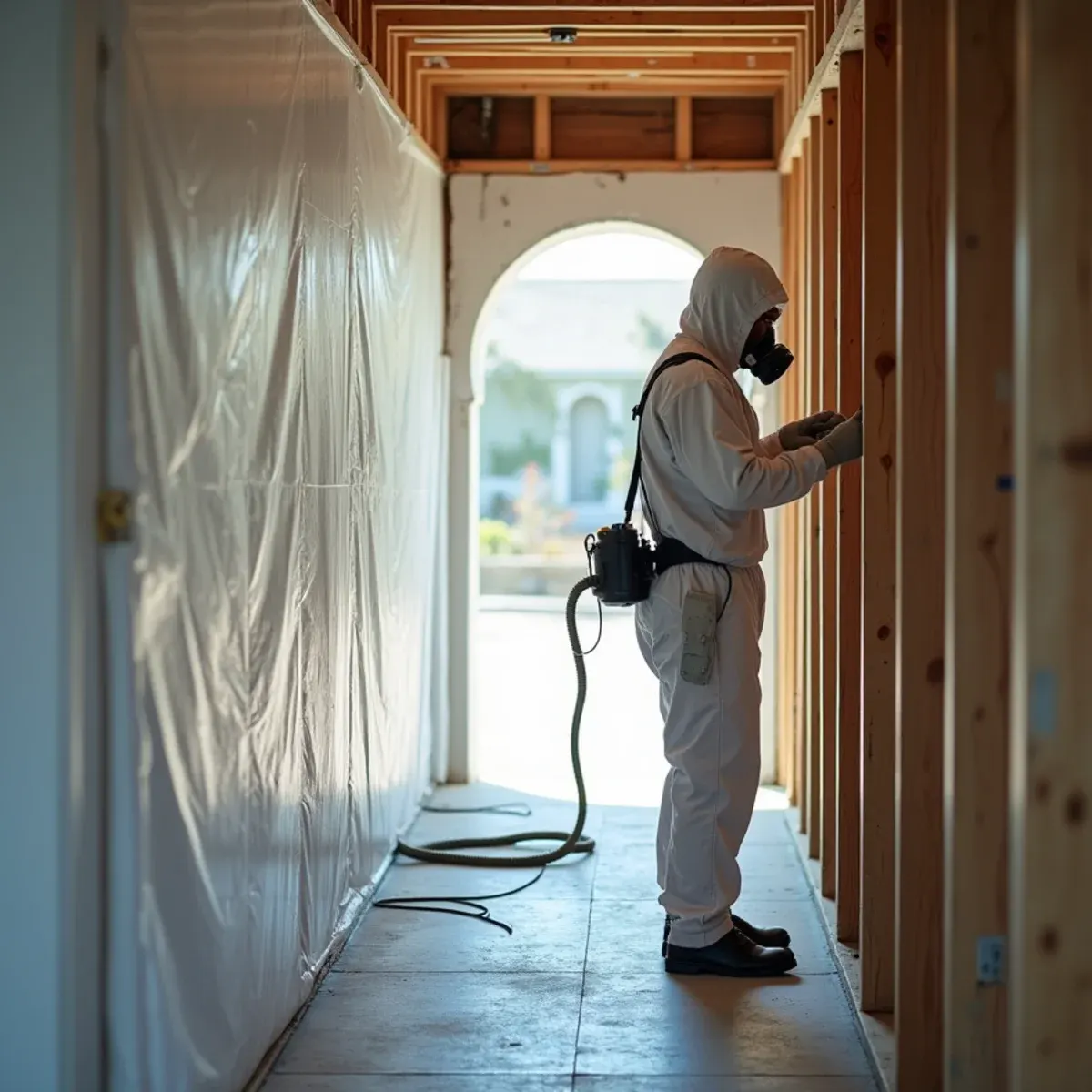
In Paramount you can stand on one corner and see a small postwar house, a four-unit apartment building, and a metal-shell manufacturing building. The city was formed out of the old Hynes and Clearwater communities on dairy and hay land, and it built out dense between about 1945 and 1965 with industry mixed straight into the residential fabric along Paramount Boulevard and the Rosecrans corridor. That mix means our mold work here splits two ways, and the same crew approach doesn't serve both. Containing a bedroom is not containing a production floor.
The other local factor is drainage. Lots here have very little permeable ground — the houses are close together with concrete side yards, and the commercial parcels are almost fully paved. When area drains silt up and the Los Angeles River channel along the western edge is running hard, water has nowhere to soak in and it stands against building perimeters instead. Growth then starts at the bottom of walls that never had a plumbing problem. We're about fourteen minutes east in Cypress and dispatch as fast as conditions allow.
What Paramount Changes About Mold Remediation
1Paved lots with nowhere for water
On a lot that's mostly concrete, one blocked area drain means standing water against the slab edge within an hour of hard rain. That water wicks into stucco, sill plates and the base of interior partitions. Every remediation we do here includes looking at the drains, because the same growth returns the next storm otherwise, and clearing them before the season is the cheapest prevention available in this city.
2Industrial buildings need different containment
A metal building with twenty-plus foot clear height and an active floor can't be handled like a bathroom. Volume drives the negative-air equipment sizing, product and racking have to be protected or relocated, and the containment barrier has to survive forklift traffic nearby. We scope those jobs by cubic volume and operational constraints, not square feet.
3Dense housing and shared systems
The multi-family stock packed between the commercial corridors often shares plumbing walls, attic space and sometimes ductwork between units. Growth doesn't respect the lease line. We identify what's shared before setting containment, so the barrier reflects the actual building rather than the unit number on the work order.
How the Work Runs
The method is the same one we use on every mold remediation job, documented to the IICRC S500:2025 standard. Here it is in short — the full mold remediation & removal process explains each stage in detail.
- Inspection and moisture source identification
- Testing where it is warranted
- Containment and negative pressure
- Removal of contaminated material
- HEPA cleaning and antimicrobial application
- Verification before containment comes down
The Paramount Background Worth Knowing
On a typical Paramount lot, the house, the driveway, the walkways and the rear slab cover most of the parcel. What is left is a narrow side yard, and everything that lands on the roof and the paving is supposed to leave through a couple of small area drains. That system has no margin. When a grate silts up, when a downspout dumps straight onto paving, or when the outlet at the curb has been crushed by a parked truck, the water has no soil to soak into and nowhere else to be. It ponds against the slab edge and comes in at the lowest threshold, which is usually a garage or a side door.
There is more on the housing stock, drainage and plumbing history of this city on our water damage restoration in Paramount page.
Paramount at a glance
- Dominant construction era
- 1945–1965
- Foundation type
- slab on grade
- Supply piping found here
- original galvanized steel, copper
- Drain line materials
- cast iron
- Terrain and water table
- flat, moderate water table
- Most common local failure
- residential and commercial losses on the same block, needing very different handling
- Highest-value local prevention
- clearing area drains before the season on lots with very little permeable ground
What It Costs in Paramount
We do not quote a number over the phone before seeing the property — anyone who does is guessing. The variables that actually move the price on a mold remediation job are square footage of affected material, where it is, containment complexity, and they are broken down in full on the mold remediation & removal page. The assessment and the written estimate are free anywhere in Paramount, day or night, with no obligation.
Mold Remediation Questions from Paramount Homeowners
Often, partially. If the affected area can be isolated, we build hard containment around it, run negative air exhausted outside, and set access so your people work around the barrier rather than through it. What we can't do is leave a contaminated zone open next to running operations. We'll walk the floor with you first, mark what has to be cleared, and be straight about which processes genuinely have to pause and for how long.
On a hard, non-porous surface like tile or glass, bleach handles surface growth. On drywall, wood, or anything porous it does not — the water content soaks in and can feed further growth while the chlorine stays on the surface. Porous material with real growth needs to be removed, not treated.
Usually not for visible growth with an obvious cause — you can see the problem and the work would be identical regardless of species. Testing is worthwhile when there is odor but nothing visible, when you need documentation for a claim or dispute, or when you want independent verification that the job was done right.
Almost certainly your area drains. Paramount lots have very little permeable ground, so everything that falls on the roof and the paving has to leave through a couple of small drains. If a grate silts up or the outlet is crushed, the water ponds against the slab and enters at the lowest threshold, which is usually the garage. Rodding the drains and checking the outlet before the season costs far less than drying the garage wall afterward.