
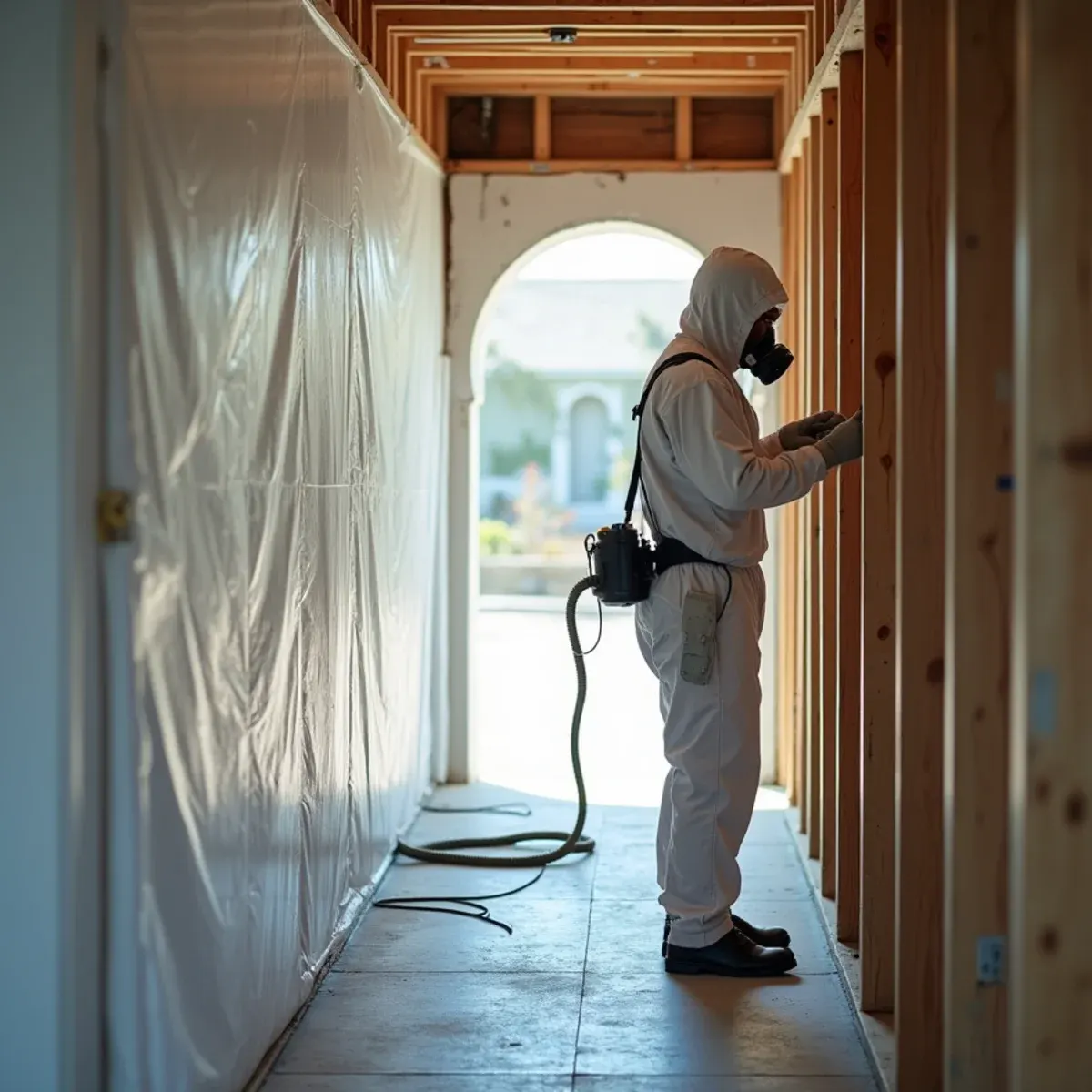
Take the trim seriously. That's the advice we'd give any Downey homeowner before a mold job starts. Jean Vandruff's Cinderella Homes put turrets, pointed roof lines, gingerbread detailing and arched doorways onto ordinary 1950s tract housing, and that woodwork cannot be bought. It can be matched by a good finish carpenter at real cost, or it can be protected by planning the removal properly in the first place. A crew that opens walls on autopilot will cost you more in millwork than the remediation itself.
Underneath the detailing, these are standard mid-century slab houses with galvanized supply lines and cast-iron drains, built out fast between about 1950 and 1965 across Orange Estates, Northeast Downey and the Rancho Estates area. So the failures are the familiar ones — a seeping galvanized joint inside a wall, a slab leak feeding the base of a partition. The difference is what sits on the wall we have to open. We're about seventeen minutes southeast in Cypress and dispatch as fast as conditions allow.
What Downey Changes About Mold Remediation
1Cut lines planned around the millwork
Before anything comes off, we map where growth actually is and where the trim seams fall. Removing drywall above a chair rail, or taking a panel out between existing joints, is often possible when the wet zone allows it. Where we do have to pull casing or base, it comes off carefully, gets labeled and set aside for reinstallation rather than tossed in the dumpster with the drywall.
2Dry in place when readings permit
S500:2025 supports drying and cleaning structural materials in place when they're non-porous or semi-porous and can be verified. In these houses that principle has real value: framing, hardwood and sound plaster stay, and only genuinely contaminated porous material leaves. It takes longer and requires more monitoring than gutting a room. On a house with irreplaceable detailing, it's the right trade.
3Galvanized behind decorative walls
The 1950s supply lines here corrode the same way they do anywhere else, but the wall in front of them may carry original detailing. That combination is why Downey jobs deserve investigative openings in inconspicuous spots — a closet back, a cabinet interior — before we touch a feature wall. Locate first, then open where it costs the least.
How the Work Runs
The method is the same one we use on every mold remediation job, documented to the IICRC S500:2025 standard. Here it is in short — the full mold remediation & removal process explains each stage in detail.
- Inspection and moisture source identification
- Testing where it is warranted
- Containment and negative pressure
- Removal of contaminated material
- HEPA cleaning and antimicrobial application
- Verification before containment comes down
The Downey Background Worth Knowing
The instinct on a wet wall is to open it, and sometimes that is correct. But IICRC S500:2025 is built around restoring rather than replacing wherever the drying goals can genuinely be met, and on a house with original arched casings and applied gingerbread, meeting those goals is worth some patience. We would rather spend three extra days with equipment running than pull a run of trim that would have to be milled from scratch to come back. The standard supports that choice and so does the arithmetic on the estimate, because custom millwork is not cheap and matching a fifties profile is not quick.
There is more on the housing stock, drainage and plumbing history of this city on our water damage restoration in Downey page.
Downey at a glance
- Dominant construction era
- 1950–1965
- Foundation type
- slab on grade
- Supply piping found here
- galvanized steel, under-slab copper
- Drain line materials
- cast iron
- Terrain and water table
- flat, moderate water table
- Most common local failure
- 1950s slab and galvanized failures in houses whose decorative woodwork makes careful, low-demolition drying worth paying for
- Highest-value local prevention
- drying in place wherever readings allow, because the trim and detailing on these houses cannot be bought
What It Costs in Downey
We do not quote a number over the phone before seeing the property — anyone who does is guessing. The variables that actually move the price on a mold remediation job are square footage of affected material, where it is, containment complexity, and they are broken down in full on the mold remediation & removal page. The assessment and the written estimate are free anywhere in Downey, day or night, with no obligation.
Mold Remediation Questions from Downey Homeowners
Only if the growth is genuinely in that assembly, and we'd check hard before accepting that. Curved casing on these houses was shop-made and matching it is expensive. We take readings around the opening, use small inspection ports where we can, and look for a removal line that leaves the casing intact. If it truly has to come off, it comes off in one piece, labeled, and goes back on afterward. We'll show you the readings behind that decision.
On a hard, non-porous surface like tile or glass, bleach handles surface growth. On drywall, wood, or anything porous it does not — the water content soaks in and can feed further growth while the chlorine stays on the surface. Porous material with real growth needs to be removed, not treated.
Usually not for visible growth with an obvious cause — you can see the problem and the work would be identical regardless of species. Testing is worthwhile when there is odor but nothing visible, when you need documentation for a claim or dispute, or when you want independent verification that the job was done right.
Usually, yes. We go into the wall cavity through small ports low on the wall, hidden behind shoe molding or inside a closet, and dry from the inside out rather than taking the finished face off. That takes longer and needs more equipment than gutting the wall would, which is exactly the trade we think is worth making on a house with millwork that cannot be bought. Where it will not work, we tell you early.