
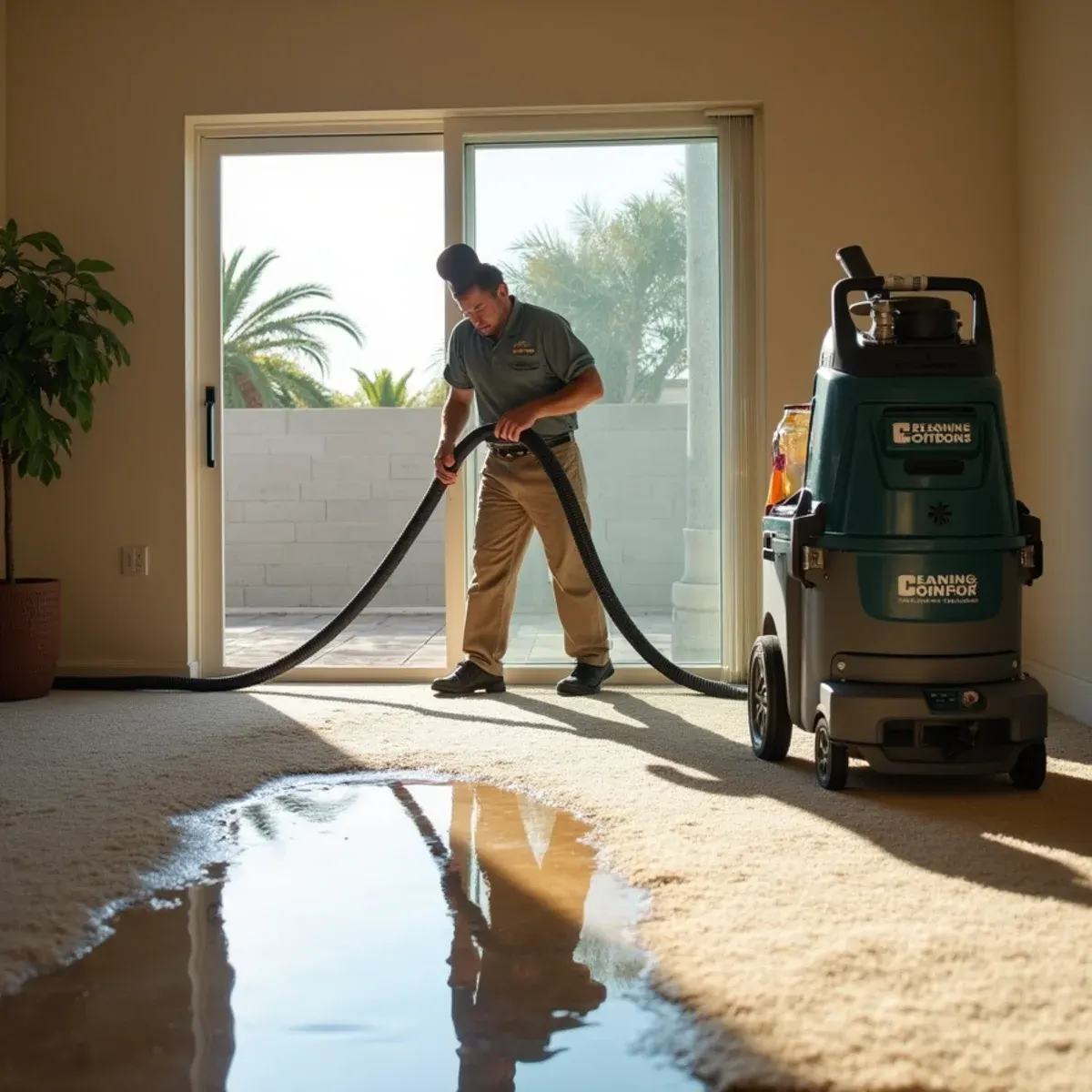
There is no single right answer for carpet in Long Beach, and anybody who gives you one over the phone hasn't asked where you live. The city spans more construction eras than anywhere else around here. Bluff Park and California Heights are 1920s lath-and-plaster with original floors hiding under the carpet. Naples is canal-front on filled land with a shallow water table. Belmont Shore is narrow lots and no driveways. East Long Beach, in El Dorado Park Estates and Los Altos, is postwar slab that behaves exactly like Cypress does.
That means four different first moves, and picking the wrong one costs you material you can't replace. In Bluff Park we lift carpet immediately to get airflow onto old-growth wood before it cups. In Naples we assume the slab carries a background moisture load and plan for a longer dry. In Belmont Shore the setup starts with where the truck can legally sit and how far the extraction hose has to run. In Los Altos it's textbook: weighted extraction, float the carpet over air movers, save the pad if the water was clean and fresh.
What Long Beach Changes About Carpet Drying
1Bluff Park carpet sits on original floors
In the 1920s stock along Bluff Park and California Heights, wall-to-wall was usually laid over the original fir or oak. That wood is the valuable layer and it cups within days under a soaked pad. We pull carpet first there, dry the boards gently, and answer the carpet question afterward. Fast, aggressive drying on old wood causes checking, so we slow it deliberately.
2Naples fill and shallow groundwater
The canal neighborhoods sit on filled land with the water table close beneath. Slabs there carry a baseline moisture load that has nothing to do with your leak, so a control reading in an unaffected room is essential before anyone decides how much pad comes out. Expect more equipment days than an equivalent loss in East Long Beach.
3Belmont Shore parking dictates the setup
Narrow lots with no driveway mean the truck sits on the street and the extraction hose runs a long way. Vacuum lift falls off with distance, and weighted extraction depends entirely on lift. We plan the route first and stage portable extractors inside when the run is long, because a weak extraction is what turns a salvageable pad into a dumpster load.
How the Work Runs
The method is the same one we use on every carpet drying job, documented to the IICRC S500:2025 standard. Here it is in short — the full carpet water damage & drying process explains each stage in detail.
- Map the real wet perimeter
- Identify the pad and the category
- Weighted extraction, pass after pass
- Float the carpet or pull the pad
- Dry the slab or subfloor
- New pad, re-stretch, reinstall
The Long Beach Background Worth Knowing
The postwar tracts around El Dorado Park, Los Altos, and the neighborhoods near the Cypress border were built in the same era and largely the same way as the housing in our home city. Single-story slab construction, plumbing routed under the concrete, and a fifty-to-seventy-year age on the supply lines.
There is more on the housing stock, drainage and plumbing history of this city on our water damage restoration in Long Beach page.
Long Beach at a glance
- Dominant construction era
- 1920–1980
- Foundation type
- mixed on grade
- Supply piping found here
- original 1920s piping, galvanized steel, under-slab copper
- Drain line materials
- cast iron, clay
- Terrain and water table
- coastal-flat, shallow water table
- Most common local failure
- the approach changing entirely by neighborhood — a 1926 plaster wall and a 1955 drywall wall are different restoration problems
- Highest-value local prevention
- identifying the construction type before anyone starts cutting
What It Costs in Long Beach
We do not quote a number over the phone before seeing the property — anyone who does is guessing. The variables that actually move the price on a carpet drying job are whether the pad is salvageable, square footage and equipment days, what sits under the pad, and they are broken down in full on the carpet water damage & drying page. The assessment and the written estimate are free anywhere in Long Beach, day or night, with no obligation.
Carpet Drying Questions from Long Beach Homeowners
Different house, not different service. A Los Altos slab home gives us flat, open concrete under the pad and a straightforward extract-and-float job. A 1920s California Heights home has carpet over original wood, and a wet pad left in place to save the carpet would cup those boards within days. So we take the carpet up to protect the floor. The carpet may still be recoverable off the floor, but the wood sets the schedule here, not the carpet.
Frequently it can be saved. The deciding factors are water category, how many hours it sat, and whether the backing has delaminated. Clean supply-line water caught within a day, on carpet that was in decent shape beforehand, usually means we replace the pad and keep the carpet. Anything past Category 1, or carpet that has come apart at the backing, is a different answer. We take the readings and check the backing before saying either way.
No, but it does more often than not. On a clean-water loss we reach quickly, we can float the carpet, push dry air into the pad space, and dry it in place. Moisture-barrier pad, dense slab rubber, and anything that sat overnight in gray water comes out. S500:2025 treats pad as non-restorable once contamination is involved, and field experience supports that. It is inexpensive material against a real risk.
All of it, with the fastest response to East Long Beach — El Dorado Park Estates, Los Altos, and the neighborhoods near the Cypress border, which are typically twenty to twenty-five minutes. Coastal and downtown areas run a little longer, and we will give you a realistic ETA when you call.