
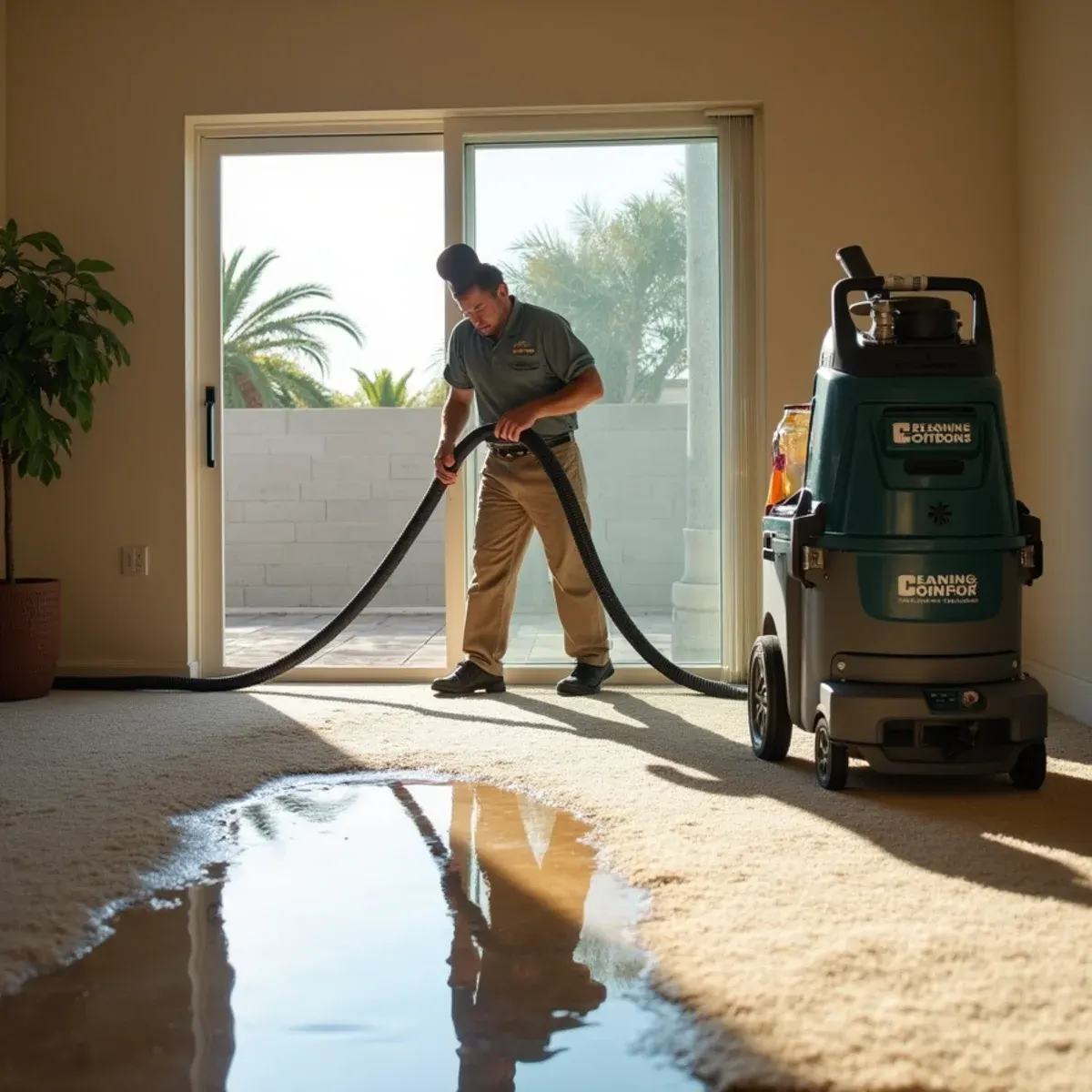
The marine layer is the quiet variable on every Seal Beach carpet job. Outside air here carries moisture most of the year, so the open-the-windows approach that works fine inland actively fights you a few blocks from the water. We dry Seal Beach carpet closed up, with dehumidification doing the real work and air movers only keeping air moving across the fibers. Plan on longer than you'd get in Cypress for the same size loss. Anyone promising a two-day dry in Old Town in June has not worked down here.
Three very different environments share this ZIP code. Old Town is dense and built from the 1920s onward, often on raised foundations, so carpet sits on a board sub-floor with a crawl space beneath and water drips away instead of pooling. Leisure World is roughly nine thousand attached units from the early 1960s, where one leak crosses a shared wall and pulls in the mutual, the management company and more than one policy at once. College Park inland is conventional slab tract and behaves like the rest of north Orange County.
What Seal Beach Changes About Carpet Drying
1Leisure World losses cross shared walls
In an attached Leisure World unit, wet pad rarely respects the demising wall. That brings in the mutual, the management company and sometimes two or three separate policies before anyone agrees who authorizes what. We document the boundary carefully, coordinate with management rather than around them, and start stabilizing the carpet while the paperwork sorts itself out.
2Open windows work against you here
Coastal air near the pier and Old Town often carries more moisture than the air inside a house that's already drying. Ventilating with it slows the job or stalls it entirely. We seal the space, size dehumidification for the grain depression we actually need, and monitor daily. It's a different setup than an inland job and it honestly takes more equipment days.
3Old Town raised floors hide the water
Where Old Town homes sit on a raised foundation, carpet and pad lie over a board sub-floor with open air underneath. Water passes through the seams and lands in the crawl space, so the carpet can meter deceptively low while joists and sub-floor stay soaked. We get eyes under the floor before making any promises about the flooring above it.
How the Work Runs
The method is the same one we use on every carpet drying job, documented to the IICRC S500:2025 standard. Here it is in short — the full carpet water damage & drying process explains each stage in detail.
- Map the real wet perimeter
- Identify the pad and the category
- Weighted extraction, pass after pass
- Float the carpet or pull the pad
- Dry the slab or subfloor
- New pad, re-stretch, reinstall
The Seal Beach Background Worth Knowing
Structural drying works by creating a vapor pressure differential — dry air pulls moisture out of wet materials. When the surrounding air is already carrying a heavy moisture load, that differential shrinks and everything slows down.
There is more on the housing stock, drainage and plumbing history of this city on our water damage restoration in Seal Beach page.
Seal Beach at a glance
- Dominant construction era
- 1920–1965
- Foundation type
- mixed on grade
- Supply piping found here
- galvanized steel, copper, shared community mains
- Drain line materials
- cast iron, clay
- Terrain and water table
- coastal-flat, shallow water table
- Most common local failure
- losses that cross shared walls between attached units, involving several policies and a mutual at once
- Highest-value local prevention
- documenting each affected unit separately from the first hour
What It Costs in Seal Beach
We do not quote a number over the phone before seeing the property — anyone who does is guessing. The variables that actually move the price on a carpet drying job are whether the pad is salvageable, square footage and equipment days, what sits under the pad, and they are broken down in full on the carpet water damage & drying page. The assessment and the written estimate are free anywhere in Seal Beach, day or night, with no obligation.
Carpet Drying Questions from Seal Beach Homeowners
That depends on the mutual's governing documents and the two policies involved, and it isn't a call we're qualified to make for you. What we can do is start work immediately and document it so the question gets answered later without guesswork: origin, path, moisture readings on both sides of the shared wall, category, and timestamped photos. We bill carriers directly and are used to working with management companies here, so nothing stalls while responsibility gets settled.
Frequently it can be saved. The deciding factors are water category, how many hours it sat, and whether the backing has delaminated. Clean supply-line water caught within a day, on carpet that was in decent shape beforehand, usually means we replace the pad and keep the carpet. Anything past Category 1, or carpet that has come apart at the backing, is a different answer. We take the readings and check the backing before saying either way.
No, but it does more often than not. On a clean-water loss we reach quickly, we can float the carpet, push dry air into the pad space, and dry it in place. Moisture-barrier pad, dense slab rubber, and anything that sat overnight in gray water comes out. S500:2025 treats pad as non-restorable once contamination is involved, and field experience supports that. It is inexpensive material against a real risk.
Coastal marine layer conditions keep ambient humidity high for extended periods, which reduces the vapor pressure differential that drives drying. Jobs near the water need sealed chambers and more dehumidification capacity than an equivalent loss inland, and the equipment stays on longer.