
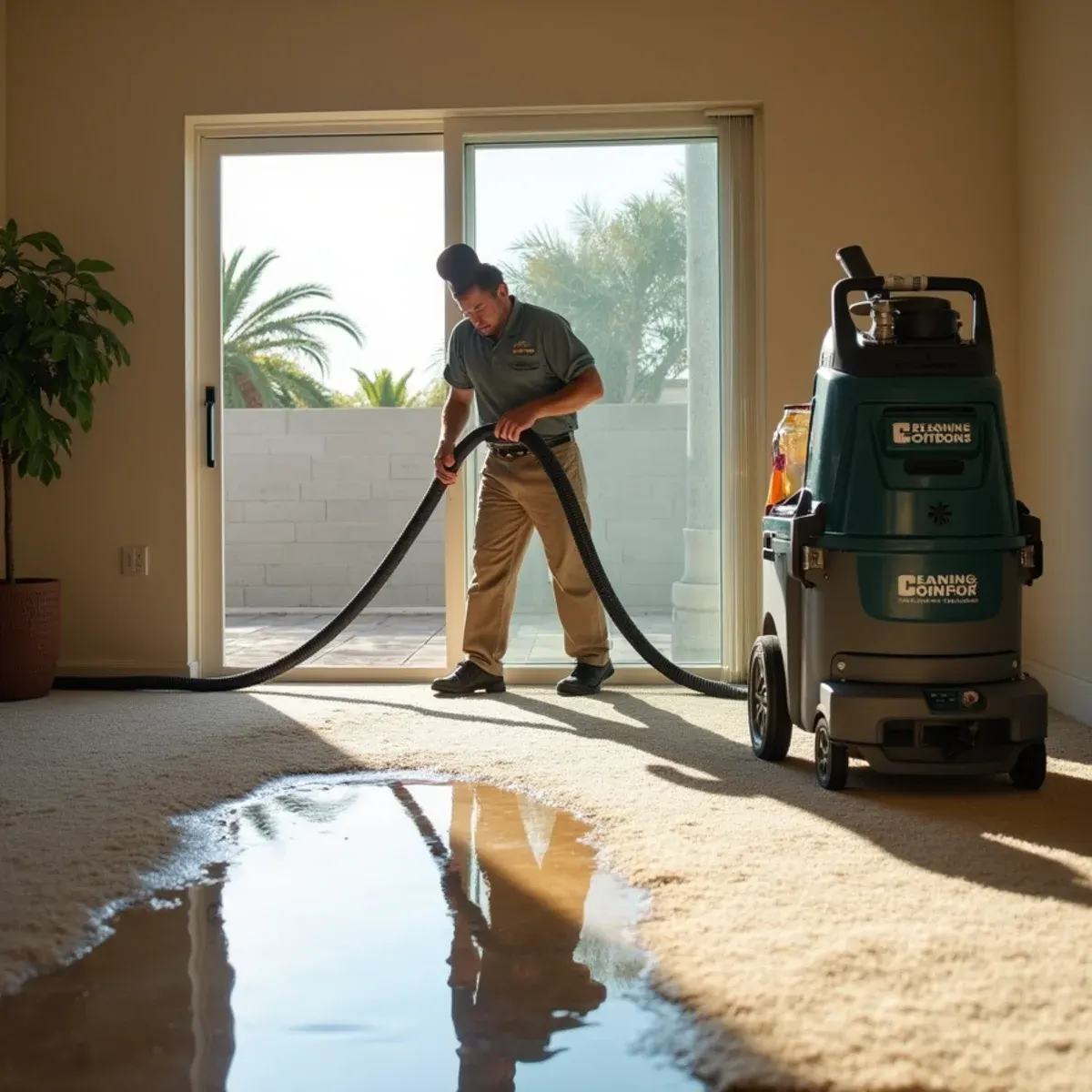
Before we talk about saving your carpet in Rossmoor, we lift a corner at the tack strip and look at what's under it. Ross Cortese built roughly 3,500 near-identical ranch homes here between 1957 and 1961 to a short list of plans, and a surprising number still have their original oak strip flooring hiding beneath later wall-to-wall. Wet carpet on top of that oak is a race. The wood cups and crowns within a day or two of sitting under a saturated pad, and by then you've lost the more valuable layer.
The uniformity cuts both ways. Because the plans repeat street to street, a slab leak in one house is a decent predictor for its neighbors, and we have walked into the same failure at the same wall three doors down. Under-slab copper from the late fifties is well into its failure window now. One more thing that catches people out: Rossmoor is unincorporated, so anything past drying runs through County permitting rather than a city counter, and that timeline is worth knowing before you plan a reinstall.
What Rossmoor Changes About Carpet Drying
1Original oak strip under later carpet
Plenty of Cortese homes were carpeted over their oak in the seventies and eighties and the wood was never touched again. If it's there, it changes the priority order. We pull carpet and pad early to get airflow onto the boards, dry them as evenly as we can, and give the oak its best chance before it cups into something only a sander can fix.
2Clustered slab leaks on identical plans
Same builder, same four years, same copper routed the same way. When we find an under-slab pinhole at a Rossmoor kitchen wall, it is worth checking the meter reading at your own kitchen wall if you live on that street. Neighbors here tend to compare notes, and that informal early warning has saved carpet in this neighborhood more than once.
3County permitting, not a city hall
Rossmoor has no city hall of its own, so any repair beyond drying and reinstall goes through Orange County rather than a municipal department. It rarely affects emergency work, which needs no permit at all. It does affect scheduling for flooring and wall repair afterward, and we will tell you where that line falls so the timeline doesn't surprise you.
How the Work Runs
The method is the same one we use on every carpet drying job, documented to the IICRC S500:2025 standard. Here it is in short — the full carpet water damage & drying process explains each stage in detail.
- Map the real wet perimeter
- Identify the pad and the category
- Weighted extraction, pass after pass
- Float the carpet or pull the pad
- Dry the slab or subfloor
- New pad, re-stretch, reinstall
The Rossmoor Background Worth Knowing
Plumbing failure is largely a function of time, water chemistry, and installation method — and in Rossmoor all three are effectively identical from house to house. That is why leak calls here tend to arrive in clusters, and why a neighbor's slab leak is genuinely relevant information about your own home.
There is more on the housing stock, drainage and plumbing history of this city on our water damage restoration in Rossmoor page.
Rossmoor at a glance
- Dominant construction era
- 1957–1961
- Foundation type
- slab on grade
- Supply piping found here
- under-slab copper, some galvanized
- Drain line materials
- cast iron
- Terrain and water table
- flat, moderate water table
- Most common local failure
- clustered slab leaks, where one failure on a street reliably predicts the neighbors
- Highest-value local prevention
- treating a neighbor's slab leak as information about your own house and running the meter test
What It Costs in Rossmoor
We do not quote a number over the phone before seeing the property — anyone who does is guessing. The variables that actually move the price on a carpet drying job are whether the pad is salvageable, square footage and equipment days, what sits under the pad, and they are broken down in full on the carpet water damage & drying page. The assessment and the written estimate are free anywhere in Rossmoor, day or night, with no obligation.
Carpet Drying Questions from Rossmoor Homeowners
We check at a closet threshold or along the tack strip, where a small lift answers it in seconds without damaging anything. In these Cortese plans the oak usually runs through the living room, hall and bedrooms and stops at the kitchen. If it's under there and it's wet, the oak drives the schedule, because carpet can wait and cupped oak can't. If it's bare slab, we go back to the normal save-or-replace call on the carpet and pad.
Frequently it can be saved. The deciding factors are water category, how many hours it sat, and whether the backing has delaminated. Clean supply-line water caught within a day, on carpet that was in decent shape beforehand, usually means we replace the pad and keep the carpet. Anything past Category 1, or carpet that has come apart at the backing, is a different answer. We take the readings and check the backing before saying either way.
No, but it does more often than not. On a clean-water loss we reach quickly, we can float the carpet, push dry air into the pad space, and dry it in place. Moisture-barrier pad, dense slab rubber, and anything that sat overnight in gray water comes out. S500:2025 treats pad as non-restorable once contamination is involved, and field experience supports that. It is inexpensive material against a real risk.
Because they were all built between 1957 and 1961 with the same materials and methods. Copper routed through a slab fails from internal erosion and external soil corrosion on a fairly predictable timeline, and when an entire community shares one construction date, it shares one failure window too.