
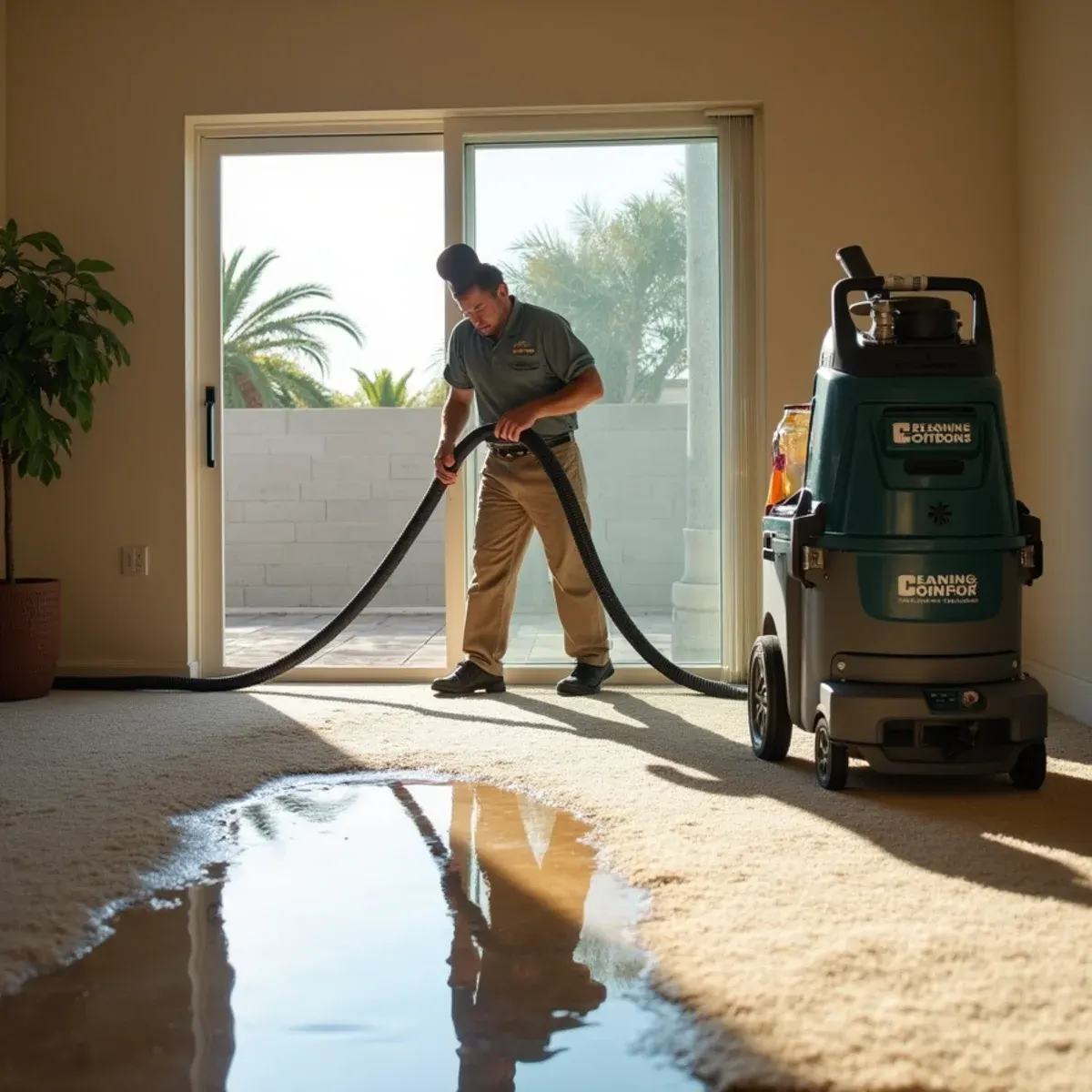
Lakewood went up in about three years, roughly 17,500 homes at a pace approaching a hundred a day, and the plans repeat down every street. That uniformity shows up in the plumbing: kitchen, bath and laundry share walls in a tight wet core near the middle of the house. When seventy-year-old galvanized steel finally lets go at a scaled, eroded fitting inside that core, the water starts in the one uncarpeted part of the house and pushes straight out under the hall carpet and into the bedrooms.
These are slab homes, so there's nowhere for the water to go but sideways, flat and wide beneath the pad and under the baseboards. Original galvanized is long past its service life here, and the corrosion that finally opens a pinhole has been building scale inside that pipe for decades. That matters for the carpet decision, because water carrying rust and pipe scale is not Category 1 no matter how clean the source technically was. Pad from a galvanized failure in Lakewood usually comes out.
What Lakewood Changes About Carpet Drying
1The wet core sends water to the hall
Kitchen, bath and laundry sharing plumbing walls means most Lakewood failures start within a few feet of each other. The hall carpet is almost always the first casualty and the bedrooms follow. We start metering in the hall on these calls even when the homeowner reports a wet spot somewhere else, because the hall tells us the direction of travel.
2Rust and scale push it past Category 1
Water from a corroded galvanized line carries iron oxide and mineral scale from seventy years of interior buildup. That stains carpet backing and pad, and it takes the category off clean water even when the break is on a supply line. Pad almost always comes out. The face carpet is sometimes salvageable if the staining hasn't reached through the backing.
3Identical plans, predictable wet footprint
Because so many Lakewood houses came from the same handful of plans in the same three years, we know where the water goes before we walk in. That shortens the assessment and cuts exploratory demolition. It also means that if your neighbor two doors down had a galvanized failure last year, the odds on yours are meaningfully higher than average.
How the Work Runs
The method is the same one we use on every carpet drying job, documented to the IICRC S500:2025 standard. Here it is in short — the full carpet water damage & drying process explains each stage in detail.
- Map the real wet perimeter
- Identify the pad and the category
- Weighted extraction, pass after pass
- Float the carpet or pull the pad
- Dry the slab or subfloor
- New pad, re-stretch, reinstall
The Lakewood Background Worth Knowing
Galvanized steel supply piping was standard when Lakewood was built, and it fails in a specific and predictable way. The zinc coating protecting the steel wears through from the inside, the steel corrodes, and scale builds up on the interior wall — narrowing the pipe over decades. As the diameter shrinks, water velocity and turbulence increase, which accelerates the erosion at elbows and fittings until a thin spot lets go.
There is more on the housing stock, drainage and plumbing history of this city on our water damage restoration in Lakewood page.
Lakewood at a glance
- Dominant construction era
- 1950–1953
- Foundation type
- slab on grade
- Supply piping found here
- original galvanized steel
- Drain line materials
- cast iron
- Terrain and water table
- flat, moderate water table
- Most common local failure
- seventy-year-old galvanized supply lines letting go at a scaled, eroded fitting
- Highest-value local prevention
- repiping while walls are already open for a repair, rather than as a separate project later
What It Costs in Lakewood
We do not quote a number over the phone before seeing the property — anyone who does is guessing. The variables that actually move the price on a carpet drying job are whether the pad is salvageable, square footage and equipment days, what sits under the pad, and they are broken down in full on the carpet water damage & drying page. The assessment and the written estimate are free anywhere in Lakewood, day or night, with no obligation.
Carpet Drying Questions from Lakewood Homeowners
Because in these Lakewood plans the leak is usually inside the wall of the wet core, not on the bathroom floor. Water exits at the bottom plate and moves under the flooring, and the bathroom's vinyl or tile sheds it while the hall carpet and pad absorb everything. The hall is simply the first porous surface it reaches. We meter the bathroom wall base and the hall together, which almost always puts the leak right between them.
Frequently it can be saved. The deciding factors are water category, how many hours it sat, and whether the backing has delaminated. Clean supply-line water caught within a day, on carpet that was in decent shape beforehand, usually means we replace the pad and keep the carpet. Anything past Category 1, or carpet that has come apart at the backing, is a different answer. We take the readings and check the backing before saying either way.
No, but it does more often than not. On a clean-water loss we reach quickly, we can float the carpet, push dry air into the pad space, and dry it in place. Moisture-barrier pad, dense slab rubber, and anything that sat overnight in gray water comes out. S500:2025 treats pad as non-restorable once contamination is involved, and field experience supports that. It is inexpensive material against a real risk.
Have it assessed. Seventy-year-old galvanized has exceeded any reasonable service life, and declining pressure or rust-colored water means it is well along. If a repair is already opening walls, that is the cheapest moment you will ever get to repipe — the demolition and patching are already in the scope.