
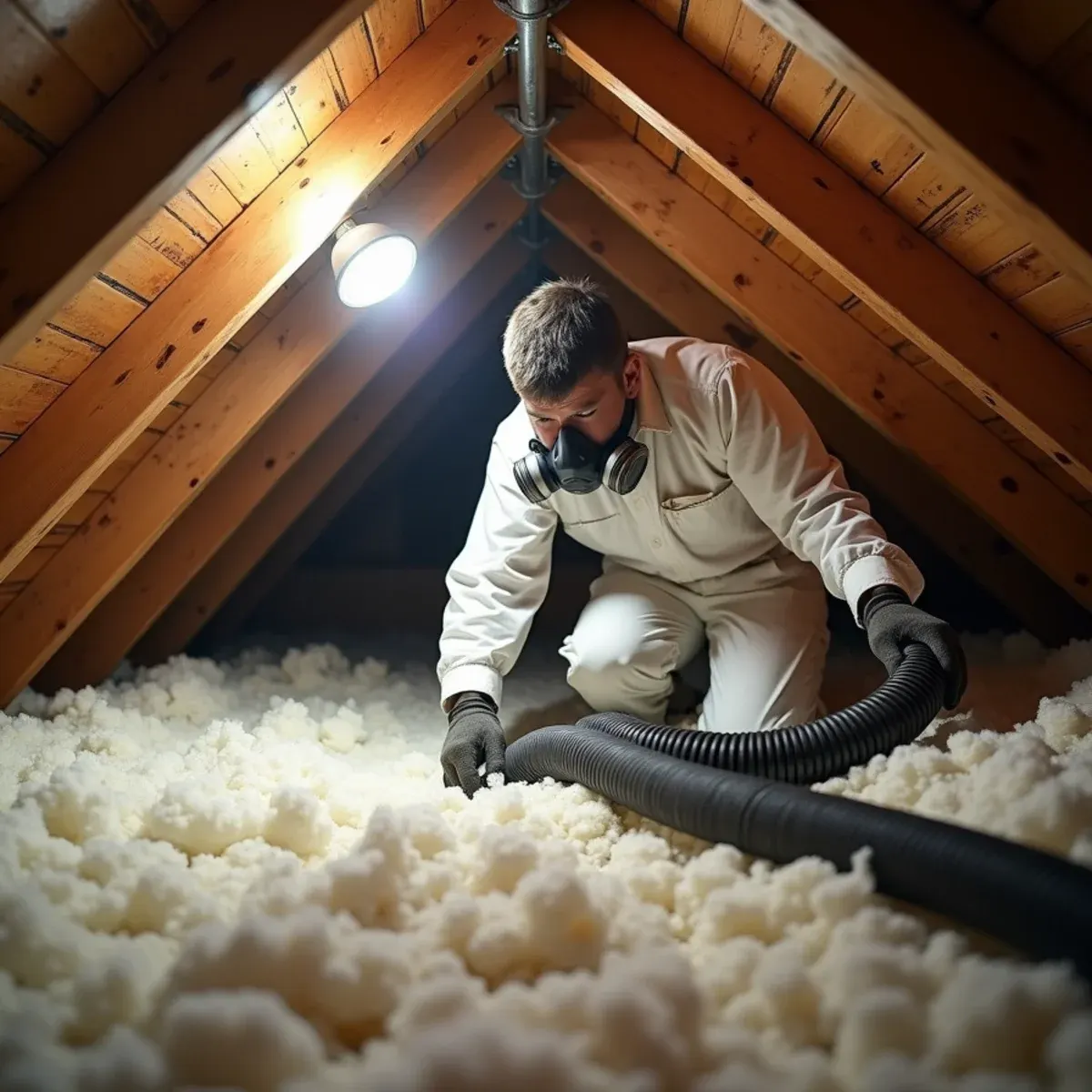
Straight answer first: a lot of Stanton homes don't have an attic to work in. Manufactured and mobile homes make up a big share of the housing here, and above the ceiling board there's usually a shallow cavity, a few inches of batt under a low-crowned metal or membrane roof, not a walkable attic with blown-in insulation and a scuttle. And the ductwork isn't up there. It runs underneath, in the belly, wrapped in a plastic membrane that holds water against the floor decking.
So the work changes shape. In a manufactured home we open the ceiling in sections, pull the wet batt, dry the underside of the roof and the truss chords, then deal with the real problem below, slitting and draining the belly wrap so the particleboard decking isn't sitting in water. Swollen particleboard doesn't come back, and we tell you that early. Stanton's older apartment buildings do have conventional vented attics, and there the standard removal, HEPA vacuum, dry and reinstall sequence applies as written.
What Stanton Changes About Attic & Insulation
1Inches of cavity, no crawl space above
A manufactured home's roof cavity is too shallow to enter, so everything happens through the ceiling. We open panels in a planned grid, pull the wet batt, dry the roof sheathing and the truss chords with directed air, and close it back up. There's no walking the plane with a vacuum hose. It's slower per square foot than a stick-built attic and the ceiling repair is part of the job, not an extra.
2The belly wrap holds water against the floor
Ceiling water in a coach ends up in the belly. The membrane under the floor is designed to keep pests and air out, which also means it keeps water in, pooled against particleboard decking and the ducts that run through it. We cut controlled drains, dry the cavity, and check the duct interiors. Decking that's already swollen and crumbling gets replaced, because drying won't restore it.
3Park lanes decide where equipment goes
Stanton is dense and the parks are tight. Coaches sit close together, lanes are narrow, and there's often nowhere to stage a truck-mounted vacuum near the unit. We plan hose routing and generator placement before we start so we're not blocking a neighbor's carport for three days. Older apartment buildings here have their own version of the same problem in the parking court.
How the Work Runs
The method is the same one we use on every attic & insulation job, documented to the IICRC S500:2025 standard. Here it is in short — the full attic water damage & insulation replacement process explains each stage in detail.
- Map the wet area before touching it
- Contain the hatch and protect the path
- Vacuum out the saturated insulation
- HEPA vacuum and treat the plane
- Dry the deck, joists, and top plates
- Reinstall insulation and check the details
The Stanton Background Worth Knowing
Mobile and manufactured homes need a genuinely different restoration approach, and the reason is what they are built from. The floor system is typically particleboard or OSB over a wood frame with insulation and a vapor barrier belly wrap underneath — and particleboard exposed to water swells, loses structural integrity, and does not recover. It cannot be dried back to serviceable the way plywood often can.
There is more on the housing stock, drainage and plumbing history of this city on our water damage restoration in Stanton page.
Stanton at a glance
- Dominant construction era
- 1950–1975
- Foundation type
- mixed on grade
- Supply piping found here
- galvanized steel, copper, manufactured-home PEX and poly
- Drain line materials
- cast iron
- Terrain and water table
- flat, moderate water table
- Most common local failure
- underfloor leaks in manufactured homes, sealed inside the belly wrap where they cannot evaporate
- Highest-value local prevention
- checking for soft spots underfoot, because a manufactured-home floor gives no other warning
What It Costs in Stanton
We do not quote a number over the phone before seeing the property — anyone who does is guessing. The variables that actually move the price on a attic & insulation job are how much of the attic got wet, clearance, access, and layout, the type of insulation up there, and they are broken down in full on the attic water damage & insulation replacement page. The assessment and the written estimate are free anywhere in Stanton, day or night, with no obligation.
Attic & Insulation Questions from Stanton Homeowners
No. A sagging ceiling panel in a coach means the batt above it is holding water and the panel has already lost strength, and neither gypsum board nor a vinyl-faced panel recovers from that. We open that section, take the wet batt out, dry the framing and sheathing, and replace the panel. Trying to dry it in place traps moisture against the roof sheathing and you'll be back to it in a season.
Only the affected area plus a margin back to dry, lofted material. If the wet section covers a small part of the attic, that is all that comes out. Once it reaches roughly half the plane, replacing the whole field usually costs less than blending old and new to an even depth, and it leaves you with one consistent R-value instead of a patchwork ceiling that performs unevenly room to room.
Most attics take a few days once the wet insulation is out, but we will not promise a number on day one, and you should be careful with anyone who does. Plywood sheathing dries at a different rate than old plank decking, a sealed attic dries faster than a heavily vented one, and marine-layer mornings slow everything down. The daily readings decide when equipment leaves, not the calendar.
Yes, and we say so explicitly because a lot of companies will not. Manufactured homes need a different approach — opening the belly wrap to dry the floor cavity, removing saturated insulation, and honestly assessing particleboard decking, which usually cannot be dried back to serviceable.