
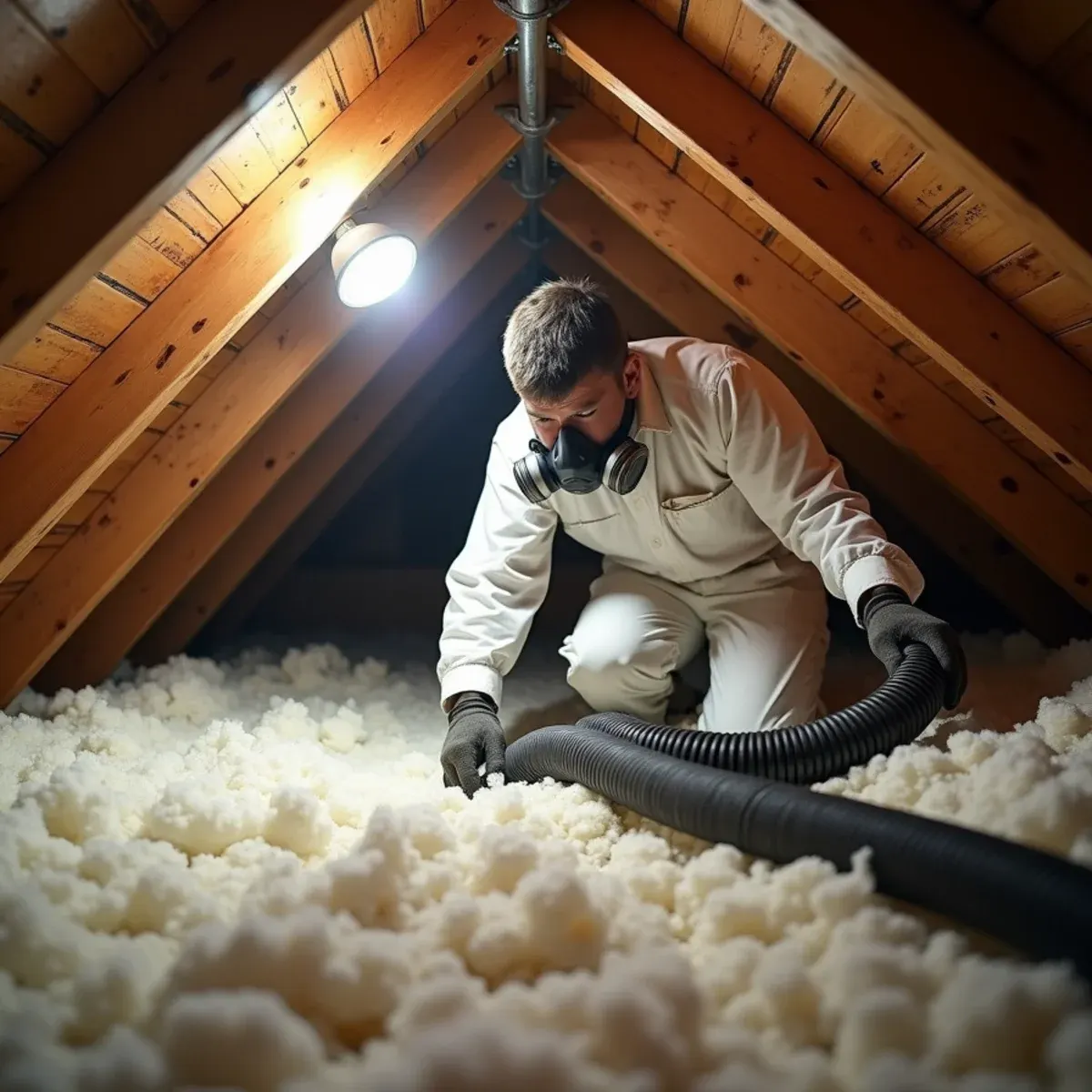
Paramount puts houses and industry on the same street. The old Hynes and Clearwater dairy land filled in between 1945 and 1965 with small slab homes packed tight, and the commercial and manufacturing corridors grew right up against them. So one storm can put us in a 1950s attic in the morning and a warehouse office in the afternoon, and the second building has no attic at all. It has a suspended ceiling with batt insulation lying loose on top of the tiles, a rooftop package unit above the deck, and a drain line that failed somewhere in between.
In the houses, attics are shallow and the lots leave almost no permeable ground, so equipment stages at the curb and hoses run across sidewalks between parked cars. There is another wrinkle here that inland cities do not have to the same degree. Decades of corridor traffic and industrial neighbors leave older blown-in loaded with settled dust, so removal is as much a containment job as a drying job. HEPA vacuuming the attic plane once the wet material is out is not optional on these houses.
What Paramount Changes About Attic & Insulation
1Rooftop units leak above drop ceilings
On the commercial side, the equivalent of an attic is the plenum above a suspended ceiling, and the usual source is a rooftop package unit with a failed condensate line or pan. Water lands on batt insulation resting on the tiles, then finds a seam. Wet batts come out, stained tiles come down, the deck and structure get dried, and new insulation goes back once the readings hold.
2Old blown-in carries decades of dust
Houses sitting a block from a manufacturing corridor accumulate settled particulate in the attic insulation over sixty years. Disturbing it without containment pushes that into the living space through the hatch and the can lights. We seal the access, run negative air, and HEPA vacuum the attic plane after removal, which is standard practice everywhere and genuinely matters more here.
3Residential and commercial claims move differently
A house and the shop next door can take the same water and need completely different handling. Commercial losses involve operations, business interruption questions and an adjuster who wants a phased scope so the floor keeps running. Residential ones involve a family that needs the ceiling back. We keep the documentation separate, work commercial after hours where it helps, and bill each carrier direct.
How the Work Runs
The method is the same one we use on every attic & insulation job, documented to the IICRC S500:2025 standard. Here it is in short — the full attic water damage & insulation replacement process explains each stage in detail.
- Map the wet area before touching it
- Contain the hatch and protect the path
- Vacuum out the saturated insulation
- HEPA vacuum and treat the plane
- Dry the deck, joists, and top plates
- Reinstall insulation and check the details
The Paramount Background Worth Knowing
On a typical Paramount lot, the house, the driveway, the walkways and the rear slab cover most of the parcel. What is left is a narrow side yard, and everything that lands on the roof and the paving is supposed to leave through a couple of small area drains. That system has no margin. When a grate silts up, when a downspout dumps straight onto paving, or when the outlet at the curb has been crushed by a parked truck, the water has no soil to soak into and nowhere else to be. It ponds against the slab edge and comes in at the lowest threshold, which is usually a garage or a side door.
There is more on the housing stock, drainage and plumbing history of this city on our water damage restoration in Paramount page.
Paramount at a glance
- Dominant construction era
- 1945–1965
- Foundation type
- slab on grade
- Supply piping found here
- original galvanized steel, copper
- Drain line materials
- cast iron
- Terrain and water table
- flat, moderate water table
- Most common local failure
- residential and commercial losses on the same block, needing very different handling
- Highest-value local prevention
- clearing area drains before the season on lots with very little permeable ground
What It Costs in Paramount
We do not quote a number over the phone before seeing the property — anyone who does is guessing. The variables that actually move the price on a attic & insulation job are how much of the attic got wet, clearance, access, and layout, the type of insulation up there, and they are broken down in full on the attic water damage & insulation replacement page. The assessment and the written estimate are free anywhere in Paramount, day or night, with no obligation.
Attic & Insulation Questions from Paramount Homeowners
The batt insulation lying on top of the ceiling tiles, and the tiles themselves where they are stained or sagging. Wet batts never regain R-value and they hold moisture against the grid and the structure above, so they come out. We dry the deck, the joists and any ductwork in that space, treat growth if we find it, then reinstall insulation to the right value once meter readings are stable rather than once it looks dry.
Only the affected area plus a margin back to dry, lofted material. If the wet section covers a small part of the attic, that is all that comes out. Once it reaches roughly half the plane, replacing the whole field usually costs less than blending old and new to an even depth, and it leaves you with one consistent R-value instead of a patchwork ceiling that performs unevenly room to room.
Most attics take a few days once the wet insulation is out, but we will not promise a number on day one, and you should be careful with anyone who does. Plywood sheathing dries at a different rate than old plank decking, a sealed attic dries faster than a heavily vented one, and marine-layer mornings slow everything down. The daily readings decide when equipment leaves, not the calendar.
Almost certainly your area drains. Paramount lots have very little permeable ground, so everything that falls on the roof and the paving has to leave through a couple of small drains. If a grate silts up or the outlet is crushed, the water ponds against the slab and enters at the lowest threshold, which is usually the garage. Rodding the drains and checking the outlet before the season costs far less than drying the garage wall afterward.