
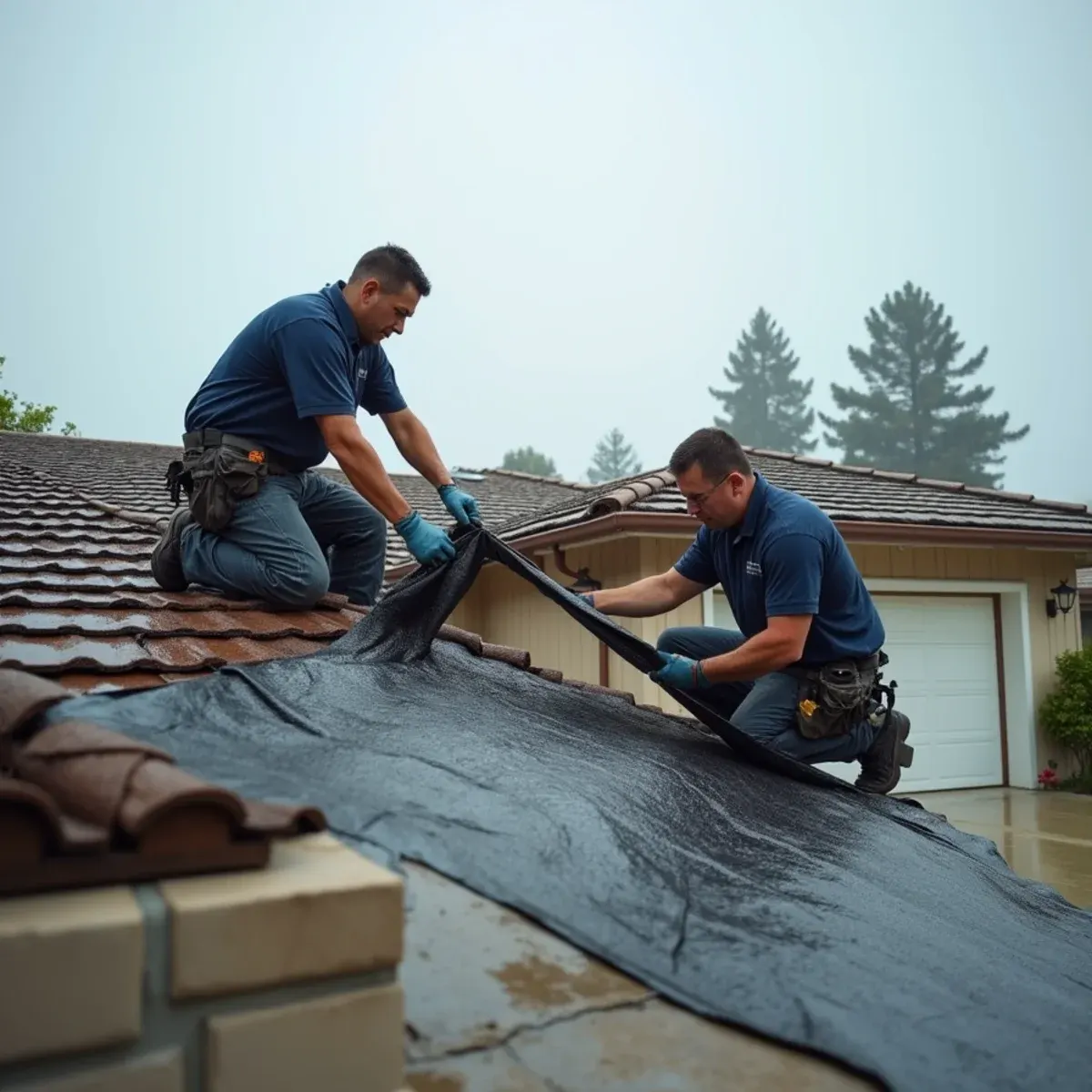
The call we get from La Palma during a hard rain almost always starts on the ceiling. Water finds a lifted shingle or a failed valley on a two-story roof, runs the sheathing, drops into the floor assembly between the stories, and shows up as a stain over the family room — nowhere near where it came in. La Palma has a higher share of two-story homes than the cities around it, and that single detail changes the whole search.
Almost the entire city was built between 1960 and 1980, and it's maintained better than most housing of that age — long-tenured owners, tidy roofs, clean gutters near Central Park and along the Walker Street corridor. That's exactly why the failures that do happen surprise people. A well-kept house still has original roof penetrations: plumbing vents, the furnace flue, the old antenna mast nobody uses. Storm damage here is almost never the field of the roof. It's the holes in it.
What La Palma Changes About Storm Damage
1Finding where the water actually entered
Because the entry point and the stain sit on different sides of the house, we start on the roof and in the attic rather than at the drywall. Thermal imaging and a pin meter tell us which direction the sheathing is wet in, and that points back toward the penetration. Cutting the ceiling first gives you a hole and no answer, and on a two-story house it's usually the wrong hole.
2Drying a closed floor assembly
Water sitting between the second floor and the ceiling below has no path to open air. We normally dry it through the ceiling cavity with directed air rather than pulling up the finished floor above, but that only works if we get there early. Once the subfloor and joists have been wet for several days, the tear-out gets larger and the timeline moves from days into weeks.
3Vent boots and flue collars fail first
The rubber pipe boots on 1960s and 1970s roofs are the weak point across this city. The collar hardens, splits at the pipe, and passes water only when rain is driven sideways — which is why it appears in February and never in a garden-hose test. Replacing boots and re-sealing the flue collar before the season costs a fraction of one drying job.
How the Work Runs
The method is the same one we use on every storm damage job, documented to the IICRC S500:2025 standard. Here it is in short — the full storm damage restoration process explains each stage in detail.
- Emergency tarping and board-up
- Water diversion and extraction
- Full damage documentation
- Interior mitigation
- Structural drying to standard
- Permanent repairs
The La Palma Background Worth Knowing
There is a pattern we see repeatedly in La Palma. A homeowner has taken excellent care of a house for thirty years — new roof, dual-pane windows, updated electrical panel, remodeled kitchen. Then a slab leak runs for eight months under the living room and nobody catches it, because there was never anything to see.
There is more on the housing stock, drainage and plumbing history of this city on our water damage restoration in La Palma page.
La Palma at a glance
- Dominant construction era
- 1960–1980
- Foundation type
- slab on grade
- Supply piping found here
- under-slab copper
- Drain line materials
- cast iron, ABS
- Terrain and water table
- flat, moderate water table
- Most common local failure
- second-floor supply and fixture failures that travel through the floor assembly into the ceiling below
- Highest-value local prevention
- knowing where the main shutoff is and confirming it still turns, because two-story losses double in size in minutes
What It Costs in La Palma
We do not quote a number over the phone before seeing the property — anyone who does is guessing. The variables that actually move the price on a storm damage job are size of the opening and duration of intrusion, emergency mitigation scope, how many rooms the water reached, and they are broken down in full on the storm damage restoration page. The assessment and the written estimate are free anywhere in La Palma, day or night, with no obligation.
Storm Damage Questions from La Palma Homeowners
That's the normal pattern in a two-story home. Water enters at a penetration, runs along the underside of the sheathing until it hits a rafter or a strap, then drops into the floor cavity and travels down a joist bay before finding a seam in the ceiling below. The stain marks the low point, not the leak. We track it back with moisture readings across the assembly before anyone opens a ceiling.
During. Emergency tarping and board-up happen in the rain — that is the entire point of them. We triage by severity, so active intrusion into occupied living space goes to the front of the queue.
Sudden wind and rain damage is generally covered, including the resulting interior water damage. What gets excluded is damage from a roof that had already failed or from deferred maintenance, and flooding from water that came across the ground, which needs separate flood insurance.
Typically fifteen to twenty minutes. La Palma borders Cypress directly to the north, so it is one of the fastest calls we run and the 60-minute commitment applies in full.