
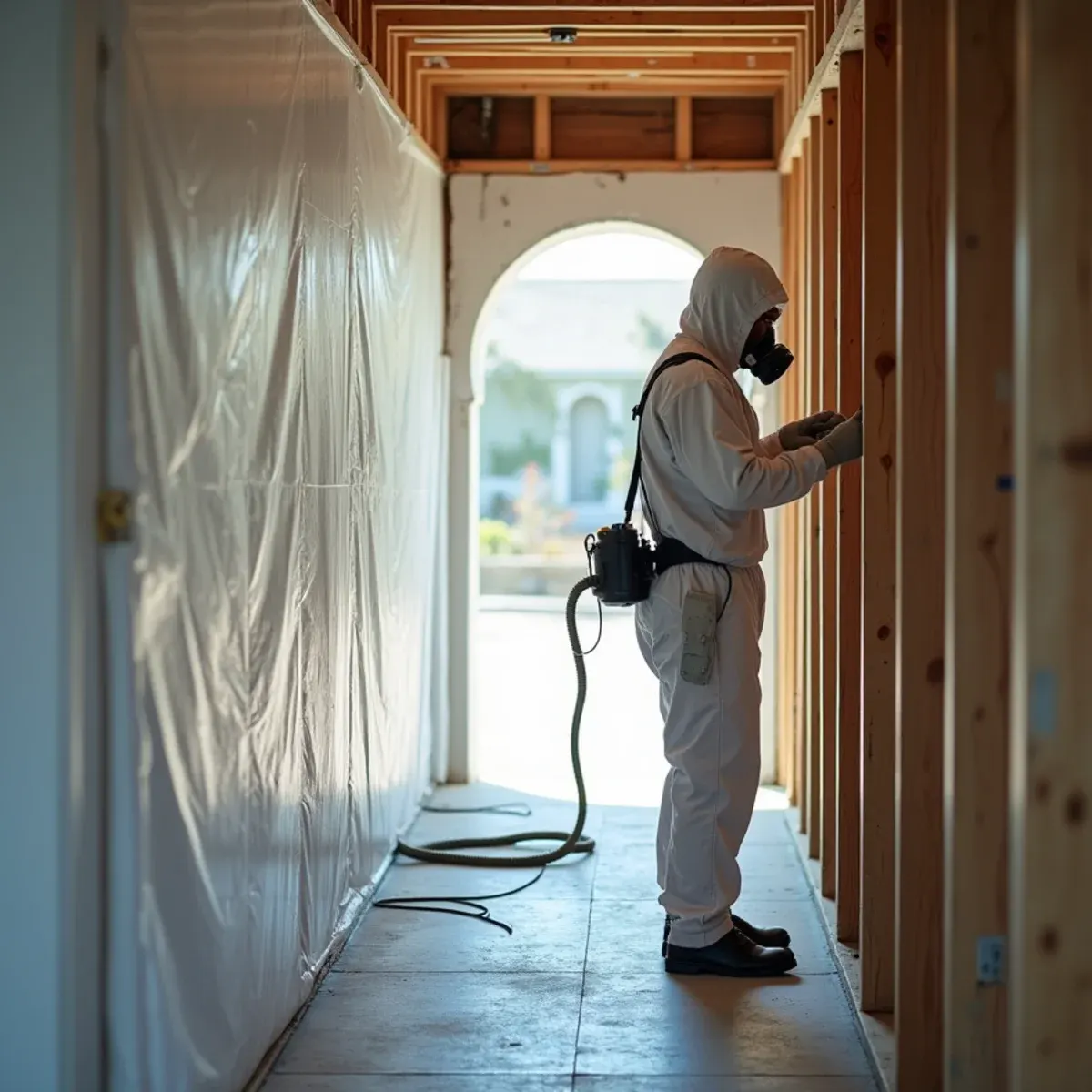
Most of our Santa Fe Springs work is not kitchens and bathrooms. This is one of the most industrial cities in this part of Los Angeles County — an oil-field history and a warehouse, manufacturing and distribution base that dwarfs the residential footprint along Telegraph Road and Norwalk Boulevard. So the mold calls come from facility managers, not homeowners, and the buildings are large open-plan floors with fire sprinkler systems overhead, tenant-improvement office build-outs along one wall, racking, loading docks and product that has to be protected or moved before anything else happens.
A sprinkler head discharging over a weekend puts hundreds of gallons into insulation, metal-stud drywall partitions and whatever was stacked beneath it, and by Monday the affected zone has already started to go. The office build-outs inside these shells are the vulnerable part — batt insulation, drywall, carpet and hollow partitions that hold moisture much longer than the concrete floor does. We're about seventeen minutes south in Cypress and dispatch as fast as conditions allow, including after hours.
What Santa Fe Springs Changes About Mold Remediation
1Sprinkler discharge across open floors
When a head lets go in a high-bay building, the water spreads far beyond the point of discharge and soaks materials that were never near it. Growth starts in the drywall partitions and insulation of the office areas while the slab itself looks nearly dry. We map the wet zone with meters across the whole affected bay rather than treating the puddle as the boundary.
2Racking, inventory and access
Nothing gets contained until we know what has to move. Palletized product, raw stock and equipment sitting in the affected area either gets relocated or protected, and that takes your people and ours working together. We scope the material handling honestly at the walkthrough, because a plan that ignores it stalls on day one.
3Access and shutoff information on file
Failures in this district happen at two in the morning more often than at two in the afternoon. Having current after-hours contacts, gate and door access, and the location of the main and sprinkler riser shutoffs on file with us before anything happens can cut hours off the response. That difference is frequently the difference between drying a partition and removing it.
How the Work Runs
The method is the same one we use on every mold remediation job, documented to the IICRC S500:2025 standard. Here it is in short — the full mold remediation & removal process explains each stage in detail.
- Inspection and moisture source identification
- Testing where it is warranted
- Containment and negative pressure
- Removal of contaminated material
- HEPA cleaning and antimicrobial application
- Verification before containment comes down
The Santa Fe Springs Background Worth Knowing
The water sitting in a wet-pipe sprinkler system has been there for years. It is stagnant, it has been in contact with black steel and scale that whole time, and some systems carry corrosion inhibitors or antifreeze as well. When a head discharges, that is what lands on your floor and soaks into your product. Under IICRC S500:2025 water gets categorized on the evidence in front of us, and sprinkler discharge that has run across a warehouse floor almost never stays in Category 1. That decision drives what we dry in place, what comes out, and how the crew works.
There is more on the housing stock, drainage and plumbing history of this city on our water damage restoration in Santa Fe Springs page.
Santa Fe Springs at a glance
- Dominant construction era
- 1950–1975
- Foundation type
- slab on grade
- Supply piping found here
- galvanized steel, copper, commercial-grade systems
- Drain line materials
- cast iron, commercial waste lines
- Terrain and water table
- flat, moderate water table
- Most common local failure
- fire-sprinkler discharge and commercial supply failures across large open-plan warehouse and manufacturing floors
- Highest-value local prevention
- keeping current building access and shutoff information on file before an after-hours failure
What It Costs in Santa Fe Springs
We do not quote a number over the phone before seeing the property — anyone who does is guessing. The variables that actually move the price on a mold remediation job are square footage of affected material, where it is, containment complexity, and they are broken down in full on the mold remediation & removal page. The assessment and the written estimate are free anywhere in Santa Fe Springs, day or night, with no obligation.
Mold Remediation Questions from Santa Fe Springs Homeowners
Usually yes, if the affected zone can be genuinely isolated. We build hard containment around it, run negative air exhausted outside the building, and set entry so traffic and forklifts route around the barrier. Production in unaffected bays continues. What we won't do is leave contaminated material open next to your workforce. We'll walk it with you, mark the boundary, and give you a straight answer about which areas and which shifts are affected.
On a hard, non-porous surface like tile or glass, bleach handles surface growth. On drywall, wood, or anything porous it does not — the water content soaks in and can feed further growth while the chlorine stays on the surface. Porous material with real growth needs to be removed, not treated.
Usually not for visible growth with an obvious cause — you can see the problem and the work would be identical regardless of species. Testing is worthwhile when there is odor but nothing visible, when you need documentation for a claim or dispute, or when you want independent verification that the job was done right.
No. Water that has sat in a wet-pipe system for years picks up scale, rust and whatever inhibitors are in the system, and once it runs across a warehouse floor it collects everything on that floor too. We categorize on the evidence per IICRC S500:2025, and sprinkler discharge almost always lands past Category 1. That affects what gets dried in place, what gets removed, and what protective equipment the crew works in.