
La Habra is not flat, and that catches people out. The city was built between roughly 1950 and 1980 on gently rolling ground at the head of the Coyote Creek watershed — the same creek that runs past our shop in Cypress. Sixty years of added patios, driveway extensions, raised planters and concrete side yards have quietly rerouted where water goes on these lots. The result is that on any given house, one wall is the low wall, and that's where the moisture and the growth concentrate, often with no plumbing failure involved at all.
Inside, the stock is uniform slab tract with under-slab copper and some remaining galvanized, so we also see plenty of the classic slab-leak-fed growth behind baseboards and cabinet kicks. Downtown La Habra and the Idaho Street area run older, and the corridors along Whittier Boulevard carry a lot of multi-family where growth crosses between units. We're about seventeen minutes south in Cypress and dispatch as fast as conditions allow, days, nights and weekends.
What La Habra Changes About Mold Remediation
1Grade sitting above the slab line
Where a patio or planter was poured up over the original slab edge, the stucco and its paper backing sit below finish grade. Soil moisture wicks straight into the wall assembly. Inside, you get growth in the bottom eight inches of drywall on one elevation and nowhere else. The removal is simple. The correction is grading or a cut-back at that transition, and we say so plainly in the report.
2Watch the first real storm
On rolling lots, the only reliable way to learn where your water goes is to stand outside during the first serious rain and watch. Homeowners around Westridge and Vista Grande are often surprised at the path. If growth keeps returning on the same wall of your house, that walk tells us more than another round of testing will.
3Shared walls on the corridor multi-family
Along Whittier Boulevard and the older apartment stock, a leak in one unit becomes growth in the neighbor's closet. Containment has to cover both sides or spores just cross back. That takes owner or manager coordination and access we can't arrange ourselves, so we set that up early rather than discovering the problem mid-job.
How the Work Runs
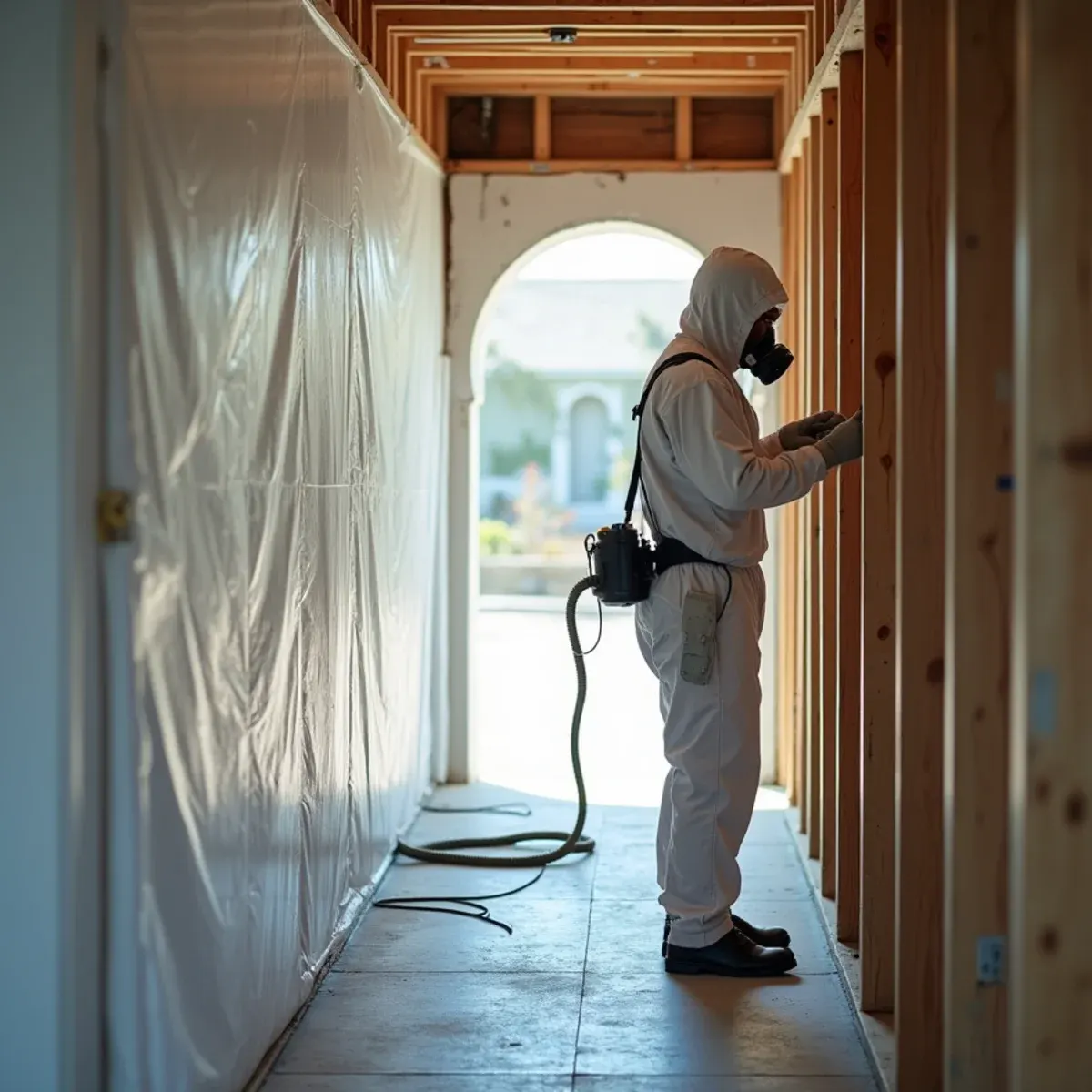
The method is the same one we use on every mold remediation job, documented to the IICRC S500:2025 standard. Here it is in short — the full mold remediation & removal process explains each stage in detail.
- Inspection and moisture source identification
- Testing where it is warranted
- Containment and negative pressure
- Removal of contaminated material
- HEPA cleaning and antimicrobial application
- Verification before containment comes down
The La Habra Background Worth Knowing
Copper is good pipe. What it is not is immortal, and the way it went in during this era shortened its life. Soft copper tubing was laid in the sand under the slab before the pour, sometimes in direct contact with aggregate, often with tight bends that thinned the wall on the outside of the curve. Add fifty to seventy years of water moving through the inside and soil chemistry working on the outside, and it develops pinholes. The hot line almost always goes first, because heat accelerates every part of that process.
There is more on the housing stock, drainage and plumbing history of this city on our water damage restoration in La Habra page.
La Habra at a glance
- Dominant construction era
- 1950–1980
- Foundation type
- slab on grade
- Supply piping found here
- under-slab copper, galvanized steel
- Drain line materials
- cast iron
- Terrain and water table
- rolling, moderate water table
- Most common local failure
- under-slab copper failures in 1960s tract housing, plus drainage that decades of added hardscape has redirected
- Highest-value local prevention
- watching where water actually runs during the first storm, because the ground here is not flat
What It Costs in La Habra
We do not quote a number over the phone before seeing the property — anyone who does is guessing. The variables that actually move the price on a mold remediation job are square footage of affected material, where it is, containment complexity, and they are broken down in full on the mold remediation & removal page. The assessment and the written estimate are free anywhere in La Habra, day or night, with no obligation.
Mold Remediation Questions from La Habra Homeowners
Possibly, but on this terrain check the outside first. If that corner is the downhill side of the lot, or if a patio or planter was added at some point that raised soil against the wall, moisture is likely entering the assembly from grade rather than a pipe. A plumber can rule out a slab leak with a meter test in an afternoon. If that comes back clean, we look at what has been built up outside that corner over the last few decades.
On a hard, non-porous surface like tile or glass, bleach handles surface growth. On drywall, wood, or anything porous it does not — the water content soaks in and can feed further growth while the chlorine stays on the surface. Porous material with real growth needs to be removed, not treated.
Usually not for visible growth with an obvious cause — you can see the problem and the work would be identical regardless of species. Testing is worthwhile when there is odor but nothing visible, when you need documentation for a claim or dispute, or when you want independent verification that the job was done right.
Do a meter test. Shut off every fixture and the irrigation, note the leak indicator, and check it again a few hours later with nobody using water. If it moved, something is losing water. In 1960s La Habra tract homes that is most often the hot line under the slab, and the giveaway is a warm patch of floor or the sound of water running behind a closed system.