
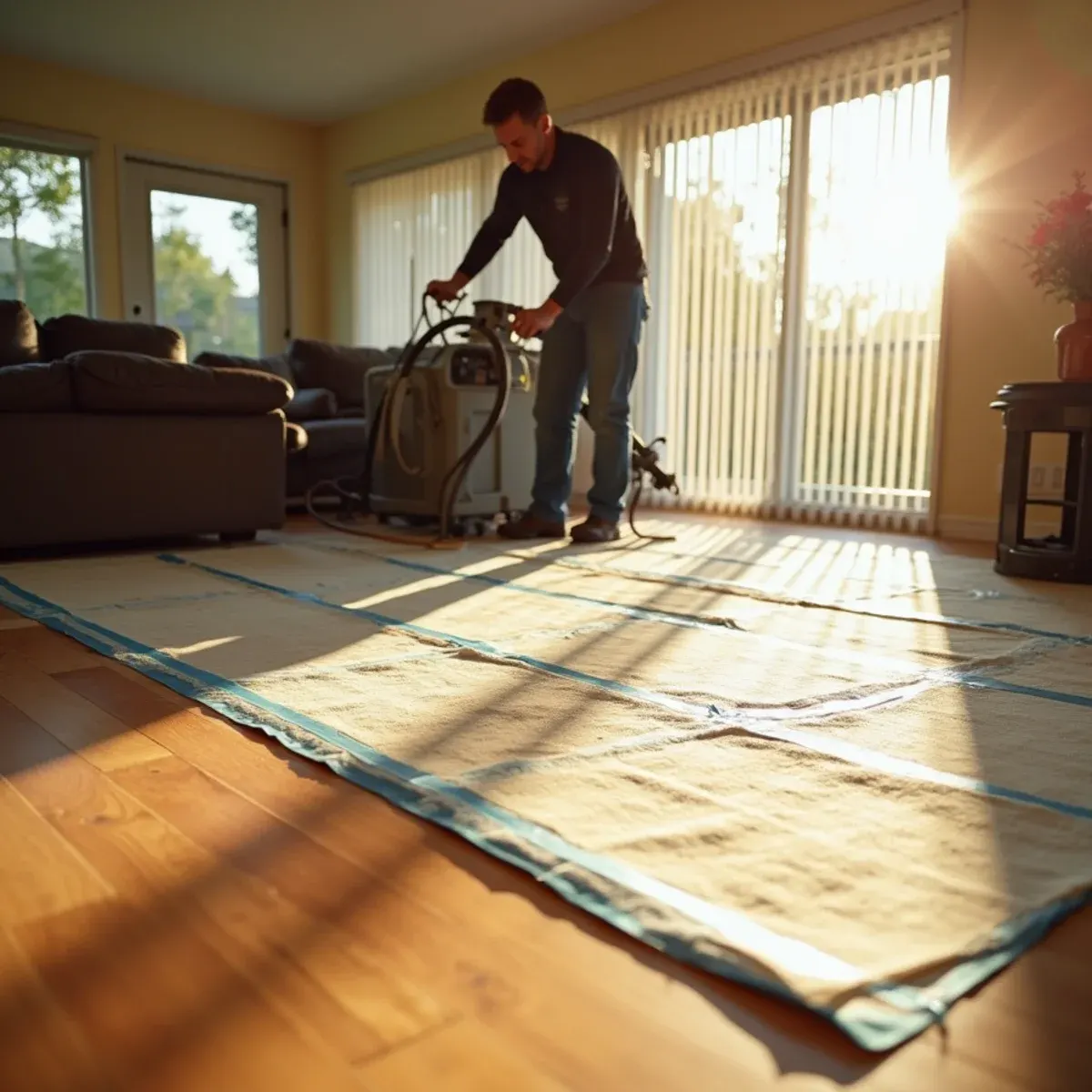
Most restoration companies will not work on a manufactured home. We do, and Stanton has more of them than anywhere else we serve, so it is worth being straight about what happens to a floor in one. The covering is usually laminate or thin engineered plank sitting on particleboard decking, and under that decking is a belly wrap, a sealed membrane that holds the insulation in and holds water in with it. Moisture down there has nowhere to evaporate to. We have opened wraps still holding water months after the original leak.
So the sequence runs backwards from a normal floor. We open the belly wrap, drain it, and dry the cavity from underneath before we ever think about the surface. Particleboard that has swollen does not recover, it loses its bond and stays soft, and laminate over it opens at the core for the same reason. What we can often save is the framing and the insulation cavity, which is what keeps the home habitable. In Stanton's older apartments and on the single-family blocks near Harry M. Dotson Park there is genuine solid wood, and that is a much better story.
What Stanton Changes About Hardwood Floor Drying
1The belly wrap has to be opened
Under a manufactured home's floor decking sits a sealed membrane holding the insulation in place. Water that reaches it stays there, and we have opened wraps still holding moisture months after the original leak. Drying the surface while that cavity is full accomplishes nothing at all. We cut, drain and dry from underneath first, then deal with the floor covering above it.
2Particleboard decking does not recover
The decking in most manufactured homes is particleboard, and swelling breaks the bond that gives it strength. It stays soft and it stays that way. Laminate or thin engineered plank on top opens at the core for the same reason. What we can usually save is the framing and the insulation cavity, and that is the part that keeps the home livable while repairs happen.
3Older Stanton apartments are a different problem
This is not only a manufactured-home city. The blocks near Harry M. Dotson Park and the older apartment stock include real solid wood over slab and over wood framing, and those respond well to mat drying. Which building you are in changes the whole prognosis, so we identify the floor assembly before committing to a plan or a timeline.
How the Work Runs
The method is the same one we use on every hardwood floor drying job, documented to the IICRC S500:2025 standard. Here it is in short — the full hardwood floor water damage drying process explains each stage in detail.
- Measure before deciding anything
- Extract from below the surface
- Control the drying rate deliberately
- Dry the subfloor and any cavity below
- Let it acclimate before judging it
- Sand and refinish only if needed
The Stanton Background Worth Knowing
Mobile and manufactured homes need a genuinely different restoration approach, and the reason is what they are built from. The floor system is typically particleboard or OSB over a wood frame with insulation and a vapor barrier belly wrap underneath — and particleboard exposed to water swells, loses structural integrity, and does not recover. It cannot be dried back to serviceable the way plywood often can.
There is more on the housing stock, drainage and plumbing history of this city on our water damage restoration in Stanton page.
Stanton at a glance
- Dominant construction era
- 1950–1975
- Foundation type
- mixed on grade
- Supply piping found here
- galvanized steel, copper, manufactured-home PEX and poly
- Drain line materials
- cast iron
- Terrain and water table
- flat, moderate water table
- Most common local failure
- underfloor leaks in manufactured homes, sealed inside the belly wrap where they cannot evaporate
- Highest-value local prevention
- checking for soft spots underfoot, because a manufactured-home floor gives no other warning
What It Costs in Stanton
We do not quote a number over the phone before seeing the property — anyone who does is guessing. The variables that actually move the price on a hardwood floor drying job are square footage under the mat system, solid versus engineered wood, what is underneath, and they are broken down in full on the hardwood floor water damage drying page. The assessment and the written estimate are free anywhere in Stanton, day or night, with no obligation.
Hardwood Floor Drying Questions from Stanton Homeowners
Yes, and sooner rather than later. A spongy floor is often the only warning a manufactured home gives, because the water is sealed inside the belly wrap where it cannot evaporate or show itself. By the time you feel it underfoot, the decking has usually been wet for a while. A meter reading takes minutes and tells you whether you are dealing with moisture or just an old soft spot.
Frequently, yes. Cupping is caused by uneven moisture between the top and bottom of each board, and when the moisture equalizes during controlled drying, much of the deformation reverses. Full flattening can take two to four weeks of acclimation after the equipment comes out, which is why we do not recommend sanding immediately.
Five to ten days under the mat system is typical, which is longer than drywall because wood gives up moisture slowly and has to be dried at a controlled rate. Rushing it causes splitting and permanent gapping, so the extra days are doing real work.
Yes, and we say so explicitly because a lot of companies will not. Manufactured homes need a different approach — opening the belly wrap to dry the floor cavity, removing saturated insulation, and honestly assessing particleboard decking, which usually cannot be dried back to serviceable.