
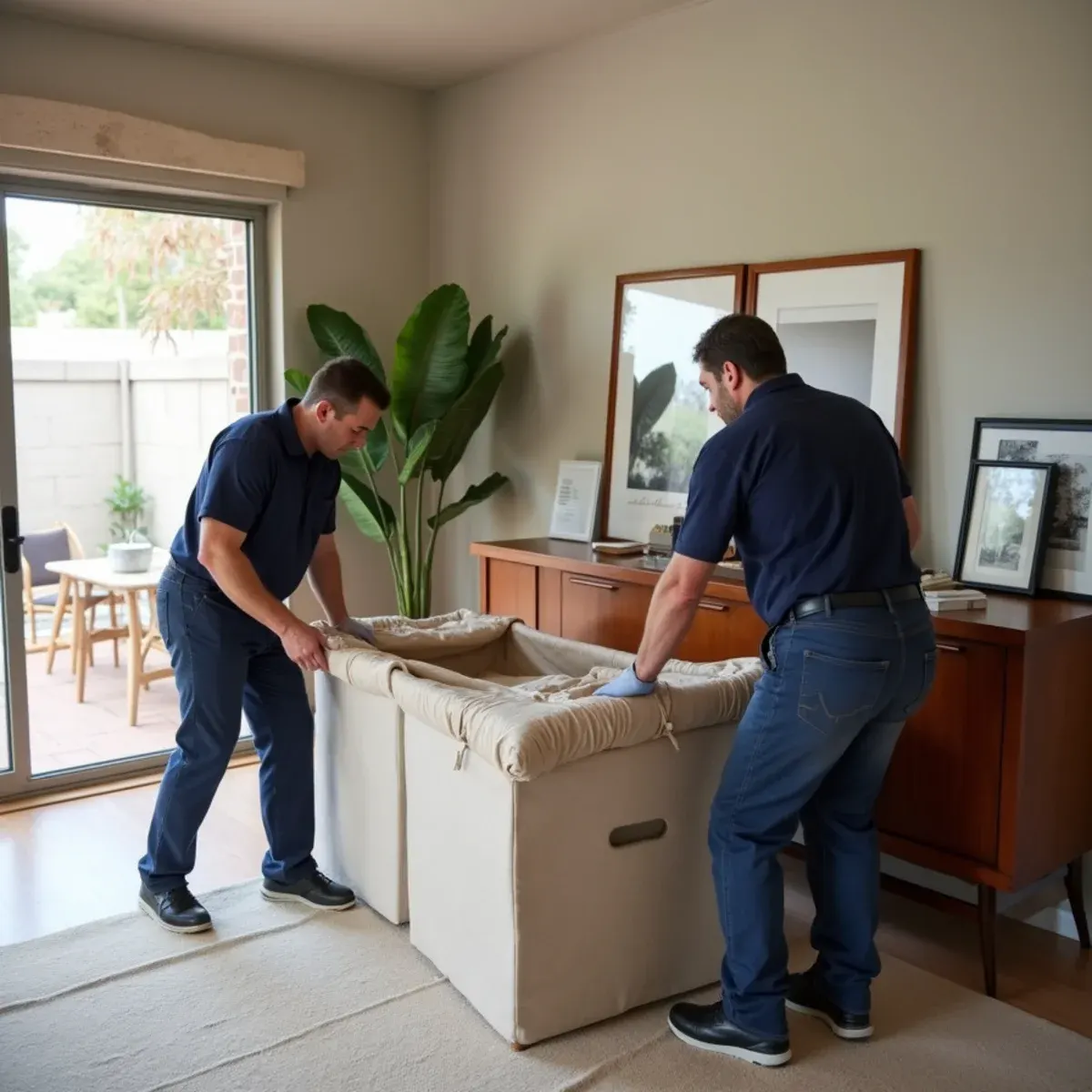
Most restoration companies will not work on a manufactured home. We do, and Stanton has one of the largest manufactured-home populations in this part of the county, so we have spent a lot of hours in them. The relevant fact for contents is simple: there is no room. A single-wide has nowhere to stack furniture in a dry corner while equipment runs, and the aisle widths will not take a loaded dolly. Pack-out is not an upgrade to the job here. It is how the job gets done at all.
The failure that brings us out is usually underfloor — a supply line leaking into the belly wrap beneath the particleboard decking, where it cannot evaporate and can sit for months. By the time the floor feels soft underfoot, the cabinets have been standing in a humid box for a long time and everything stored at floor level has taken it on. Stanton's older apartment stock off Beach Boulevard has its own version of this, with cast-iron waste lines backing up into ground-floor units.
What Stanton Changes About Contents & Pack-Out
1Nowhere to stage inside a single-wide
In a manufactured home, every square foot of floor is either walkway or furniture. Contents have to leave the building before we can open the decking or set a dehumidifier anywhere it will do something. We inventory on the porch or in the truck under cover, box tightly, and empty the unit in one pass instead of shuffling items from room to room.
2Particleboard decking ruins what sits on it
Manufactured-home floors are particleboard over a sealed belly wrap. Once wet, that decking swells, crumbles and stays damp, and anything resting on it — the bottom of a dresser, a bed frame, boxes in a closet — wicks from underneath rather than from above. We check the underside of furniture legs and case pieces first, because that is where the damage starts.
3Park rules and lane width shape the plan
Working in a mobile home park means narrow lanes, limited parking and neighbors a few feet away. We size the truck to the lane, keep the carry short, and clear equipment placement with park management before anything goes in. Contents go to climate-controlled storage rather than a pod on the pad, because there is no pad to put one on.
How the Work Runs
The method is the same one we use on every contents & pack-out job, documented to the IICRC S500:2025 standard. Here it is in short — the full contents restoration & pack-out process explains each stage in detail.
- Room-by-room photographic inventory
- Triage into three categories
- Careful packing and transport
- Cleaning and restoration by material type
- Climate-controlled storage
- Delivery and placement back
The Stanton Background Worth Knowing
Mobile and manufactured homes need a genuinely different restoration approach, and the reason is what they are built from. The floor system is typically particleboard or OSB over a wood frame with insulation and a vapor barrier belly wrap underneath — and particleboard exposed to water swells, loses structural integrity, and does not recover. It cannot be dried back to serviceable the way plywood often can.
There is more on the housing stock, drainage and plumbing history of this city on our water damage restoration in Stanton page.
Stanton at a glance
- Dominant construction era
- 1950–1975
- Foundation type
- mixed on grade
- Supply piping found here
- galvanized steel, copper, manufactured-home PEX and poly
- Drain line materials
- cast iron
- Terrain and water table
- flat, moderate water table
- Most common local failure
- underfloor leaks in manufactured homes, sealed inside the belly wrap where they cannot evaporate
- Highest-value local prevention
- checking for soft spots underfoot, because a manufactured-home floor gives no other warning
What It Costs in Stanton
We do not quote a number over the phone before seeing the property — anyone who does is guessing. The variables that actually move the price on a contents & pack-out job are volume of contents, proportion of specialty items, storage duration, and they are broken down in full on the contents restoration & pack-out page. The assessment and the written estimate are free anywhere in Stanton, day or night, with no obligation.
Contents & Pack-Out Questions from Stanton Homeowners
Often yes, and often more than the floor is. A slow belly-wrap leak keeps humidity high without ever visibly flooding, so dishes, tools, hard goods and solid furniture usually clean up fine while paper, cardboard, upholstery and anything with a fabric backing take the hit. The honest answer needs a meter and hands on the items. We triage into three piles — salvageable, restorable, gone — and you see the list before anything is discarded.
It depends on the scope. For a contained single-room loss we often move contents to an unaffected part of the home and block furniture in place. When the drying chamber covers most of the living area or reconstruction is extensive, off-site pack-out is usually both safer and faster.
Every item is photographed and barcoded at your home and tracked through cleaning, storage, and delivery. You receive the inventory, and at delivery we reconcile it with you item by item before we leave.
Yes, and we say so explicitly because a lot of companies will not. Manufactured homes need a different approach — opening the belly wrap to dry the floor cavity, removing saturated insulation, and honestly assessing particleboard decking, which usually cannot be dried back to serviceable.