
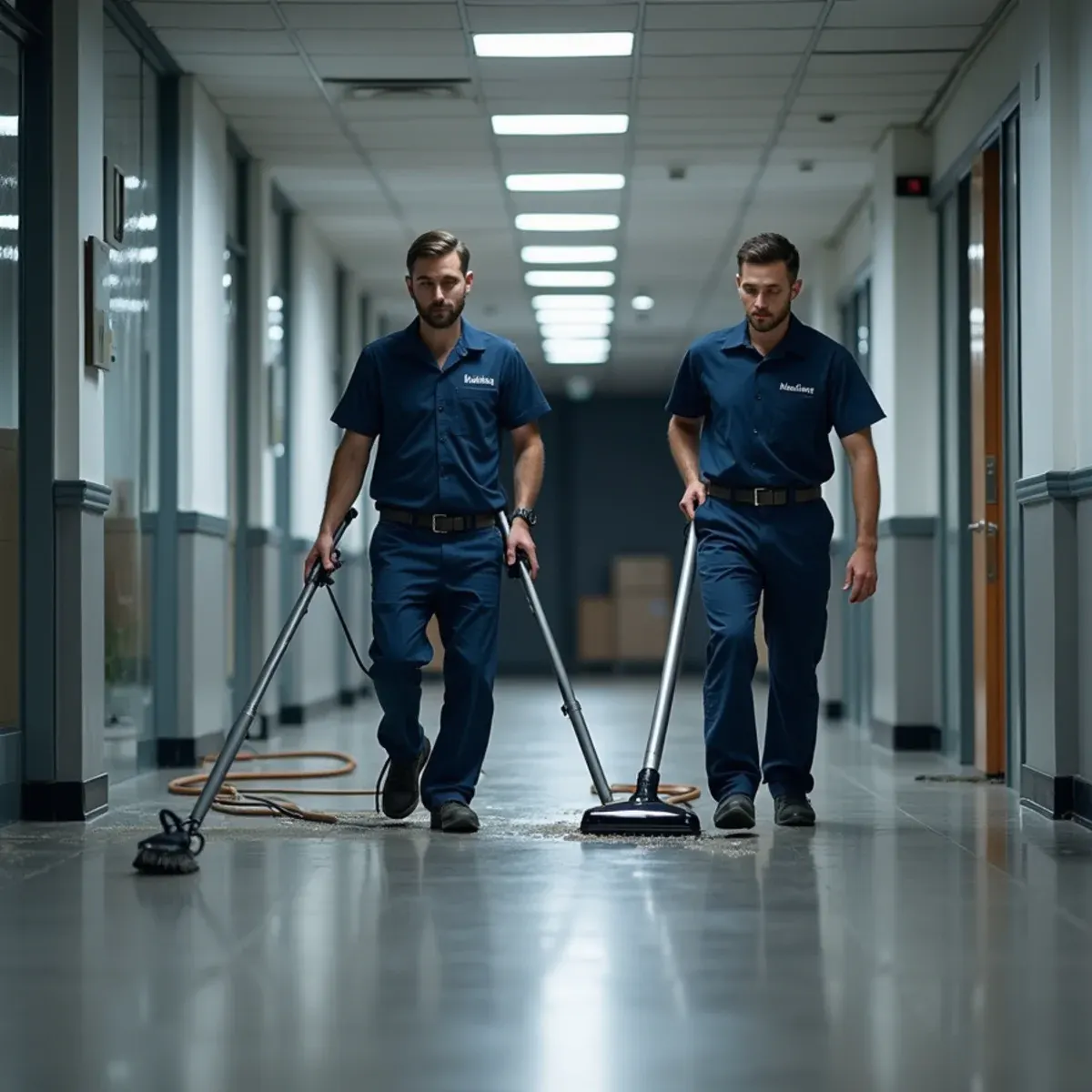
Santa Fe Springs is a working industrial city with an oil-field history and a warehouse, manufacturing and distribution base that dwarfs its residential footprint. The buildings along Telegraph Road and the Norwalk Boulevard district are big open floor plates, fire sprinkler systems overhead, dock doors at one end and tenant improvement offices tucked in a corner. Almost all of our work here is commercial, and it looks nothing like drying a kitchen. There are no interior walls to slow water down and no residential-scale equipment that would make a dent in the volume.
The failure that defines this city is sprinkler discharge. A single head puts out enough water per minute that a few minutes of run time covers an enormous area, and the water is not clean, it has been sitting in a black steel pipe for years. Commercial supply and process line failures do the same thing at a different rate. The damage is rarely the concrete. It is the corrugated, the pallets, the paper and the product sitting on the bottom rack, wicking upward while everyone is trying to find the riser.
What Santa Fe Springs Changes About Commercial Restoration
1Sprinkler discharge is volume, not depth
An inch across sixty thousand square feet is thousands of gallons and it moves to the low corner of the slab fast. Truck-mounted extraction and squeegee crews come first, then dehumidification sized to the cubic volume of a high-bay space, not the floor area. Sprinkler water is also not potable water. It carries pipe scale and corrosion, which affects what porous product can be salvaged.
2Racked product wicks from the bottom up
Corrugated draws water vertically through a stack, so the pallet that looks fine on top may be compromised three layers down. We de-stack the affected bays, separate salvageable from unsalvageable with the adjuster present where possible, and photograph by rack location and SKU. Inventory documentation is usually the largest number in a warehouse claim and the one that gets disputed.
3Access details on file beat any response time
At two in the morning the delay is almost never the drive from Cypress. It is a locked gate, an unlisted after-hours contact, an alarm nobody can silence, or nobody knowing where the riser and PIV are. We keep that information on file for the industrial clients we work with, and we will walk your building once to build it. It is free and it saves more time than any promise we could make.
How the Work Runs
The method is the same one we use on every commercial restoration job, documented to the IICRC S500:2025 standard. Here it is in short — the full commercial water damage restoration process explains each stage in detail.
- Rapid assessment with a business continuity lens
- Coordinate with stakeholders
- After-hours mobilization
- Documentation at commercial standard
- Scaled drying and containment
- Phased reconstruction
The Santa Fe Springs Background Worth Knowing
The water sitting in a wet-pipe sprinkler system has been there for years. It is stagnant, it has been in contact with black steel and scale that whole time, and some systems carry corrosion inhibitors or antifreeze as well. When a head discharges, that is what lands on your floor and soaks into your product. Under IICRC S500:2025 water gets categorized on the evidence in front of us, and sprinkler discharge that has run across a warehouse floor almost never stays in Category 1. That decision drives what we dry in place, what comes out, and how the crew works.
There is more on the housing stock, drainage and plumbing history of this city on our water damage restoration in Santa Fe Springs page.
Santa Fe Springs at a glance
- Dominant construction era
- 1950–1975
- Foundation type
- slab on grade
- Supply piping found here
- galvanized steel, copper, commercial-grade systems
- Drain line materials
- cast iron, commercial waste lines
- Terrain and water table
- flat, moderate water table
- Most common local failure
- fire-sprinkler discharge and commercial supply failures across large open-plan warehouse and manufacturing floors
- Highest-value local prevention
- keeping current building access and shutoff information on file before an after-hours failure
What It Costs in Santa Fe Springs
We do not quote a number over the phone before seeing the property — anyone who does is guessing. The variables that actually move the price on a commercial restoration job are square footage and ceiling height, occupancy and access constraints, building systems involved, and they are broken down in full on the commercial water damage restoration page. The assessment and the written estimate are free anywhere in Santa Fe Springs, day or night, with no obligation.
Commercial Restoration Questions from Santa Fe Springs Homeowners
No, usually just the affected bays and enough surrounding aisle to work safely. We map the discharge pattern and the water travel across the slab first, then de-stack only where readings and the flow path say product was exposed. Pallets get separated and staged for the adjuster rather than dumped. The parts of the building the water never reached keep operating behind containment, which is normally most of the floor.
Yes, and for most commercial clients that is the default. Night and weekend crews cost somewhat more in labor and almost always cost far less than the revenue lost by closing during business hours.
Regularly. Multi-family losses are documented unit by unit with separate files, moisture mapping, and drying logs, which is what allows multiple owners, an HOA, and several carriers to resolve their portions cleanly.
No. Water that has sat in a wet-pipe system for years picks up scale, rust and whatever inhibitors are in the system, and once it runs across a warehouse floor it collects everything on that floor too. We categorize on the evidence per IICRC S500:2025, and sprinkler discharge almost always lands past Category 1. That affects what gets dried in place, what gets removed, and what protective equipment the crew works in.