
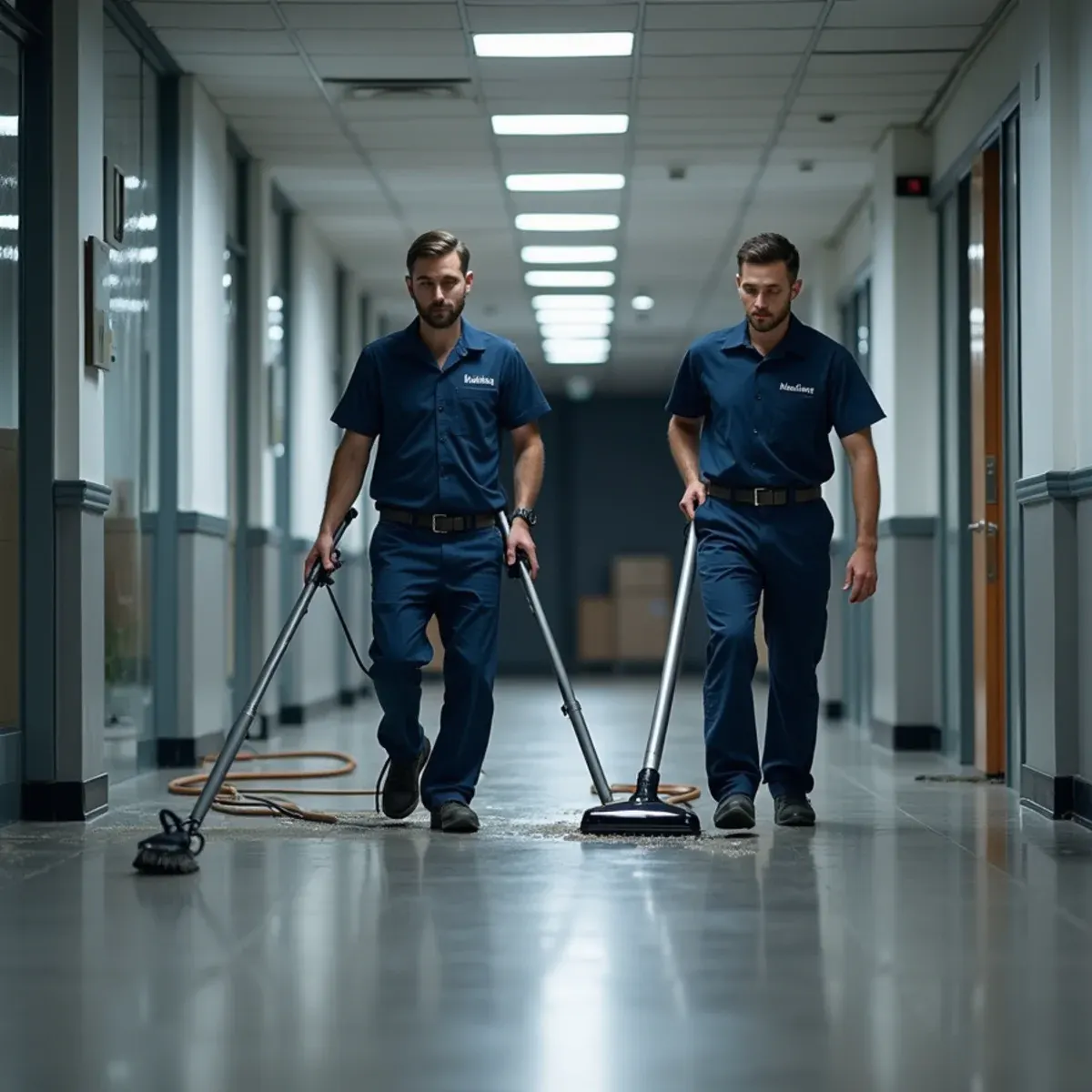
Unlike almost everywhere else we work, La Mirada is not flat. It was developed as a planned community across a concentrated twelve-year window on gently rolling ground, and storm water here moves across properties rather than ponding on them. That is normally an advantage. The exception, and it is the source of most exterior-water commercial losses in this city, is where five decades of added patios, raised planters, retaining walls and settled hardscape have quietly redirected the original drainage back toward a building.
Institutional property is a significant share of the picture. Biola University's campus buildings, the surrounding student housing, La Mirada Theatre and the civic buildings near La Mirada Regional Park all sit on this same terrain, and they all have decades of added paving and landscaping around them. When water gets in at grade during a storm, the drying is the easy part. Finding the path so it does not happen again next season is where the value is, and it usually means walking the site while it is still raining.
What La Mirada Changes About Commercial Restoration
1Added hardscape reverses original drainage
The grading these properties were built with worked. What changed is everything added since: raised planters holding soil against a wall, a patio poured with fall toward the building, a retaining wall with no drain behind it. We trace entry points during or immediately after the event, photograph the grade, and give you a specific correction rather than a general recommendation to improve drainage.
2Campus and institutional scheduling
Buildings around Biola run on academic calendars and event schedules, and closing a lecture hall or performance space mid-term is not an option. We work nights and between sessions, contain so adjacent rooms stay in use, and phase reconstruction around the term. Breaks are when the disruptive work gets done, and we plan the sequence toward those windows deliberately.
3Slab drying in a consistent 1950s stock
La Mirada's commercial and residential stock went up in a tight window on slab, so the construction is consistent and the diagnosis is quick. Under-slab copper and cast iron waste of that generation fail in familiar ways. We test the slab in-situ before any flooring is replaced, because a slab that reads dry at the surface after a storm intrusion is frequently still holding water at depth.
How the Work Runs
The method is the same one we use on every commercial restoration job, documented to the IICRC S500:2025 standard. Here it is in short — the full commercial water damage restoration process explains each stage in detail.
- Rapid assessment with a business continuity lens
- Coordinate with stakeholders
- After-hours mobilization
- Documentation at commercial standard
- Scaled drying and containment
- Phased reconstruction
The La Mirada Background Worth Knowing
La Mirada's gentle slopes mean storm water moves across properties instead of sitting on them, which is generally an advantage — except where fifty years of added patios, raised planters, retaining walls, and settled hardscape have redirected it.
There is more on the housing stock, drainage and plumbing history of this city on our water damage restoration in La Mirada page.
La Mirada at a glance
- Dominant construction era
- 1953–1965
- Foundation type
- slab on grade
- Supply piping found here
- under-slab copper, galvanized steel
- Drain line materials
- cast iron
- Terrain and water table
- rolling, moderate water table
- Most common local failure
- exterior water entering where fifty years of added patios, planters and retaining walls redirected the original drainage back toward the house
- Highest-value local prevention
- walking the property during the first real rain and watching where water actually goes
What It Costs in La Mirada
We do not quote a number over the phone before seeing the property — anyone who does is guessing. The variables that actually move the price on a commercial restoration job are square footage and ceiling height, occupancy and access constraints, building systems involved, and they are broken down in full on the commercial water damage restoration page. The assessment and the written estimate are free anywhere in La Mirada, day or night, with no obligation.
Commercial Restoration Questions from La Mirada Homeowners
Almost always the ground outside, not the weather. On this rolling terrain, water is supposed to move past the building, and something added or settled has turned it back. Common culprits are a planter bed raised above the slab edge, a patio poured with the wrong fall, or a retaining wall without a functioning drain. We walk the site during the next real rain and watch where the water actually goes, which is far more reliable than reading the grade on a dry day.
Yes, and for most commercial clients that is the default. Night and weekend crews cost somewhat more in labor and almost always cost far less than the revenue lost by closing during business hours.
Regularly. Multi-family losses are documented unit by unit with separate files, moisture mapping, and drying logs, which is what allows multiple owners, an HOA, and several carriers to resolve their portions cleanly.
Almost always exterior drainage rather than a plumbing leak — a plugged area drain, a patio that has settled toward the house, or a planter holding moisture against the wall. We identify the actual path rather than just drying the wall, because drying without fixing the cause means doing it again next storm.