
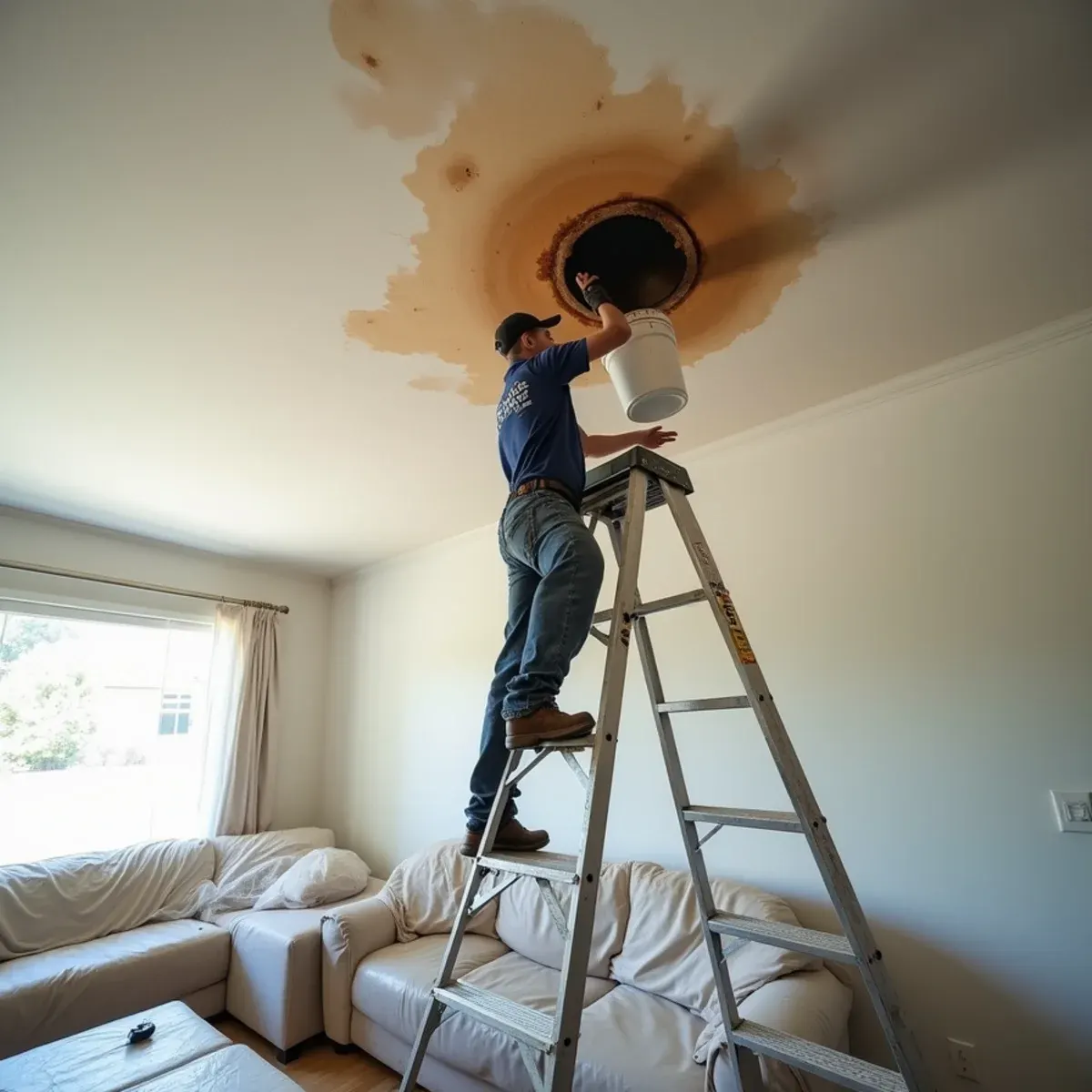
A good share of our ceiling calls in La Habra come from the multi-family along Whittier Boulevard and the other corridors, and the first job there is not drying. It is establishing whose water it is. A stain on a ground-floor ceiling in a two-story fourplex is a plumbing question about the unit above. A stain on a top-floor ceiling is a roof question. Those get investigated differently, documented differently and paid for differently, and the tenant who called us is usually not the person who can authorize the work. We sort that out fast, because the water does not wait.
The single-family side is more predictable. La Habra built out mostly between 1950 and 1980 on gently rolling ground at the head of the Coyote Creek watershed, the same creek that runs past our Cypress base. Low-pitch gable roofs, truss attics, and blown insulation that got added during a 1970s energy retrofit and packed hard into the eaves. That insulation matters after a leak. It buries the soffit vents, so the attic has almost no natural airflow working with us, and it stays damp long after the roof is repaired.
What La Habra Changes About Ceiling & Roof Leaks
1Whose water is it in a fourplex
Corridor multi-family here is largely two-story, and top-floor units get roof water while lower units get the neighbor's supply line or shower pan. We determine which before opening anything, document it for both the property owner's carrier and the resident's contents coverage, and keep the tenant informed. Getting that wrong means drying the right ceiling for the wrong reason while the actual source keeps running.
2Retrofit insulation buries the soffit vents
Blown insulation added to these 1960s and 1970s tract attics was rarely baffled at the eaves. It sits packed against the roof sheathing, blocking the soffit vents that would otherwise help an attic dry itself. After a roof leak that means slower drying, damp sheathing at the perimeter, and a real risk of growth if nobody intervenes. We remove the wet portion and flag the blocked vents in writing.
3Limbs riding on 1960s composition roofs
The mature canopy through Vista Grande and the Idaho Street area is close enough to the roofs that limbs rest on them. Branch movement scours granules off composition shingle, and shade keeps north slopes damp enough for moss. Both shorten the roof's life in patches rather than evenly, so La Habra ceiling leaks often start under one specific tree rather than from general age.
How the Work Runs
The method is the same one we use on every ceiling & roof leaks job, documented to the IICRC S500:2025 standard. Here it is in short — the full ceiling & roof leak water damage process explains each stage in detail.
- Emergency tarping or temporary dry-in
- Controlled relief of trapped water
- Trace the intrusion to its real source
- Remove wet insulation and compromised drywall
- Dry the attic and the ceiling assembly
- Restore the ceiling completely
The La Habra Background Worth Knowing
Copper is good pipe. What it is not is immortal, and the way it went in during this era shortened its life. Soft copper tubing was laid in the sand under the slab before the pour, sometimes in direct contact with aggregate, often with tight bends that thinned the wall on the outside of the curve. Add fifty to seventy years of water moving through the inside and soil chemistry working on the outside, and it develops pinholes. The hot line almost always goes first, because heat accelerates every part of that process.
There is more on the housing stock, drainage and plumbing history of this city on our water damage restoration in La Habra page.
La Habra at a glance
- Dominant construction era
- 1950–1980
- Foundation type
- slab on grade
- Supply piping found here
- under-slab copper, galvanized steel
- Drain line materials
- cast iron
- Terrain and water table
- rolling, moderate water table
- Most common local failure
- under-slab copper failures in 1960s tract housing, plus drainage that decades of added hardscape has redirected
- Highest-value local prevention
- watching where water actually runs during the first storm, because the ground here is not flat
What It Costs in La Habra
We do not quote a number over the phone before seeing the property — anyone who does is guessing. The variables that actually move the price on a ceiling & roof leaks job are how long the leak has been active, ceiling texture and finish, attic access and insulation type, and they are broken down in full on the ceiling & roof leak water damage page. The assessment and the written estimate are free anywhere in La Habra, day or night, with no obligation.
Ceiling & Roof Leaks Questions from La Habra Homeowners
We can come out and we can protect the property, which usually means emergency tarping and getting standing water off ceilings and floors before it spreads. What we cannot do is start a full restoration and bill an owner who has not agreed to it. In practice we stabilize, document everything with photos and moisture readings, and give you and the owner the same report. Most La Habra property owners authorize the work quickly once they see the readings.
Clear the room and keep everyone out from underneath it, including pets. Move furniture if you can do it from the side. Put a bucket down if you can place it safely without standing under the bulge. Then call us — we relieve it deliberately, which is safer and preserves much more of the ceiling than letting it fail on its own.
We tarp immediately to stop the intrusion and coordinate the roofing repair with a licensed roofer, then handle all the interior restoration ourselves. You get one point of contact and one schedule instead of managing two trades during a storm week.
Do a meter test. Shut off every fixture and the irrigation, note the leak indicator, and check it again a few hours later with nobody using water. If it moved, something is losing water. In 1960s La Habra tract homes that is most often the hot line under the slab, and the giveaway is a warm patch of floor or the sound of water running behind a closed system.