
Original clay tile is not a walking surface, and Uptown Whittier has a great deal of it. The 1920s Spanish Revival houses around Greenleaf Avenue and Philadelphia Street wear barrel tile that has been up there a century. It is brittle, the fasteners are corroded, and a careless step costs a piece nobody stocks in a matching profile or color. So we work these roofs from ladders and foam pads at load points, and we do most of the diagnosis from inside the attic looking up for daylight and wet sheathing rather than from the top down.
Uptown's Victorians and Craftsman are raised-foundation houses with rafter attics, deep porches and plaster ceilings, and the porch roof-to-wall tie-in is among the most common entries we find in this city. College Hills, subdivided in 1923 as Whittier's first planned hillside development, adds grade to everything: curving streets, short steep driveways, and roofs you approach from above rather than beside. East Whittier out toward the postwar tracts behaves like conventional slab-and-truss housing and needs none of this care.
What Whittier Changes About Ceiling & Roof Leaks
1Century-old barrel tile breaks underfoot
Matching original clay tile in Uptown is difficult and sometimes impossible, so every unnecessary step is real damage. We spread load with pads at rafter locations, keep crew traffic to a single planned path, and prefer attic-side tracing. When emergency tarping is needed on tile, we bridge rather than fasten through the field, which holds well enough to get through a storm without adding breakage.
2Porch roof tie-ins on Uptown Craftsman
The deep porches that define these houses tie a low-slope roof into a tall wall, and the flashing at that junction has usually been painted over, patched and re-roofed around several times. Water enters there and runs into the main ceiling framing, so the stain appears well inside the house. We check that junction before anything else on a Craftsman or Victorian in Uptown.
3Hillside access in College Hills
The 1923 street layout gives us curving roads, steep short driveways and houses set above or below grade. Getting a ladder to the right elevation safely takes planning, and in bad weather it sometimes takes waiting. We stage from the uphill side where the geometry allows and are straightforward about which roof faces can be worked in current conditions and which have to wait for daylight or calmer wind.
How the Work Runs
The method is the same one we use on every ceiling & roof leaks job, documented to the IICRC S500:2025 standard. Here it is in short — the full ceiling & roof leak water damage process explains each stage in detail.
- Emergency tarping or temporary dry-in
- Controlled relief of trapped water
- Trace the intrusion to its real source
- Remove wet insulation and compromised drywall
- Dry the attic and the ceiling assembly
- Restore the ceiling completely
The Whittier Background Worth Knowing
A leak under a raised foundation does not announce itself the way a slab leak does. There is no puddle on the floor and no warm spot underfoot, because the water drips down into the soil and stays there. What you get instead is a smell that is stronger in the morning, a board that feels slightly soft, and eventually a floor that has been quietly feeding fungal growth for months. By the time an Uptown homeowner calls us about a crawl space leak, the question is rarely how to dry it. It is how much of the joist and subfloor is still doing its job.
There is more on the housing stock, drainage and plumbing history of this city on our water damage restoration in Whittier page.
Whittier at a glance
- Dominant construction era
- 1890–1980
- Foundation type
- mixed on grade
- Supply piping found here
- original turn-of-century piping, galvanized steel, under-slab copper
- Drain line materials
- cast iron, clay
- Terrain and water table
- hillside-mixed, moderate water table
- Most common local failure
- raised-foundation crawl-space leaks in Uptown, and slope drainage failures in the hillside tracts
- Highest-value local prevention
- an annual crawl-space or slope-drain check, depending which Whittier you live in
What It Costs in Whittier
We do not quote a number over the phone before seeing the property — anyone who does is guessing. The variables that actually move the price on a ceiling & roof leaks job are how long the leak has been active, ceiling texture and finish, attic access and insulation type, and they are broken down in full on the ceiling & roof leak water damage page. The assessment and the written estimate are free anywhere in Whittier, day or night, with no obligation.
Ceiling & Roof Leaks Questions from Whittier Homeowners
Yes, with a method built for tile rather than composition. We bridge the affected area and secure the tarp with ballast and edge anchoring outside the tile field instead of driving fasteners through hundred-year-old clay. It is slower and it is not as tight as a tarp stapled to a shingle roof, so we set expectations for what it will hold in heavy wind. Where the geometry makes safe work impossible in the dark, we say so and protect the interior instead.
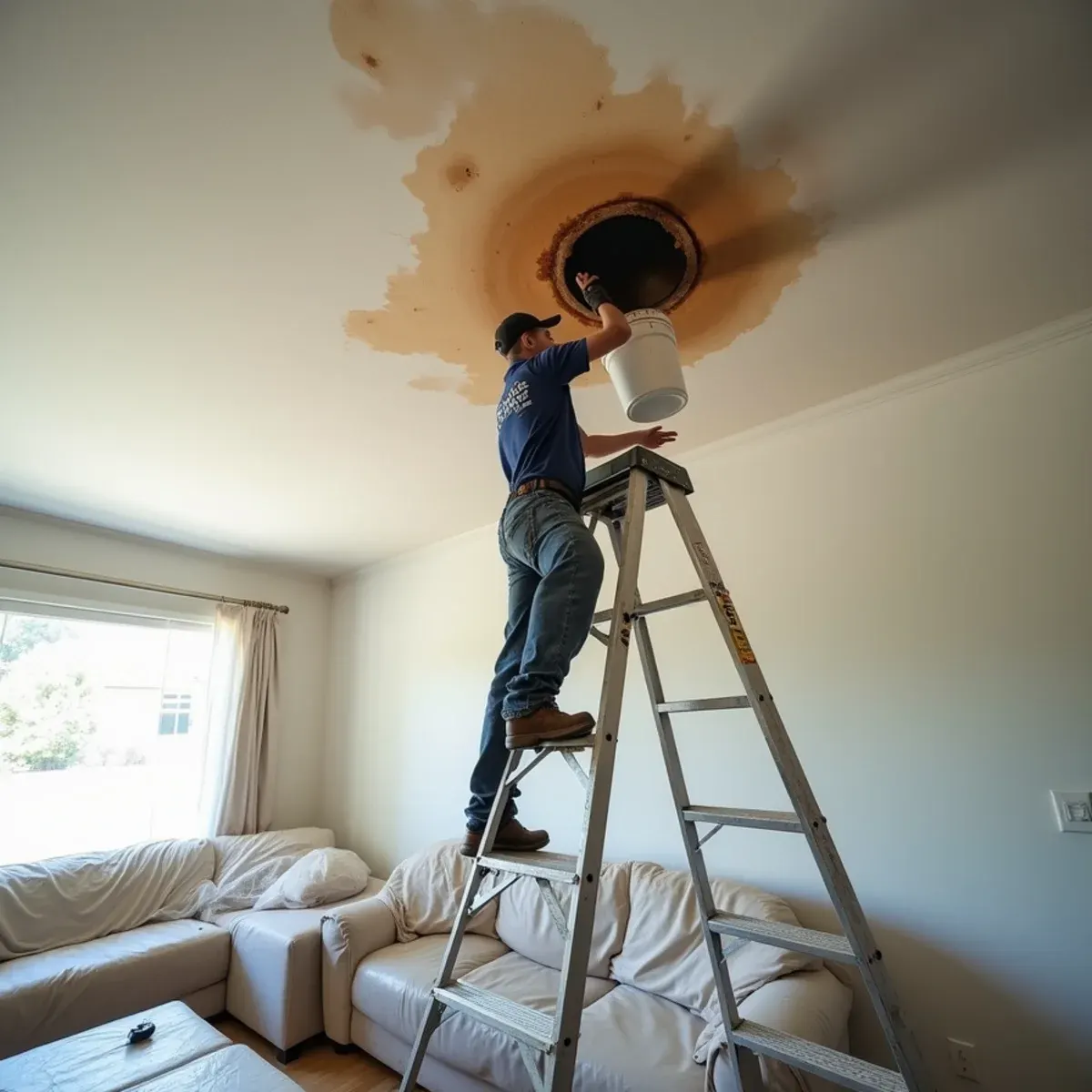
Clear the room and keep everyone out from underneath it, including pets. Move furniture if you can do it from the side. Put a bucket down if you can place it safely without standing under the bulge. Then call us — we relieve it deliberately, which is safer and preserves much more of the ceiling than letting it fail on its own.
We tarp immediately to stop the intrusion and coordinate the roofing repair with a licensed roofer, then handle all the interior restoration ourselves. You get one point of contact and one schedule instead of managing two trades during a storm week.
It cuts both ways. A crawl space leak hides longer, because the water drips into soil instead of pooling on your floor, so it often runs for months and reaches the framing before anyone notices. The upside is real though: the plumbing is accessible, so locating and repairing it does not mean breaking concrete. On balance, detection is your weak point in Uptown, which is why an annual look under the house is worth doing.