
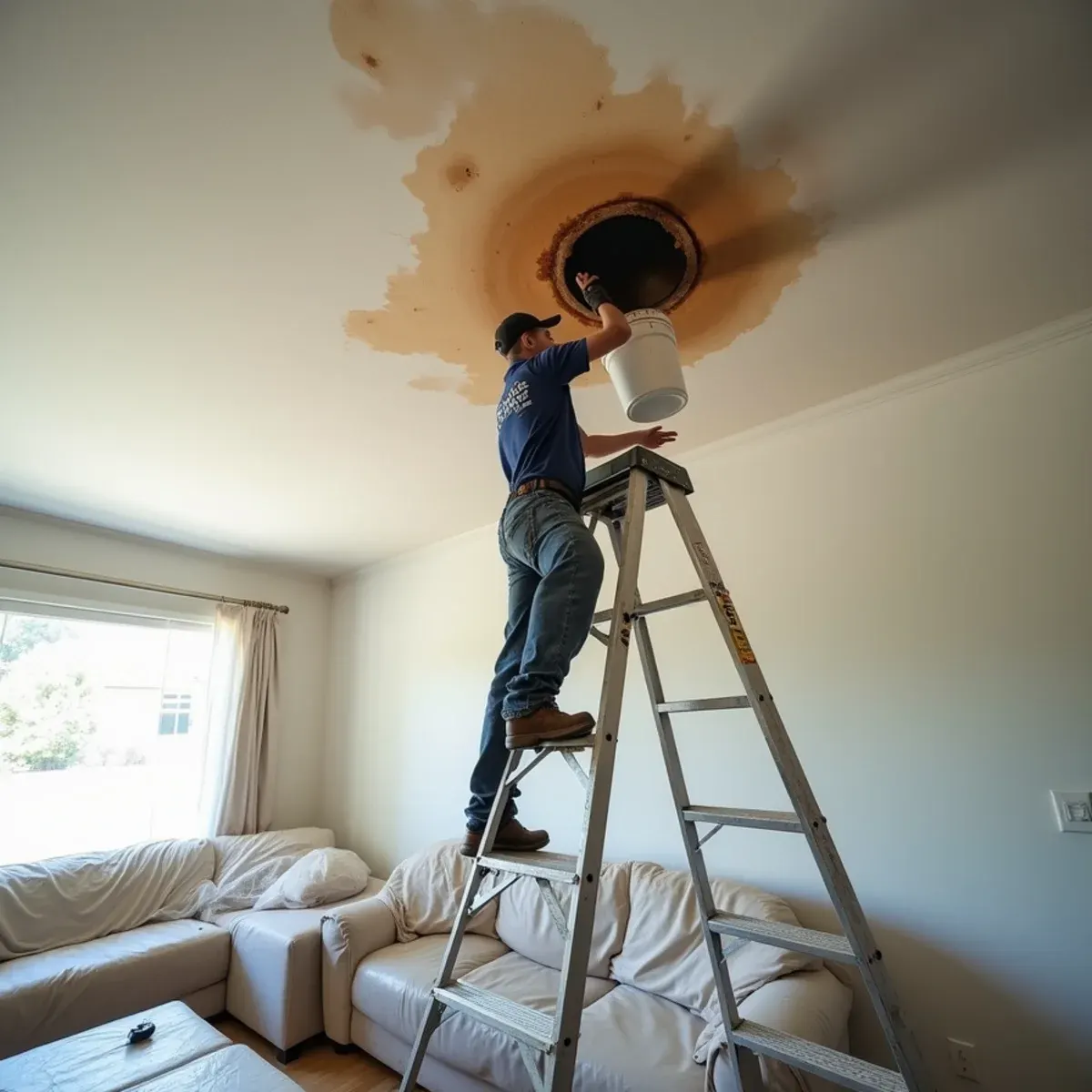
Nobody calls on day one in a student rental. The ceiling stains during the first storm week, someone puts a bucket under it, and the call finally comes when a bulge appears over a bed or the drip reaches a laptop. By then the insulation has been saturated for ten days and we are having a mold conversation instead of a drying conversation. Around Cal State Fullerton and Fullerton College this is the single biggest difference between a two-day job and a two-week one, and it has nothing to do with the roof and everything to do with who lives there and who owns it.
The older side of the city is a different problem worth taking seriously. The Craftsman and Spanish Revival homes near downtown and up toward Hillcrest Park were framed in old-growth Douglas fir with deep overhangs, exposed rafter tails and skip sheathing under whatever roofing has been added since. That framing is denser and more stable than anything sold today. It dries and stays straight if we get to it in time, and it is well worth the extra day of drying rather than cutting out and replacing with modern lumber that will move.
What Fullerton Changes About Ceiling & Roof Leaks
1Delayed reporting in rentals
A ceiling leak reported in hours is drywall and insulation. The same leak reported in two weeks is framing, microbial growth and a much larger claim. Under IICRC S500:2025 the condition of the water changes with time and contact, not just its source, so delay genuinely changes the scope. Post the emergency number and the shutoff location where tenants can see them.
2Deep eaves and exposed rafter tails
Craftsman overhangs shed water well and rot quietly. Water that gets past a failed gutter or a plugged valley runs out along the rafter tail, where it stays wet under the shade of the eave far longer than the rest of the roof. Interior staining near an exterior wall in these homes usually means checking the tails and the eave blocking, not just the field.
3Old-growth framing is worth drying
Pre-war Douglas fir has tight growth rings and behaves very differently from kiln-dried modern lumber. Given proper airflow and enough dehumidification, it comes back without cupping or twisting. We meter it to a documented standard and give it the time rather than defaulting to demolition, because once that framing is out of a 1920s house it cannot be matched.
How the Work Runs
The method is the same one we use on every ceiling & roof leaks job, documented to the IICRC S500:2025 standard. Here it is in short — the full ceiling & roof leak water damage process explains each stage in detail.
- Emergency tarping or temporary dry-in
- Controlled relief of trapped water
- Trace the intrusion to its real source
- Remove wet insulation and compromised drywall
- Dry the attic and the ceiling assembly
- Restore the ceiling completely
The Fullerton Background Worth Knowing
The pre-war homes around downtown Fullerton were built with materials that behave completely differently from modern construction. Lath and plaster walls hold several times the water drywall does. Old-growth Douglas fir framing is dense and dries slowly. Original oak and fir flooring is thick, high-quality material that is well worth saving.
There is more on the housing stock, drainage and plumbing history of this city on our water damage restoration in Fullerton page.
Fullerton at a glance
- Dominant construction era
- 1910–1980
- Foundation type
- mixed on grade
- Supply piping found here
- galvanized steel, copper, original pre-war piping
- Drain line materials
- cast iron, clay
- Terrain and water table
- rolling, moderate water table
- Most common local failure
- crawl-space leaks that run undetected for weeks because the water drips away instead of pooling on a floor
- Highest-value local prevention
- posting a shutoff location and emergency contact in every rental, since delayed reporting is the local failure mode
What It Costs in Fullerton
We do not quote a number over the phone before seeing the property — anyone who does is guessing. The variables that actually move the price on a ceiling & roof leaks job are how long the leak has been active, ceiling texture and finish, attic access and insulation type, and they are broken down in full on the ceiling & roof leak water damage page. The assessment and the written estimate are free anywhere in Fullerton, day or night, with no obligation.
Ceiling & Roof Leaks Questions from Fullerton Homeowners
Assume it is possible and have it inspected rather than assuming either way. Microbial growth generally becomes a real risk after roughly 24 to 48 hours of wet materials, and two weeks of saturated insulation in a warm attic is well past that. That does not automatically mean a large containment job. It means we inspect, meter, and look above the ceiling before scoping, so you find out what you are dealing with before you commit to a repair.
Clear the room and keep everyone out from underneath it, including pets. Move furniture if you can do it from the side. Put a bucket down if you can place it safely without standing under the bulge. Then call us — we relieve it deliberately, which is safer and preserves much more of the ceiling than letting it fail on its own.
We tarp immediately to stop the intrusion and coordinate the roofing repair with a licensed roofer, then handle all the interior restoration ourselves. You get one point of contact and one schedule instead of managing two trades during a storm week.
Yes, and they need a different approach. Lath and plaster and old-growth framing hold far more water than modern materials and dry much more slowly, so we plan for seven to fourteen days with higher-capacity equipment. The original material is worth that effort — nothing sold today replaces it.