
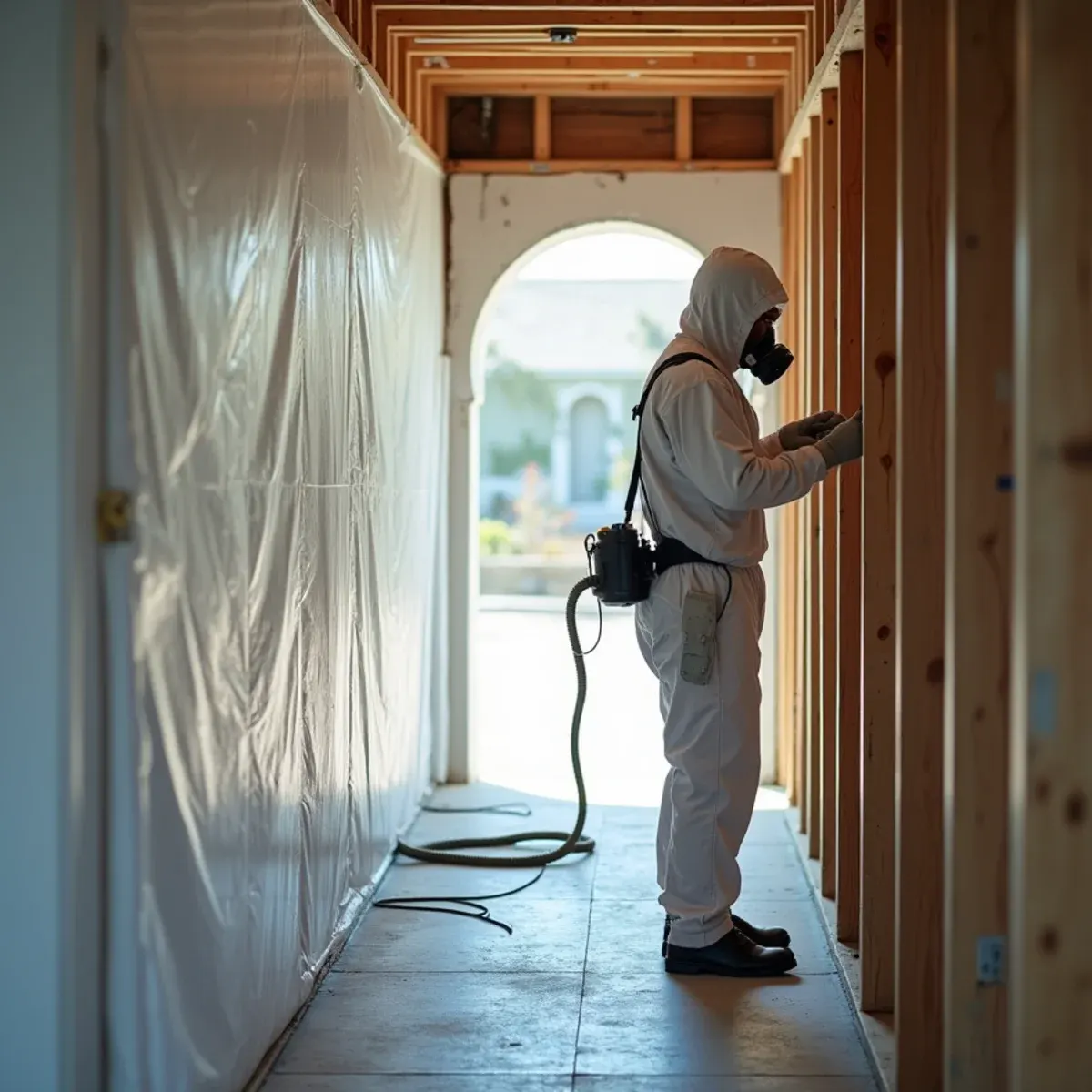
Placentia was built out of Valencia orange groves between the mid-1950s and the late 1970s, and the tract stock is uniform enough that failures cluster. When under-slab copper starts giving out on one street, it tends to give out on that street generally, and the mold that follows shows up in the same place house to house — behind a hallway baseboard, under the flooring in a bedroom that shares a wall with the water heater closet, in the toe kick of the kitchen cabinets. Same plan, same routing, same wet corner.
That predictability helps us, but it doesn't shorten the work. A slab leak feeds moisture for weeks before anyone hears it, so by the time you smell something the wall base and the flooring adhesive have been damp a long while. Around Old Town Placentia the stock is older and less consistent, and near Cal State Fullerton the rentals off Kraemer and Morse often go unreported until a tenant moves out. We're about sixteen minutes from Cypress and dispatch as fast as conditions allow.
What Placentia Changes About Mold Remediation
1Under-slab copper failing tract-wide
A pinhole in under-slab copper doesn't announce itself. It saturates the fill under the slab, wicks up through the concrete, and feeds the paper facing on the drywall and the pad above it. Until that line is repaired or rerouted, nothing we do stays fixed. On Placentia jobs we hold off on removal scope until the plumbing side is settled and the slab starts giving up moisture.
2Flooring over slab traps the evidence
Most of these homes have been re-floored at least once, often with laminate or vinyl plank over the original slab with no vapor retarder consideration. That covering keeps slab moisture from evaporating and gives growth a dark, undisturbed underside to live on. The floor can look fine and cup only slightly while the pad and the underside are already contaminated.
3Student rentals off Kraemer and Morse
Rentals near Cal State Fullerton get reported late — a slow bathroom leak lives through a school year because nobody wants to be the one to call it in. By the time we're brought in, the growth has moved past the wet spot into adjoining framing. For landlords, we document conditions and the corrected source clearly, since that record usually matters more later than the removal itself.
How the Work Runs
The method is the same one we use on every mold remediation job, documented to the IICRC S500:2025 standard. Here it is in short — the full mold remediation & removal process explains each stage in detail.
- Inspection and moisture source identification
- Testing where it is warranted
- Containment and negative pressure
- Removal of contaminated material
- HEPA cleaning and antimicrobial application
- Verification before containment comes down
The Placentia Background Worth Knowing
Copper under a slab fails in two directions at once. From the inside, decades of water flow erode thin spots at bends and fittings, especially on the hot side where the metal runs warmer and the water moves faster. From the outside, soil chemistry and stray current attack the pipe wall. Either way the result is a pinhole rather than a burst, which is precisely why these losses are so expensive by the time we see them. A pinhole under concrete can run for months, soaking the sub-base, wicking up into the slab, and surfacing at the edge of the carpet as a stain nobody can explain.
There is more on the housing stock, drainage and plumbing history of this city on our water damage restoration in Placentia page.
Placentia at a glance
- Dominant construction era
- 1955–1980
- Foundation type
- slab on grade
- Supply piping found here
- under-slab copper, galvanized steel
- Drain line materials
- cast iron
- Terrain and water table
- flat, moderate water table
- Most common local failure
- under-slab copper reaching the end of its service life across whole tracts at once
- Highest-value local prevention
- the annual water-meter test, and treating a neighbor's slab leak as information
What It Costs in Placentia
We do not quote a number over the phone before seeing the property — anyone who does is guessing. The variables that actually move the price on a mold remediation job are square footage of affected material, where it is, containment complexity, and they are broken down in full on the mold remediation & removal page. The assessment and the written estimate are free anywhere in Placentia, day or night, with no obligation.
Mold Remediation Questions from Placentia Homeowners
It's worth taking seriously. These tracts were plumbed at the same time with the same materials by the same crews, so when one house on the street loses under-slab copper the odds on the rest of the block go up. Run the water-meter test with everything off overnight. Then check the low corners — baseboards in the hallway, cabinet toe kicks, closet floors on shared walls. Musty smell with no visible water is exactly how these start.
On a hard, non-porous surface like tile or glass, bleach handles surface growth. On drywall, wood, or anything porous it does not — the water content soaks in and can feed further growth while the chlorine stays on the surface. Porous material with real growth needs to be removed, not treated.
Usually not for visible growth with an obvious cause — you can see the problem and the work would be identical regardless of species. Testing is worthwhile when there is odor but nothing visible, when you need documentation for a claim or dispute, or when you want independent verification that the job was done right.
Worried is the wrong word, but you should start paying attention. These tracts were built in tight windows with the same copper at the same depth in the same soil, so failures cluster on a street rather than scattering randomly. Treat a neighbor's slab leak as a service bulletin for your own house. Run the meter test, listen for the water heater cycling at odd hours, and check the hallway and bedroom floors for warm or damp patches every so often.