
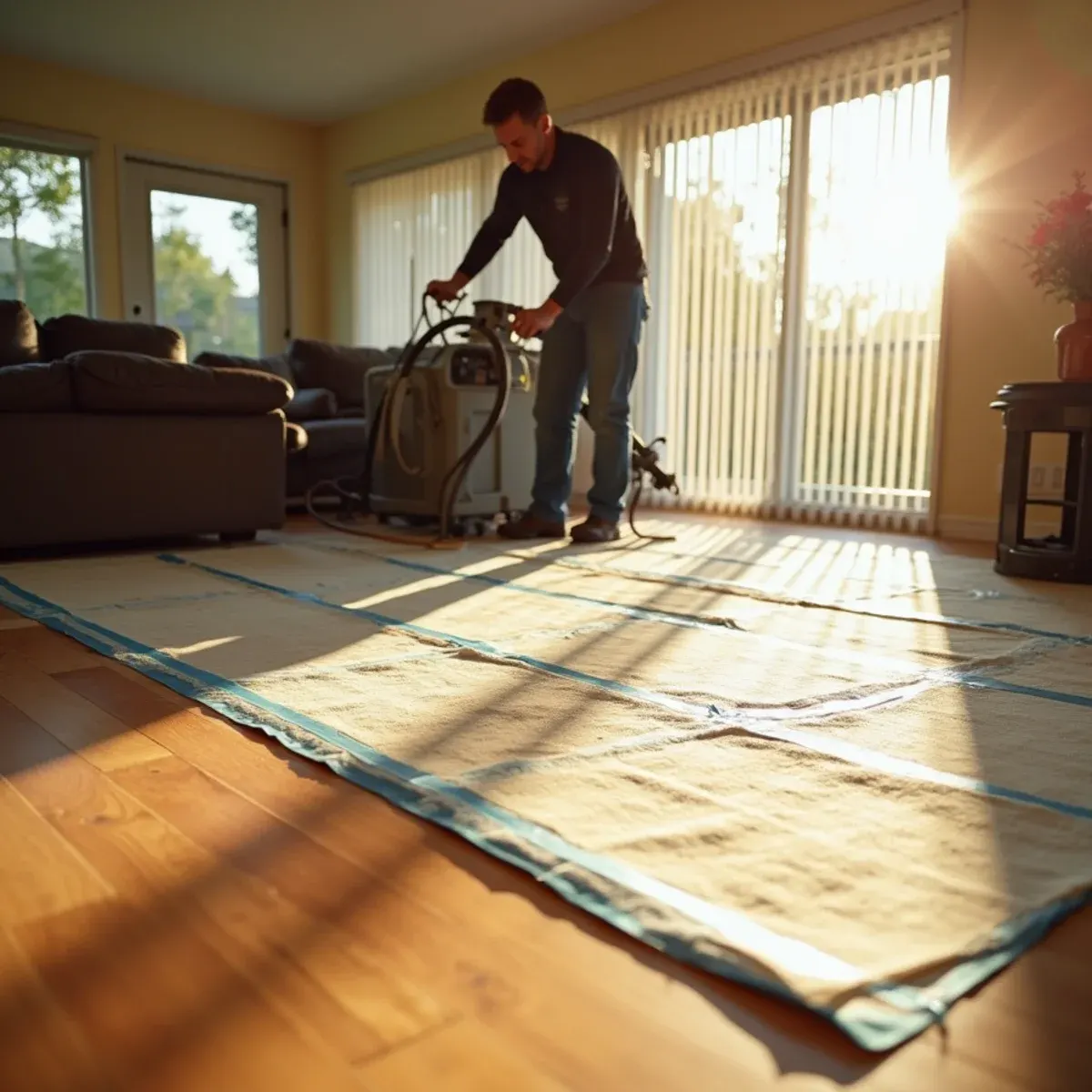
Drying a wood floor is a moisture-gradient problem, and Huntington Beach makes the gradient shallow. When the marine layer holds for days at a time, the air we are pushing through those board seams is already carrying a load, so the floor releases moisture more slowly than the same floor would in Fullerton. The answer is not more heat. It is more dehumidification capacity and a sealed room, so the mats have somewhere to send the water. Anyone quoting you a three-day dry on a coastal oak floor in June is guessing.
Location inside the city matters as much as the weather. Out in Huntington Harbour the groundwater moves with the tide, so a slab is never as dry as one inland and the floor sitting on it reflects that. Downtown near Main Street the lots are narrow with no driveway, which turns truck-mount extraction into long hose runs and makes equipment staging something to settle before we arrive. And plenty of the water we find on floors here never came from a pipe at all. It came through salt-corroded window flashing, which is why the cupping starts at the outside wall.
What Huntington Beach Changes About Hardwood Floor Drying
1Capacity, not heat, sets the pace
The instinct on a coastal job is to add heat. Heat without dehumidification just moves moisture into the room air, and here the room air is already loaded. We size dehumidification to the space first, seal the room, then let the mats pull through the board seams into air that can actually accept it. That is what makes a marine-layer job finish rather than plateau.
2Huntington Harbour slabs track the tide
Groundwater in the Harbour moves with the tide, so a slab there never reads as dry as an inland slab of the same age. Wood over that slab is working against a constant background load. It does not make drying impossible. It makes the target moisture content something we verify against actual slab conditions rather than a generic published number.
3Downtown lots need a staging plan
Near Main Street the lots are narrow with no driveway and limited street parking. Truck-mounted extraction means long hose runs through a front door or side gate, and dehumidifiers need somewhere to sit that is not a walkway. We work that out before arriving. On a wet floor, an hour lost figuring out where equipment goes is an hour of deeper cupping.
How the Work Runs
The method is the same one we use on every hardwood floor drying job, documented to the IICRC S500:2025 standard. Here it is in short — the full hardwood floor water damage drying process explains each stage in detail.
- Measure before deciding anything
- Extract from below the surface
- Control the drying rate deliberately
- Dry the subfloor and any cavity below
- Let it acclimate before judging it
- Sand and refinish only if needed
The Huntington Beach Background Worth Knowing
Salt does not damage buildings directly. It damages the details that keep water out, and then water does the rest.
There is more on the housing stock, drainage and plumbing history of this city on our water damage restoration in Huntington Beach page.
Huntington Beach at a glance
- Dominant construction era
- 1960–1990
- Foundation type
- slab on grade
- Supply piping found here
- under-slab copper
- Drain line materials
- cast iron, ABS
- Terrain and water table
- coastal-flat, shallow water table
- Most common local failure
- wind-driven rain entering through salt-corroded window flashing and failed exterior sealant
- Highest-value local prevention
- renewing exterior caulking and flashing on a far shorter cycle than inland guidance suggests
What It Costs in Huntington Beach
We do not quote a number over the phone before seeing the property — anyone who does is guessing. The variables that actually move the price on a hardwood floor drying job are square footage under the mat system, solid versus engineered wood, what is underneath, and they are broken down in full on the hardwood floor water damage drying page. The assessment and the written estimate are free anywhere in Huntington Beach, day or night, with no obligation.
Hardwood Floor Drying Questions from Huntington Beach Homeowners
Longer than the same floor inland, and we will not pretend otherwise. Coastal humidity flattens the drying gradient, so moisture leaves the wood more slowly. What we can commit to is daily readings and a visible trend. If the numbers are not moving, the plan changes rather than the clock just running. Solid wood over a crawl space finishes fastest. Solid wood over a Harbour slab in a June marine layer takes longest.
Frequently, yes. Cupping is caused by uneven moisture between the top and bottom of each board, and when the moisture equalizes during controlled drying, much of the deformation reverses. Full flattening can take two to four weeks of acclimation after the equipment comes out, which is why we do not recommend sanding immediately.
Five to ten days under the mat system is typical, which is longer than drywall because wood gives up moisture slowly and has to be dried at a controlled rate. Rushing it causes splitting and permanent gapping, so the extra days are doing real work.
Ambient humidity near the coast stays high enough for long enough that materials dry slowly on their own, which widens the window in which growth can establish after any moisture event. Combined with salt-accelerated failures of exterior sealants and flashings, coastal homes simply get more moisture intrusion and dry from it more slowly.