
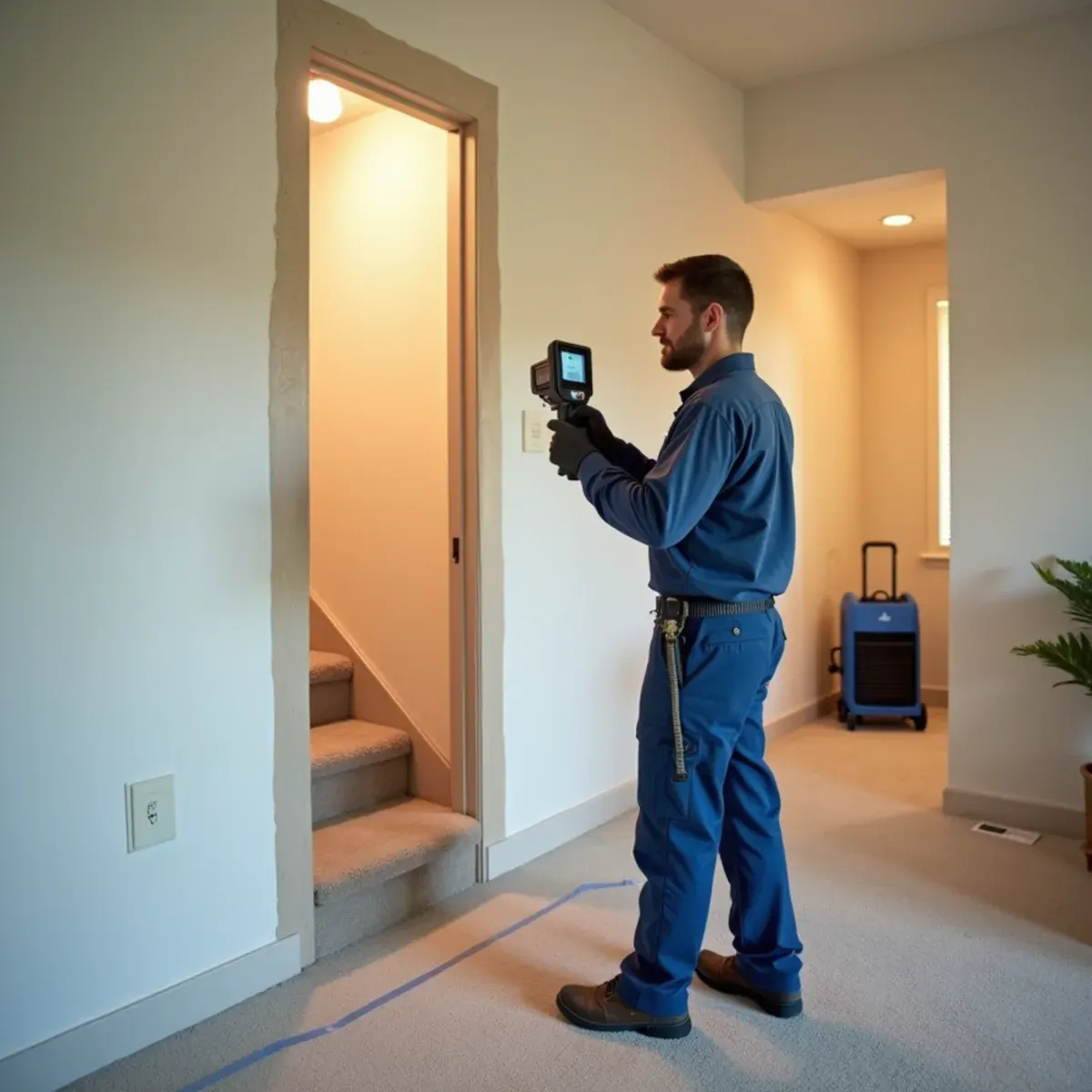
Be honest about what this service looks like here. Santa Fe Springs is one of the most industrial cities in this part of LA County — oil-field history plus a warehouse, manufacturing and distribution base on a footprint that dwarfs its housing — so most of our drywall work is commercial. A fire sprinkler head lets go over an open floor and the water goes everywhere at once, but the gypsum damage concentrates in the office build-out at the front: metal-stud partitions, drywall soffits over reception, and rated corridor walls that have to go back correctly.
Metal framing changes the calculation. Studs and track don't swell or rot, so the framing usually stays and only the board comes off. But the bottom of the board wicks fast and the track holds standing water against it, so cuts run low and the track gets cleared and dried before new board goes up. Ceilings are often lay-in tile, which gets replaced rather than dried, while any drywall soffit above it needs a stain-blocking primer or the sprinkler water's rust and pipe scale will bleed through fresh paint within weeks.
What Santa Fe Springs Changes About Drywall Repair
1Low cuts, cleared track, dried metal
Sprinkler water lands on the floor and the bottom of the board pulls it up. Metal track holds a puddle right against that edge. So the cut goes low, the track gets opened and dried, and insulation in exterior or demising walls comes out. The studs stay, which keeps the rebuild to board, tape, texture and paint instead of framing work.
2Inventory and operations set the sequence
Racked product, forklift lanes and shipping schedules decide the order of work more than the drywall does. We contain the affected area, protect what can't move, and stage cutting and rebuilding so the floor keeps running where it can. Sprinkler discharge is also a fire-system event, so system status and sign-off get coordinated with your people rather than assumed.
3Residential work here is the smaller share
There are houses in Santa Fe Springs — 1950s through 1970s slab tract, half-inch board, orange peel — and they get the same treatment as anywhere else. But it would be dishonest to pretend residential is the center of gravity in a city whose industrial footprint dwarfs its housing. Most of what we cut, dry and rebuild here is commercial gypsum.
How the Work Runs
The method is the same one we use on every drywall repair job, documented to the IICRC S500:2025 standard. Here it is in short — the full drywall water damage repair process explains each stage in detail.
- Meter the wall first
- Decide dry-in-place or remove
- Open the cavity, not the wall
- Cut to a stud and a seam line
- Clear the cavity and dry the framing
- Tape, texture, prime, paint
The Santa Fe Springs Background Worth Knowing
The water sitting in a wet-pipe sprinkler system has been there for years. It is stagnant, it has been in contact with black steel and scale that whole time, and some systems carry corrosion inhibitors or antifreeze as well. When a head discharges, that is what lands on your floor and soaks into your product. Under IICRC S500:2025 water gets categorized on the evidence in front of us, and sprinkler discharge that has run across a warehouse floor almost never stays in Category 1. That decision drives what we dry in place, what comes out, and how the crew works.
There is more on the housing stock, drainage and plumbing history of this city on our water damage restoration in Santa Fe Springs page.
Santa Fe Springs at a glance
- Dominant construction era
- 1950–1975
- Foundation type
- slab on grade
- Supply piping found here
- galvanized steel, copper, commercial-grade systems
- Drain line materials
- cast iron, commercial waste lines
- Terrain and water table
- flat, moderate water table
- Most common local failure
- fire-sprinkler discharge and commercial supply failures across large open-plan warehouse and manufacturing floors
- Highest-value local prevention
- keeping current building access and shutoff information on file before an after-hours failure
What It Costs in Santa Fe Springs
We do not quote a number over the phone before seeing the property — anyone who does is guessing. The variables that actually move the price on a drywall repair job are how much board comes out, cut height and seam count, texture type and match difficulty, and they are broken down in full on the drywall water damage repair page. The assessment and the written estimate are free anywhere in Santa Fe Springs, day or night, with no obligation.
Drywall Repair Questions from Santa Fe Springs Homeowners
Extraction and drying come first, and that's driven by readings rather than by the calendar. In a Santa Fe Springs building the wet area usually includes metal track holding water, insulation inside demising walls, and lay-in ceiling tile that gets replaced instead of dried. Once the cavity is dry, board, tape, texture and paint each need their own cure time. We phase it so the floor keeps operating and the office comes back in stages.
No, and that assumption is why a lot of walls come out that did not need to. Gypsum board that got clean water, still reads firm under thumb pressure, and is coming down in moisture content day over day can usually be dried in place through the cavity. What forces removal is contaminated water, a core that has softened or swelled, visible growth on the paper, or insulation behind it that holds moisture against the board. We take readings before we answer that question.
Usually two feet or four feet above the floor, measured level across the whole run rather than following the stain. Board comes in four-foot widths, so a cut at either height lands the new seam where a factory edge would sit, which is far easier to hide than a seam floating mid-wall. The cut also has to end at the center of a stud on each side, so the patch has something to fasten to. Cutting to the shape of the damage looks thrifty and finishes badly.
No. Water that has sat in a wet-pipe system for years picks up scale, rust and whatever inhibitors are in the system, and once it runs across a warehouse floor it collects everything on that floor too. We categorize on the evidence per IICRC S500:2025, and sprinkler discharge almost always lands past Category 1. That affects what gets dried in place, what gets removed, and what protective equipment the crew works in.