
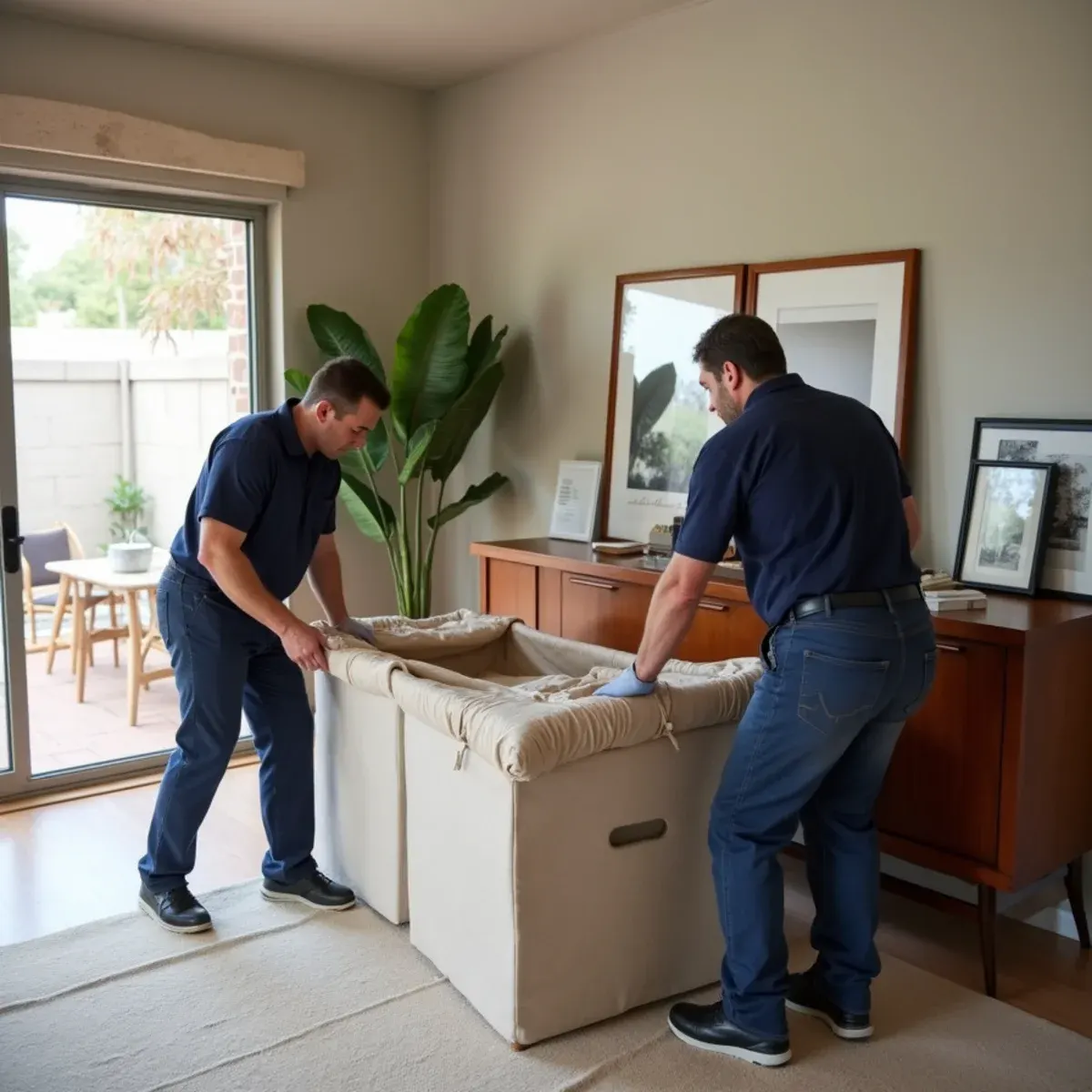
Most people in Leisure World downsized once already, on the way in. What is left in a nine-hundred-square-foot unit is not clutter — it is the distilled version of a whole life, chosen deliberately when they moved. That changes how we triage. Very little of it is replaceable with a check, and a lot of it belongs to someone who physically cannot pack a box or lift one. So we do the packing, slowly enough that the resident can watch and correct us, photographing as we go.
The building side is its own tangle. These are attached units from the early sixties sharing walls and in places sharing mains, so one failure crosses into two or three homes and pulls in the mutual, the management company and several separate policies at once. Documenting each unit independently from the first hour is the only thing that keeps that from becoming a months-long argument. And the marine layer off the pier keeps ambient humidity high, so nothing wet gets stored on site.
What Seal Beach Changes About Contents & Pack-Out
1Residents who cannot pack for themselves
In Leisure World we assume the resident is not lifting anything and may need to sit down through the process. We bring enough crew that packing is not slow, set a chair where they can see the room, and confirm item by item on the things that matter — medication, documents, hearing aids, photographs — before general packing begins.
2Shared walls mean separate inventories
When water crosses into a neighboring unit, both units get their own photographic inventory, their own numbering and their own storage bay, even though one mutual covers the building. Mixing them is how belongings get delivered to the wrong door and how two adjusters end up disputing the same schedule. We copy the mutual and management on both.
3Marine humidity rules out on-site storage
Within a mile of the pier the marine layer holds ambient humidity high for long stretches, which is why drying runs longer here than inland and why a pod in the driveway is a poor container for damp contents. Everything goes to climate-controlled storage where temperature and humidity stay steady, not to a box sitting in Old Town air.
How the Work Runs
The method is the same one we use on every contents & pack-out job, documented to the IICRC S500:2025 standard. Here it is in short — the full contents restoration & pack-out process explains each stage in detail.
- Room-by-room photographic inventory
- Triage into three categories
- Careful packing and transport
- Cleaning and restoration by material type
- Climate-controlled storage
- Delivery and placement back
The Seal Beach Background Worth Knowing
Structural drying works by creating a vapor pressure differential — dry air pulls moisture out of wet materials. When the surrounding air is already carrying a heavy moisture load, that differential shrinks and everything slows down.
There is more on the housing stock, drainage and plumbing history of this city on our water damage restoration in Seal Beach page.
Seal Beach at a glance
- Dominant construction era
- 1920–1965
- Foundation type
- mixed on grade
- Supply piping found here
- galvanized steel, copper, shared community mains
- Drain line materials
- cast iron, clay
- Terrain and water table
- coastal-flat, shallow water table
- Most common local failure
- losses that cross shared walls between attached units, involving several policies and a mutual at once
- Highest-value local prevention
- documenting each affected unit separately from the first hour
What It Costs in Seal Beach
We do not quote a number over the phone before seeing the property — anyone who does is guessing. The variables that actually move the price on a contents & pack-out job are volume of contents, proportion of specialty items, storage duration, and they are broken down in full on the contents restoration & pack-out page. The assessment and the written estimate are free anywhere in Seal Beach, day or night, with no obligation.
Contents & Pack-Out Questions from Seal Beach Homeowners
We do, alongside you rather than instead of you. The mutual and the management company need documentation of the shared assembly and the repair; your carrier needs the personal property schedule. Those are separate submissions and we prepare both, copying you on everything so you are never hearing about your own claim secondhand. You do not need to lift anything, and you do not need to chase three parties by phone.
It depends on the scope. For a contained single-room loss we often move contents to an unaffected part of the home and block furniture in place. When the drying chamber covers most of the living area or reconstruction is extensive, off-site pack-out is usually both safer and faster.
Every item is photographed and barcoded at your home and tracked through cleaning, storage, and delivery. You receive the inventory, and at delivery we reconcile it with you item by item before we leave.
Coastal marine layer conditions keep ambient humidity high for extended periods, which reduces the vapor pressure differential that drives drying. Jobs near the water need sealed chambers and more dehumidification capacity than an equivalent loss inland, and the equipment stays on longer.