
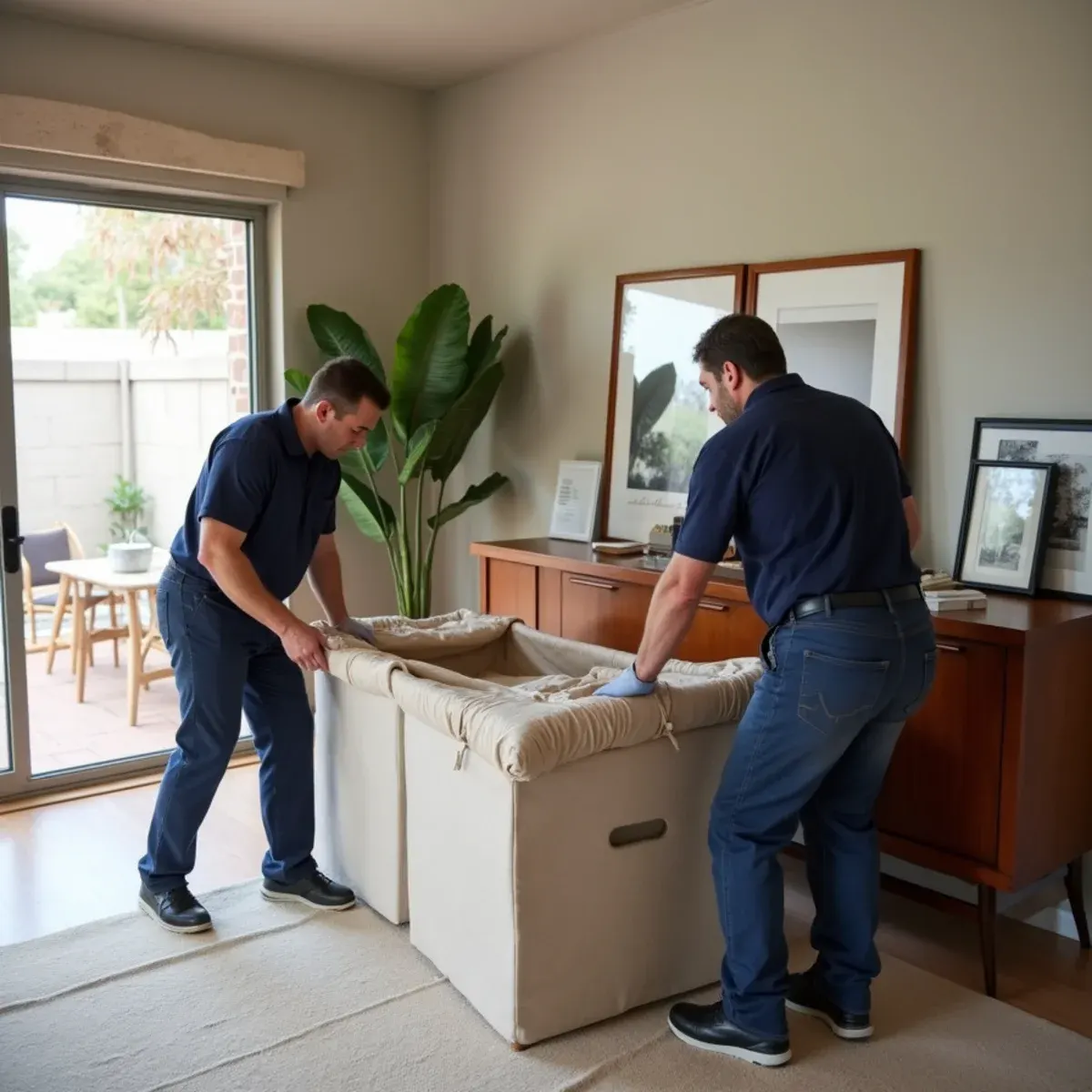
Ross Cortese built roughly 3,500 houses here in about four years, off a short list of floor plans, and almost none of them have a second story. That does two things to a pack-out. First, we know the layout before we walk in — where the linen closet is, where the water heater sits, which wall the kitchen and bath share. Second, everything a family owns is on one level, and the overflow lives in the garage, because a Rossmoor ranch has no usable attic and no basement.
Under a lot of those carpets is the original oak strip flooring, and it deserves more attention than the carpet on top of it. Once contents are out, that floor can often be dried and saved rather than replaced. The other Rossmoor factor is clustering: the plumbing across The Ranchos went in during one narrow window, so when a neighbor on Montecito Road has a slab leak, the houses around it are on the same clock. We have packed out two homes on the same street in a month.
What Rossmoor Changes About Contents & Pack-Out
1Identical plans make inventory faster
Because the floor plans repeat, we can plan box count, truck size and staging area from the address alone. That matters at hour one, when the difference between a good contents outcome and a bad one is how quickly wet items get separated from dry ones. We arrive with the right amount of material instead of losing an hour to a second trip.
2Garages hold what the house cannot
A single-story ranch with no basement and a shallow attic pushes storage into the garage — holiday boxes, tools, paperwork, kids' school things stacked straight on the slab. Cardboard sitting on concrete wicks, and when a slab leak migrates that way the boxes are the first casualty and the last thing anyone thinks to check.
3Original oak deserves a decision, not a default
Rossmoor's original oak strip flooring cannot be matched with anything milled today. Pulling contents out promptly is what buys the room to set drying equipment on that floor instead of tearing it out. It does not always work — cupped boards sometimes stay cupped — but the attempt is worth making, and the attempt requires an empty room.
How the Work Runs
The method is the same one we use on every contents & pack-out job, documented to the IICRC S500:2025 standard. Here it is in short — the full contents restoration & pack-out process explains each stage in detail.
- Room-by-room photographic inventory
- Triage into three categories
- Careful packing and transport
- Cleaning and restoration by material type
- Climate-controlled storage
- Delivery and placement back
The Rossmoor Background Worth Knowing
Plumbing failure is largely a function of time, water chemistry, and installation method — and in Rossmoor all three are effectively identical from house to house. That is why leak calls here tend to arrive in clusters, and why a neighbor's slab leak is genuinely relevant information about your own home.
There is more on the housing stock, drainage and plumbing history of this city on our water damage restoration in Rossmoor page.
Rossmoor at a glance
- Dominant construction era
- 1957–1961
- Foundation type
- slab on grade
- Supply piping found here
- under-slab copper, some galvanized
- Drain line materials
- cast iron
- Terrain and water table
- flat, moderate water table
- Most common local failure
- clustered slab leaks, where one failure on a street reliably predicts the neighbors
- Highest-value local prevention
- treating a neighbor's slab leak as information about your own house and running the meter test
What It Costs in Rossmoor
We do not quote a number over the phone before seeing the property — anyone who does is guessing. The variables that actually move the price on a contents & pack-out job are volume of contents, proportion of specialty items, storage duration, and they are broken down in full on the contents restoration & pack-out page. The assessment and the written estimate are free anywhere in Rossmoor, day or night, with no obligation.
Contents & Pack-Out Questions from Rossmoor Homeowners
Nothing dramatic, but two things help. Get the boxes in your garage up off the slab onto shelving or pallets, since that is where a migrating leak shows up first and cardboard on concrete has no defense. And photograph your rooms — wide shots, then closets and drawers open. If you ever need a contents claim, a set of pre-loss photos settles arguments about condition faster than anything we can document afterward.
It depends on the scope. For a contained single-room loss we often move contents to an unaffected part of the home and block furniture in place. When the drying chamber covers most of the living area or reconstruction is extensive, off-site pack-out is usually both safer and faster.
Every item is photographed and barcoded at your home and tracked through cleaning, storage, and delivery. You receive the inventory, and at delivery we reconcile it with you item by item before we leave.
Because they were all built between 1957 and 1961 with the same materials and methods. Copper routed through a slab fails from internal erosion and external soil corrosion on a fairly predictable timeline, and when an entire community shares one construction date, it shares one failure window too.