
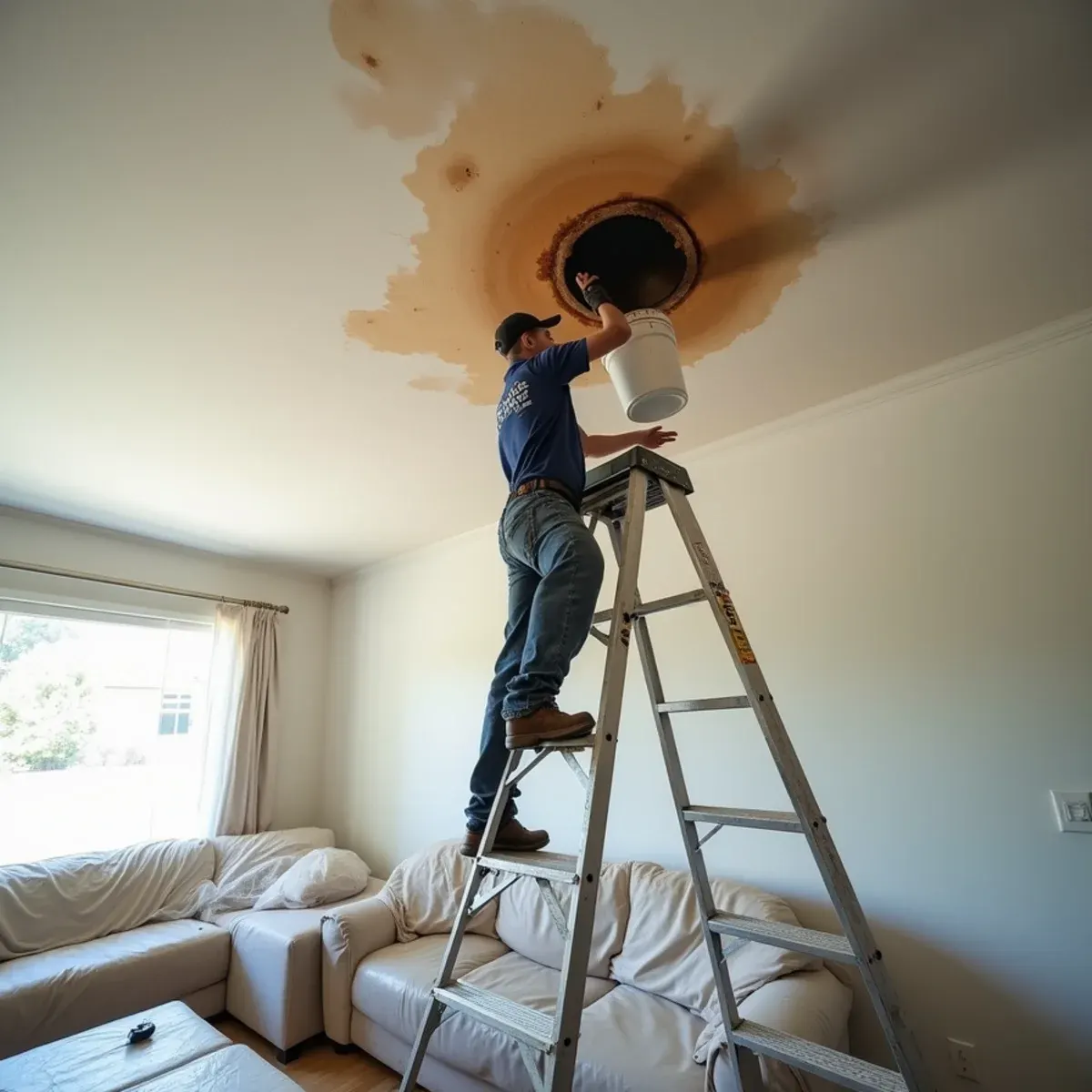
If you live in one of Stanton's manufactured home communities, you have probably already been told no by somebody. A lot of restoration companies simply decline this housing type, which leaves owners calling a handyman for what is actually a water loss. Stanton has one of the larger manufactured home populations in this part of the county, and those roofs and ceilings behave nothing like the stick-built houses on the next street. We work on them, and the construction deserves to be handled on its own terms rather than approached as a tract house with a lower ceiling.
The roof on most of these homes is a shallow metal or membrane system that has been coated and re-coated over the years, and it fails at seams, at vent and stack penetrations, and where a later add-on carport or awning was fastened through it. Water gets in, runs along the rafter and reaches the sidewall, and the ceiling below is a thin vinyl-backed gypsum panel with battens at the joints. The cavity above it is a few inches deep and packed with batt insulation. There is no attic to speak of and no airflow, so what would dry in a day in a normal attic sits wet for weeks.
What Stanton Changes About Ceiling & Roof Leaks
1Coating over coating on a metal roof
Elastomeric coating buys years, and most of these roofs have had several campaigns of it. What coating cannot do is bridge a seam that is still moving, or seal around a stack that has been fastened through twice. When we tarp or dry-in a manufactured roof we work with the seam and penetration pattern rather than skinning over it again, because another coat on an open seam just hides where the water is coming in.
2Vinyl-backed ceiling panels hold moisture in
The ceiling panels in these homes have a vinyl face that behaves like a vapor barrier. Water above it cannot evaporate downward into the room the way it does through painted drywall, so the panel looks fine while the insulation and the framing above stay wet. Sagging at a batten line or a stain that will not lighten means the cavity has to be opened, not repainted.
3Park access and where equipment fits
Spaces in Stanton's communities are close together, with limited parking and shared utilities. We plan the setup before we arrive: shorter hose runs, smaller equipment footprints, power drawn so we do not overload a pedestal shared with your neighbors, and clearance kept for the coach next to you. Park management usually needs notice too, and we can make that call with you.
How the Work Runs
The method is the same one we use on every ceiling & roof leaks job, documented to the IICRC S500:2025 standard. Here it is in short — the full ceiling & roof leak water damage process explains each stage in detail.
- Emergency tarping or temporary dry-in
- Controlled relief of trapped water
- Trace the intrusion to its real source
- Remove wet insulation and compromised drywall
- Dry the attic and the ceiling assembly
- Restore the ceiling completely
The Stanton Background Worth Knowing
Mobile and manufactured homes need a genuinely different restoration approach, and the reason is what they are built from. The floor system is typically particleboard or OSB over a wood frame with insulation and a vapor barrier belly wrap underneath — and particleboard exposed to water swells, loses structural integrity, and does not recover. It cannot be dried back to serviceable the way plywood often can.
There is more on the housing stock, drainage and plumbing history of this city on our water damage restoration in Stanton page.
Stanton at a glance
- Dominant construction era
- 1950–1975
- Foundation type
- mixed on grade
- Supply piping found here
- galvanized steel, copper, manufactured-home PEX and poly
- Drain line materials
- cast iron
- Terrain and water table
- flat, moderate water table
- Most common local failure
- underfloor leaks in manufactured homes, sealed inside the belly wrap where they cannot evaporate
- Highest-value local prevention
- checking for soft spots underfoot, because a manufactured-home floor gives no other warning
What It Costs in Stanton
We do not quote a number over the phone before seeing the property — anyone who does is guessing. The variables that actually move the price on a ceiling & roof leaks job are how long the leak has been active, ceiling texture and finish, attic access and insulation type, and they are broken down in full on the ceiling & roof leak water damage page. The assessment and the written estimate are free anywhere in Stanton, day or night, with no obligation.
Ceiling & Roof Leaks Questions from Stanton Homeowners
It depends on how long it has been wet and whether the panel has lost its stiffness. A panel that is still firm and only recently wet can sometimes be dried in place once we open the cavity above it and get airflow into that shallow space. A panel that has bowed at the battens or delaminated is done and comes out. Either way the insulation above it needs to come out, because it will not dry sealed in that cavity.
Clear the room and keep everyone out from underneath it, including pets. Move furniture if you can do it from the side. Put a bucket down if you can place it safely without standing under the bulge. Then call us — we relieve it deliberately, which is safer and preserves much more of the ceiling than letting it fail on its own.
We tarp immediately to stop the intrusion and coordinate the roofing repair with a licensed roofer, then handle all the interior restoration ourselves. You get one point of contact and one schedule instead of managing two trades during a storm week.
Yes, and we say so explicitly because a lot of companies will not. Manufactured homes need a different approach — opening the belly wrap to dry the floor cavity, removing saturated insulation, and honestly assessing particleboard decking, which usually cannot be dried back to serviceable.