
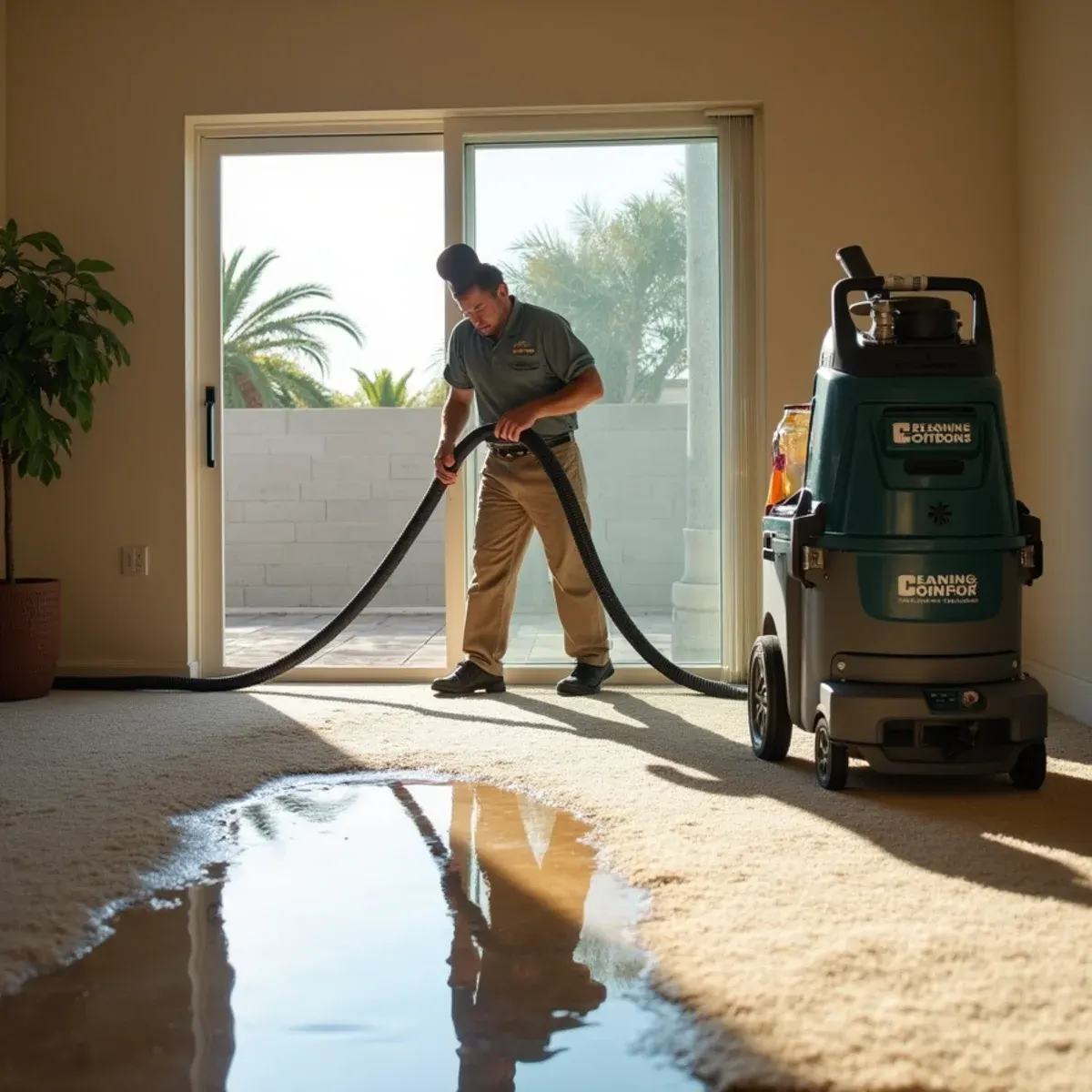
Stairs are the part of a Signal Hill water loss people forget. On a 365-foot hill completely surrounded by Long Beach, houses sit on steep engineered lots with retaining walls and terrace drains, and the newer hillside homes built on former oil land are multi-level by necessity. When exterior water gets in at an upper level it does not spread across a floor, it finds the staircase and runs. Stair carpet cannot be floated over air movers the way a bedroom carpet can. It gets dried in place or taken out tread by tread.
The other Signal Hill conditions pull in different directions. Water arriving with velocity off engineered slopes gets behind the wall base rather than sitting in the field of the room, so we look at plate lines and stringers, not just the visible wet. The 1921 Alamitos No. 1 discovery left a field that is still moderately productive, with active wells and oilfield infrastructure intermixed with housing, so soil crossing into a house here can carry more than dirt. And steady marine influence keeps ambient humidity up, which slows every dry.
What Signal Hill Changes About Carpet Drying
1Stair carpet is its own drying problem
Pad on stairs is stapled in sections and the carpet wraps over the nosings, so nothing about it floats. Water runs to the back of each tread and into the stringer. We dry treads individually with directed airflow, check the framing under the landing, and where pad is contaminated we take it out stair by stair rather than pretending the run dried on its own.
2Velocity water gets behind the base
Runoff coming off a steep Signal Hill lot arrives with push. It does not pond politely at the threshold, it drives under the wall base and into the cavity, then wets carpet from the perimeter inward. We open low, discreet access along the affected wall and meter the cavity, because carpet dried with a wet plate behind it comes back damp at the edge.
3Marine air slows every hillside dry
Sitting where it does, the hill catches steady marine influence, and outdoor humidity stays high enough for long stretches that ventilation alone will not finish a carpet. We run a closed drying system with dehumidification sized to the load. It takes longer than the same job inland, and we would rather tell you that at the start than at day three.
How the Work Runs
The method is the same one we use on every carpet drying job, documented to the IICRC S500:2025 standard. Here it is in short — the full carpet water damage & drying process explains each stage in detail.
- Map the real wet perimeter
- Identify the pad and the category
- Weighted extraction, pass after pass
- Float the carpet or pull the pad
- Dry the slab or subfloor
- New pad, re-stretch, reinstall
The Signal Hill Background Worth Knowing
On these lots the drainage is engineered rather than natural. Terrace drains catch water partway down a slope, v-ditches carry it around a pad instead of across it, and retaining walls have weep holes with a gravel drain behind them so pressure never builds in the soil. All of that works until something clogs. Then a retaining wall stops being a wall and starts being a dam, and saturated soil pushes water through the joints and into whatever sits on the other side, which is usually a garage, a storage room, or the back of a lower level.
There is more on the housing stock, drainage and plumbing history of this city on our water damage restoration in Signal Hill page.
Signal Hill at a glance
- Dominant construction era
- 1920–2005
- Foundation type
- mixed on grade
- Supply piping found here
- original 1920s piping, galvanized steel, modern PEX in newer hillside builds
- Drain line materials
- cast iron, ABS
- Terrain and water table
- hillside-mixed, deep water table
- Most common local failure
- slope drainage and retaining-wall failures on steep lots, where water arrives with velocity rather than ponding
- Highest-value local prevention
- keeping terrace drains, v-ditches and retaining-wall weeps clear before the first storm
What It Costs in Signal Hill
We do not quote a number over the phone before seeing the property — anyone who does is guessing. The variables that actually move the price on a carpet drying job are whether the pad is salvageable, square footage and equipment days, what sits under the pad, and they are broken down in full on the carpet water damage & drying page. The assessment and the written estimate are free anywhere in Signal Hill, day or night, with no obligation.
Carpet Drying Questions from Signal Hill Homeowners
Not necessarily, but it takes different work. On Signal Hill that water usually came off a slope, which puts it past clean category, so the stair pad comes out. The carpet itself, if the backing is sound, gets extracted on each tread, dried in place with directed airflow, and reinstalled once we confirm the stringers and landing framing are dry. What ends a stair carpet is delamination at the nosings, and we check for that early rather than at the end.
Frequently it can be saved. The deciding factors are water category, how many hours it sat, and whether the backing has delaminated. Clean supply-line water caught within a day, on carpet that was in decent shape beforehand, usually means we replace the pad and keep the carpet. Anything past Category 1, or carpet that has come apart at the backing, is a different answer. We take the readings and check the backing before saying either way.
No, but it does more often than not. On a clean-water loss we reach quickly, we can float the carpet, push dry air into the pad space, and dry it in place. Moisture-barrier pad, dense slab rubber, and anything that sat overnight in gray water comes out. S500:2025 treats pad as non-restorable once contamination is involved, and field experience supports that. It is inexpensive material against a real risk.
Start uphill. On this hill the cause is almost never at the place the water got in. Walk the slope above your pad and check the terrace drains, the v-ditch and the retaining wall weep holes. A weep that has been painted or stuccoed over is common and completely disables the drain behind the wall. Then look at where the uphill property discharges. Fixing the entry point without finding the redirect just moves the problem a few feet.