
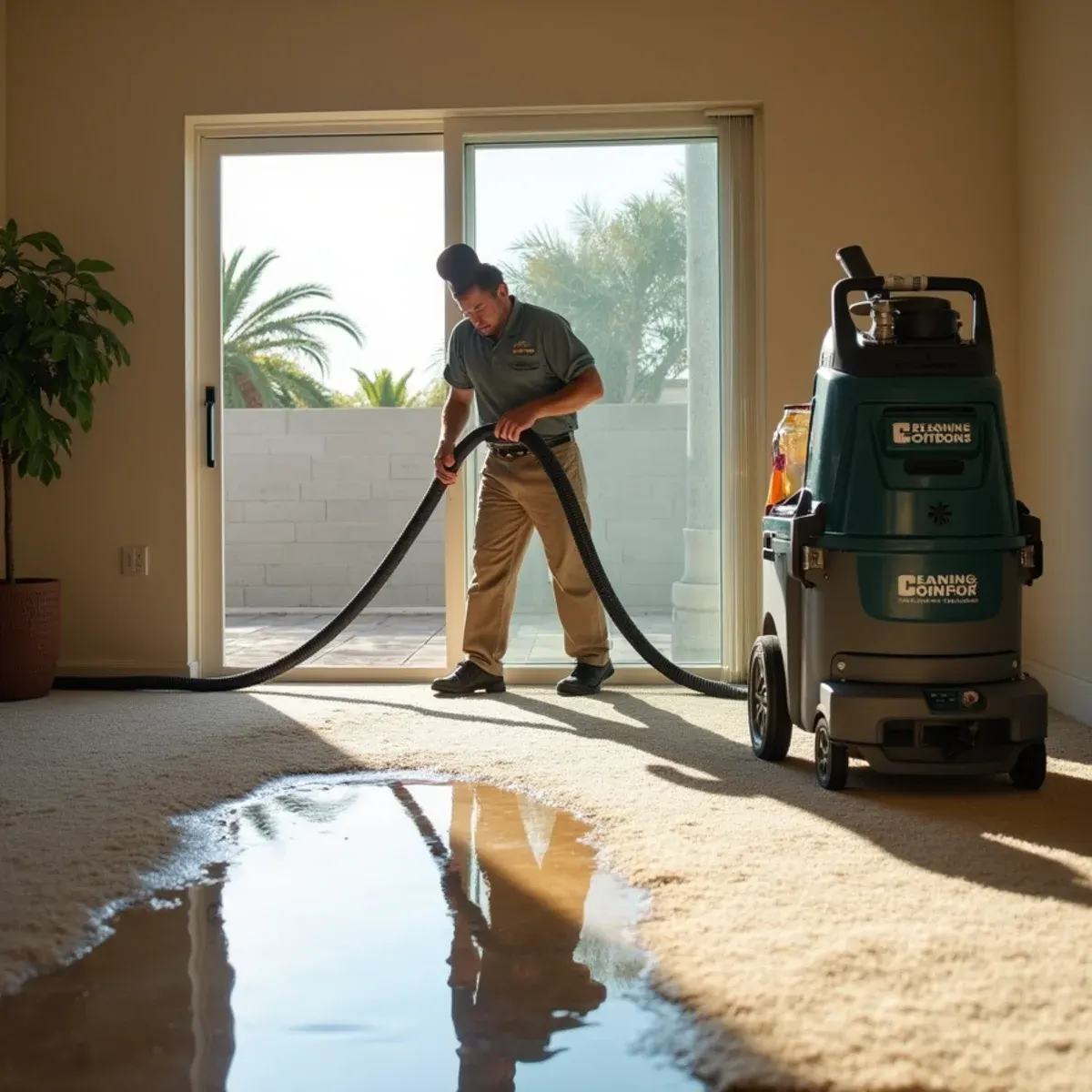
Paramount packs housing tightly between commercial corridors, and that shows up in this work as two jobs that look similar and are not. In the postwar houses formed out of the old Hynes and Clearwater dairy communities, carpet is stretched over pad on a slab, and the pad is the decision. In the offices and light-industrial suites on the same block, carpet is direct-glued to concrete with no pad at all. Glue-down does not float, does not take weighted extraction the same way, and either dries in place or lets go from its adhesive.
The ground is the other Paramount factor. This is one of the more industrially dense cities around here, with very little permeable surface between the buildings and the Los Angeles River channel on the western edge. Rain that lands on a Paramount block mostly runs. It does not soak in. In sustained storms that means water arriving at door thresholds and roll-up door tracks rather than rising slowly, and it arrives having crossed asphalt and yard surfaces. Carpet wet that way is handled as contaminated, whatever it looked like coming under the door.
What Paramount Changes About Carpet Drying
1Glue-down commercial carpet has no pad
Direct-glue goods in a Paramount office or shop suite give you nothing to remove and nothing to float. Drying happens through the face and the adhesive layer, which is slower, and the failure mode is delamination and adhesive release rather than a ruined pad. We monitor bond and concrete moisture together, because a floor that dries fine over a wet slab lifts later.
2Hard surfaces send water to the door
With so little permeable ground between the street and the building, storm water travels rather than absorbs. It shows up under thresholds, at roll-up door tracks and along the slab edge. On residential carpet that means a wet perimeter running well past the visible line, so we meter the whole exterior wall instead of treating the stain as the boundary.
3Two loss types, one block, one crew
A duplex and a warehouse office can flood the same night here. They need different equipment, different documentation and different drying targets, and mixing them up wastes days. We scope them separately even when it comes in as one call, and bill each to the correct policy, since commercial and homeowner coverage treat carpet and contents differently.
How the Work Runs
The method is the same one we use on every carpet drying job, documented to the IICRC S500:2025 standard. Here it is in short — the full carpet water damage & drying process explains each stage in detail.
- Map the real wet perimeter
- Identify the pad and the category
- Weighted extraction, pass after pass
- Float the carpet or pull the pad
- Dry the slab or subfloor
- New pad, re-stretch, reinstall
The Paramount Background Worth Knowing
On a typical Paramount lot, the house, the driveway, the walkways and the rear slab cover most of the parcel. What is left is a narrow side yard, and everything that lands on the roof and the paving is supposed to leave through a couple of small area drains. That system has no margin. When a grate silts up, when a downspout dumps straight onto paving, or when the outlet at the curb has been crushed by a parked truck, the water has no soil to soak into and nowhere else to be. It ponds against the slab edge and comes in at the lowest threshold, which is usually a garage or a side door.
There is more on the housing stock, drainage and plumbing history of this city on our water damage restoration in Paramount page.
Paramount at a glance
- Dominant construction era
- 1945–1965
- Foundation type
- slab on grade
- Supply piping found here
- original galvanized steel, copper
- Drain line materials
- cast iron
- Terrain and water table
- flat, moderate water table
- Most common local failure
- residential and commercial losses on the same block, needing very different handling
- Highest-value local prevention
- clearing area drains before the season on lots with very little permeable ground
What It Costs in Paramount
We do not quote a number over the phone before seeing the property — anyone who does is guessing. The variables that actually move the price on a carpet drying job are whether the pad is salvageable, square footage and equipment days, what sits under the pad, and they are broken down in full on the carpet water damage & drying page. The assessment and the written estimate are free anywhere in Paramount, day or night, with no obligation.
Carpet Drying Questions from Paramount Homeowners
Not automatically. Glue-down commercial carpet has no pad holding water, so if the source was clean and we get to it early it usually dries in place with airflow across the face and dehumidification. What kills it is contamination, or a concrete slab that stays wet under intact adhesive. We monitor the slab as well as the carpet, because a floor that reads dry over a wet slab will bubble or release weeks later.
Frequently it can be saved. The deciding factors are water category, how many hours it sat, and whether the backing has delaminated. Clean supply-line water caught within a day, on carpet that was in decent shape beforehand, usually means we replace the pad and keep the carpet. Anything past Category 1, or carpet that has come apart at the backing, is a different answer. We take the readings and check the backing before saying either way.
No, but it does more often than not. On a clean-water loss we reach quickly, we can float the carpet, push dry air into the pad space, and dry it in place. Moisture-barrier pad, dense slab rubber, and anything that sat overnight in gray water comes out. S500:2025 treats pad as non-restorable once contamination is involved, and field experience supports that. It is inexpensive material against a real risk.
Almost certainly your area drains. Paramount lots have very little permeable ground, so everything that falls on the roof and the paving has to leave through a couple of small drains. If a grate silts up or the outlet is crushed, the water ponds against the slab and enters at the lowest threshold, which is usually the garage. Rodding the drains and checking the outlet before the season costs far less than drying the garage wall afterward.