
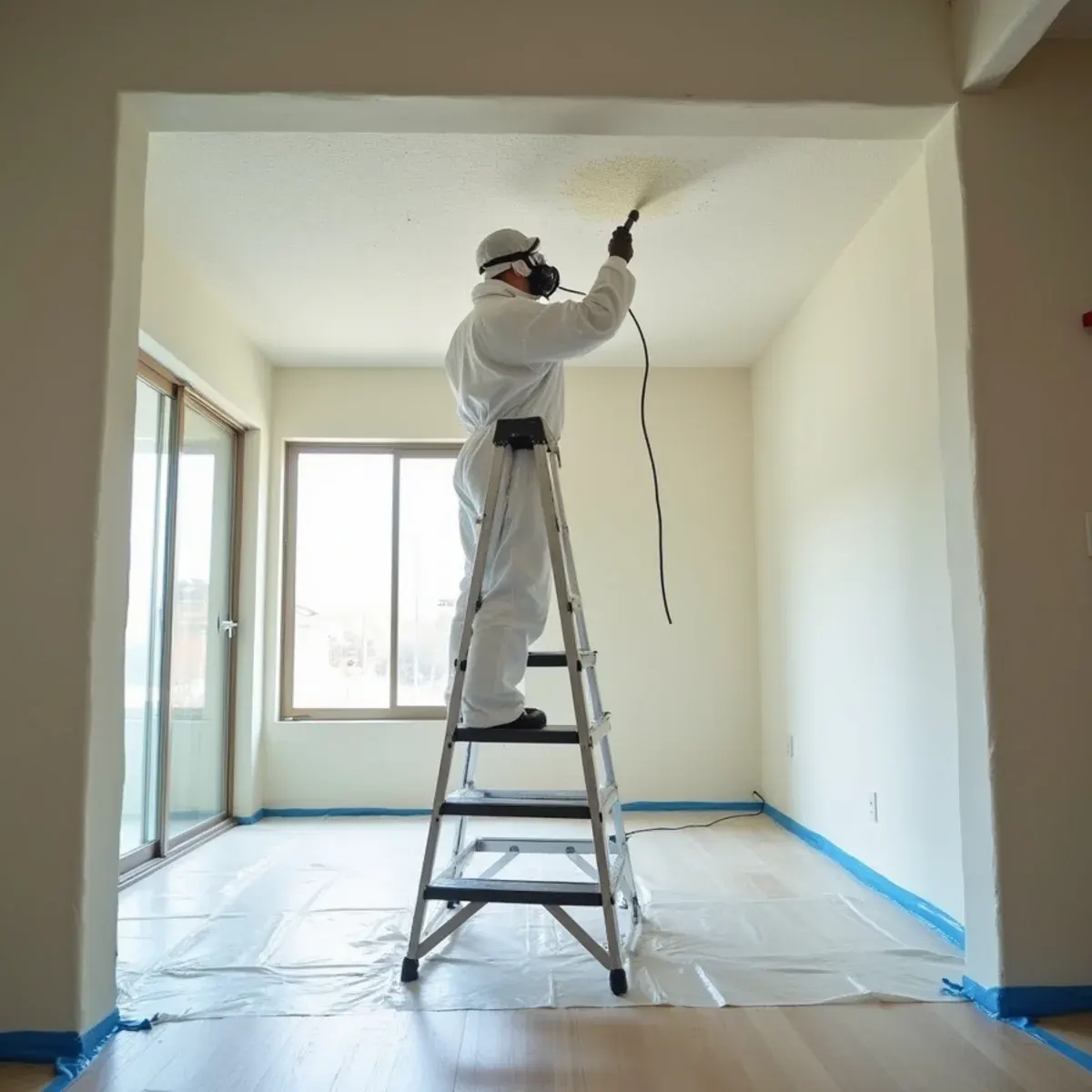
Jean Vandruff's Cinderella Homes are the reason we work differently in Downey. Turrets, pointed roofs, scalloped gingerbread trim, diamond-pane windows — detailing you cannot buy replacements for. It is also detailing with a lot of painted surface area, applied when lead was standard, and it is the first thing a restoration crew is tempted to sand, strip or pull. Test it before anyone touches it. A clean result frees you to restore in place; a positive tells you the trim needs containment, not a demolition bag.
Under the ornament these are conventional 1950s slab houses with galvanized supply, and they fail the way 1950s houses fail — a pinhole in a wall, a slab leak, wet drywall at the base. The ceiling texture, the taped seams and the original kitchen flooring all come from the same window as the paint. What makes Downey different is the calculus afterward. Low-demolition drying is worth paying for when the millwork behind that wet drywall cannot be replaced, and it only works if you know what is in the materials first.
What Downey Changes About Asbestos & Lead Testing
1Millwork gets tested component by component
Wall paint and trim paint are often different products from different years. On a Cinderella Home the trim is what matters, so we sample the trim, the sash and the exterior gingerbread as separate components rather than characterizing the whole house from one wall chip. That precision is what lets a restorer strip and repair in place instead of removing original material.
2Low-demolition drying depends on early results
Aggressive drying with minimal cutting only makes sense if we know the wall cavity materials are safe to open in a small way. Getting samples in on day one keeps that option alive. Wait until demolition is underway and the safe default becomes removing more, not less — which in these houses means losing detail nobody can put back.
31950s flooring under later remodels
Kitchens and baths in Downey have usually been redone once or twice, with new flooring laid straight over the original vinyl tile. That first layer and its black mastic are still there under two later floors, and a slab repair reaches it. Routine to find and routine to abate — but only if somebody sampled instead of assuming the visible floor was the whole story.
How the Work Runs
The method is the same one we use on every asbestos & lead testing job, documented to the IICRC S500:2025 standard. Here it is in short — the full asbestos & lead paint testing process explains each stage in detail.
- Emergency stabilization without cutting
- Define exactly what gets disturbed
- A certified inspector takes the samples
- Independent laboratory analysis
- Lead assessment on painted surfaces
- Abatement, clearance, then restoration
The Downey Background Worth Knowing
The instinct on a wet wall is to open it, and sometimes that is correct. But IICRC S500:2025 is built around restoring rather than replacing wherever the drying goals can genuinely be met, and on a house with original arched casings and applied gingerbread, meeting those goals is worth some patience. We would rather spend three extra days with equipment running than pull a run of trim that would have to be milled from scratch to come back. The standard supports that choice and so does the arithmetic on the estimate, because custom millwork is not cheap and matching a fifties profile is not quick.
There is more on the housing stock, drainage and plumbing history of this city on our water damage restoration in Downey page.
Downey at a glance
- Dominant construction era
- 1950–1965
- Foundation type
- slab on grade
- Supply piping found here
- galvanized steel, under-slab copper
- Drain line materials
- cast iron
- Terrain and water table
- flat, moderate water table
- Most common local failure
- 1950s slab and galvanized failures in houses whose decorative woodwork makes careful, low-demolition drying worth paying for
- Highest-value local prevention
- drying in place wherever readings allow, because the trim and detailing on these houses cannot be bought
What It Costs in Downey
We do not quote a number over the phone before seeing the property — anyone who does is guessing. The variables that actually move the price on a asbestos & lead testing job are the number of distinct materials, how many samples each needs, how fast you need results, and they are broken down in full on the asbestos & lead paint testing page. The assessment and the written estimate are free anywhere in Downey, day or night, with no obligation.
Asbestos & Lead Testing Questions from Downey Homeowners
Usually, yes. A positive result does not require removal. Licensed abatement crews can work leaded components in place with containment, wet methods and clearance testing afterward, or the trim can be stabilized and encapsulated under new coatings. Removal is the wrong answer for millwork nobody can reproduce. The test simply tells the restorer which pieces need controlled handling and which can be sanded normally.
No, and that's the whole point of testing. Plenty of ceilings from that decade come back clean — the manufacturers were mixed, the formulas changed year to year, and two houses on the same street can give different results. What we can't do is assume either way. A 1974 ceiling is a suspect material, which means one sample and a lab report separates a routine repair from a regulated one. Guessing in either direction is the expensive choice.
Usually less than people fear, and we design around it. Extraction, containment and dehumidification all start on the first visit, because none of that disturbs a suspect material. Sampling happens the same day where we can get an inspector out, and rush lab analysis is available when the clock matters. What genuinely adds time is a positive result, since abatement, containment and clearance testing have to finish before we cut. We'll give you a realistic date rather than an optimistic one.
Usually, yes. We go into the wall cavity through small ports low on the wall, hidden behind shoe molding or inside a closet, and dry from the inside out rather than taking the finished face off. That takes longer and needs more equipment than gutting the wall would, which is exactly the trade we think is worth making on a house with millwork that cannot be bought. Where it will not work, we tell you early.