
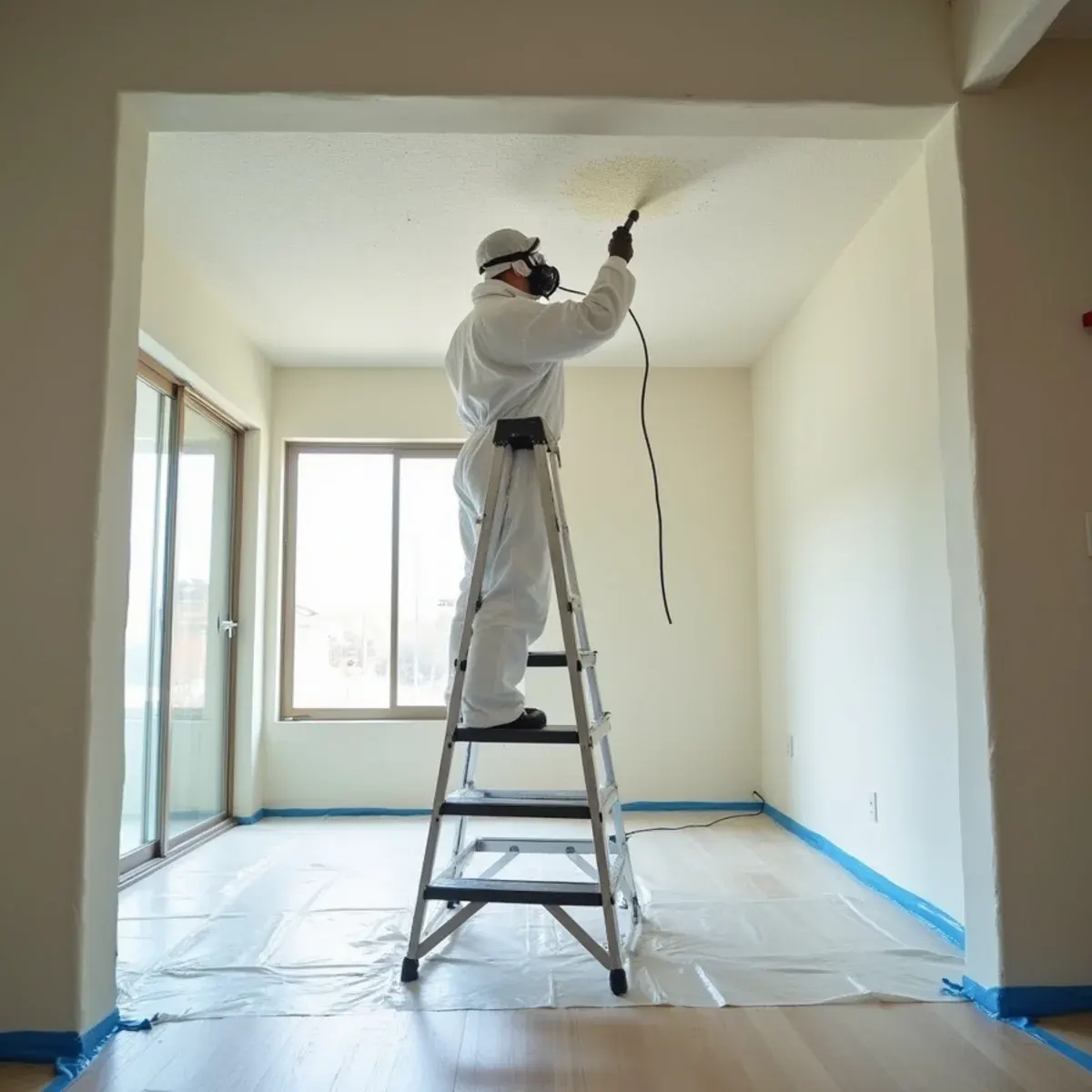
Carson has an unusually large mobile home park population alongside its postwar tract, and manufactured housing is its own world for this service. Pre-1980 coaches used asbestos in vinyl flooring, in furnace and duct components, and sometimes in wall panel and roofing products, and the assemblies are nothing like site-built construction — thin walls, a metal-framed chassis, and a belly wrap under the floor that traps water instead of letting it drain. A leak up there can sit in the wrap for weeks, and getting it out means opening the underside.
The regulatory path is different too. Manufactured homes fall under state Housing and Community Development jurisdiction rather than the city building department, which surprises owners expecting the same process as a house. On the site-built side, Carson's 1950s to 1975 slab tract behaves conventionally — ceiling texture, joint compound, floor tile and mastic, lead paint on anything before 1978. The shallow water table keeps slabs damp, and refinery and logistics operations immediately adjacent mean commercial work here follows survey rules regardless of age.
What Carson Changes About Asbestos & Lead Testing
1Manufactured homes use different materials
Coach flooring, furnace plenums, duct connectors and some wall panel products in pre-1980 units can contain asbestos, and none of them look like their site-built equivalents. Sampling a mobile home means knowing what to pull and where, and the confined layout leaves very little room for containment if a positive comes back. We scope those units in person rather than from a phone description.
2Belly wrap traps water under the floor
The wrap under a manufactured home holds a leak against the underside of the floor with almost no evaporation. Insulation stays saturated, subfloor swells, and the fix is cutting the wrap open to drain and dry it. That cut is the disturbance, so if the unit is pre-1980 the underfloor materials get sampled before the knife goes in.
3HCD jurisdiction, not city permits
Work on a manufactured home is overseen by the state rather than the city, so permitting and inspection differ from the tract house across the street. Abatement contractors still work to the same containment and clearance standards. Knowing which agency applies before the crew mobilizes keeps a park job from stalling, and park management usually has its own access rules on top of that.
How the Work Runs
The method is the same one we use on every asbestos & lead testing job, documented to the IICRC S500:2025 standard. Here it is in short — the full asbestos & lead paint testing process explains each stage in detail.
- Emergency stabilization without cutting
- Define exactly what gets disturbed
- A certified inspector takes the samples
- Independent laboratory analysis
- Lead assessment on painted surfaces
- Abatement, clearance, then restoration
The Carson Background Worth Knowing
Manufactured homes are built with the floor deck, usually particleboard or OSB, sitting on a steel frame, with batt insulation below it and a vapor barrier belly wrap stapled underneath to hold everything in place. Supply lines run through that cavity. When one leaks, the water does not run out onto the ground where you would see it. The belly wrap catches and holds it, the insulation soaks it up, and you now have a sealed reservoir under your floor with no path to evaporate. It can sit there for months before anything shows upstairs.
There is more on the housing stock, drainage and plumbing history of this city on our water damage restoration in Carson page.
Carson at a glance
- Dominant construction era
- 1950–1975
- Foundation type
- slab on grade
- Supply piping found here
- galvanized steel, under-slab copper, manufactured-home supply lines
- Drain line materials
- cast iron
- Terrain and water table
- flat, shallow water table
- Most common local failure
- manufactured-home underfloor leaks trapped in the belly wrap, alongside conventional 1960s slab failures
- Highest-value local prevention
- treating any soft spot in a manufactured-home floor as moisture until a meter proves otherwise
What It Costs in Carson
We do not quote a number over the phone before seeing the property — anyone who does is guessing. The variables that actually move the price on a asbestos & lead testing job are the number of distinct materials, how many samples each needs, how fast you need results, and they are broken down in full on the asbestos & lead paint testing page. The assessment and the written estimate are free anywhere in Carson, day or night, with no obligation.
Asbestos & Lead Testing Questions from Carson Homeowners
The flooring assembly first — sheet vinyl and its backing, any tile under it, and the adhesive — then the underfloor insulation and the duct and furnace components you will have to open to dry it out. In a 1974 unit all of those sit inside the asbestos window, and the belly wrap has to be cut regardless. Sampling before that cut is quicker and cheaper than stopping mid-repair in a park with neighbors ten feet away.
No, and that's the whole point of testing. Plenty of ceilings from that decade come back clean — the manufacturers were mixed, the formulas changed year to year, and two houses on the same street can give different results. What we can't do is assume either way. A 1974 ceiling is a suspect material, which means one sample and a lab report separates a routine repair from a regulated one. Guessing in either direction is the expensive choice.
Usually less than people fear, and we design around it. Extraction, containment and dehumidification all start on the first visit, because none of that disturbs a suspect material. Sampling happens the same day where we can get an inspector out, and rush lab analysis is available when the clock matters. What genuinely adds time is a positive result, since abatement, containment and clearance testing have to finish before we cut. We'll give you a realistic date rather than an optimistic one.
By locating it rather than arguing about it. The dividing line is the connection point where the park's service meets your home. Upstream of that is the park's responsibility, downstream is yours. We open the belly wrap where water is pooling, trace the wet path back to its source, and photograph what we find with the connection in frame. That documentation settles the question. Guessing from where the wet spot showed up inside is unreliable, because water travels along the frame first.