
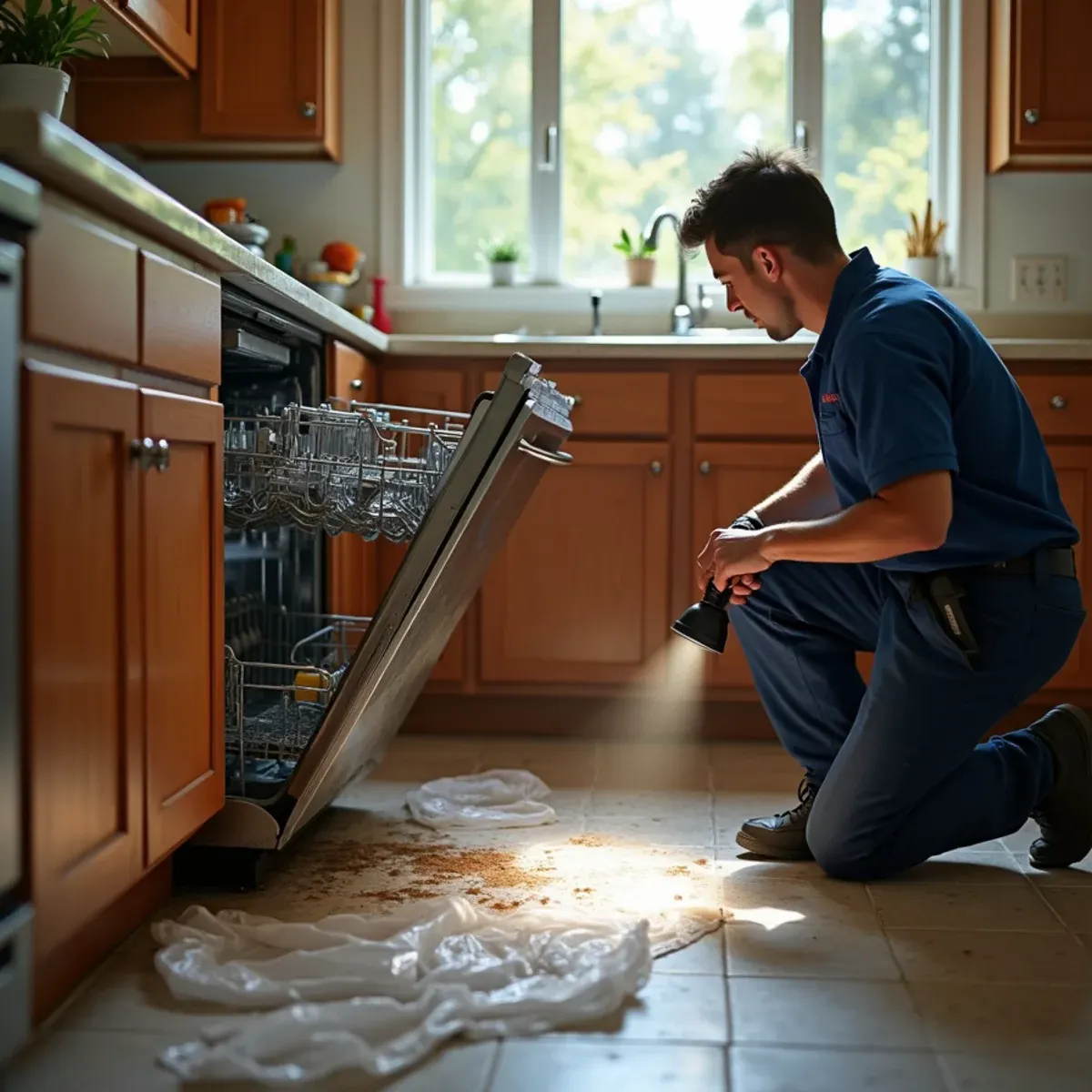
A washer supply line in a manufactured home doesn't flood the floor. It soaks through the particleboard decking, drops into the belly wrap slung under the frame, and stops there. That wrap is a sealed plastic membrane. Water getting into it has nowhere to go and nothing to evaporate into, so it sits, sometimes for months, softening the decking from below while the vinyl on top still looks perfectly fine. Stanton has one of the largest manufactured-home populations in this part of the county, and plenty of restoration companies simply won't work on them.
We do. That means opening the belly wrap in the right places, draining it, drying the cavity and the decking, and closing it back up properly instead of leaving it slit open. Stanton's older apartment buildings along the Beach Boulevard corridor are a different job again: 1960s and 70s stacked units where a dishwasher or a closet water heater sends water down through a shared wall. And the city's stick-built houses run on a mix of galvanized, copper and later patchwork, so no two of them are quite alike.
What Stanton Changes About Appliance Leaks
1Belly wrap traps water underneath
A manufactured home's underfloor is wrapped in a sealed membrane. Water from a washer or supply line soaks the particleboard decking, drops into that wrap and stays there with nothing to evaporate into. Months later the decking is failing and the vinyl above still looks fine. Drying one properly means opening the wrap where the water sits, draining it, and closing it back up.
2Soft spots are the only warning
Manufactured-home floors don't stain the way a stick-built floor does. The first sign is usually a patch that gives slightly underfoot near the laundry closet, the water heater or the bathroom. Treat any spongy area as a moisture problem until a meter says otherwise. By the time the surface shows anything at all, the decking underneath has already lost strength.
3Hall water heaters in older apartments
Stanton's 1960s and 70s apartment buildings put water heaters in hall or closet spaces, frequently with no pan and no drain line. When one lets go, water leaves the closet and heads straight for the shared wall and the unit below. We check adjacent units in these buildings as a matter of course rather than waiting to be asked.
How the Work Runs
The method is the same one we use on every appliance leaks job, documented to the IICRC S500:2025 standard. Here it is in short — the full appliance leak water damage cleanup process explains each stage in detail.
- Isolate the supply
- Pull the appliance and read behind it
- Open cabinet bases where needed
- Extract and remove unsalvageable material
- Targeted drying of the enclosed spaces
- Rebuild and reinstall
The Stanton Background Worth Knowing
Mobile and manufactured homes need a genuinely different restoration approach, and the reason is what they are built from. The floor system is typically particleboard or OSB over a wood frame with insulation and a vapor barrier belly wrap underneath — and particleboard exposed to water swells, loses structural integrity, and does not recover. It cannot be dried back to serviceable the way plywood often can.
There is more on the housing stock, drainage and plumbing history of this city on our water damage restoration in Stanton page.
Stanton at a glance
- Dominant construction era
- 1950–1975
- Foundation type
- mixed on grade
- Supply piping found here
- galvanized steel, copper, manufactured-home PEX and poly
- Drain line materials
- cast iron
- Terrain and water table
- flat, moderate water table
- Most common local failure
- underfloor leaks in manufactured homes, sealed inside the belly wrap where they cannot evaporate
- Highest-value local prevention
- checking for soft spots underfoot, because a manufactured-home floor gives no other warning
What It Costs in Stanton
We do not quote a number over the phone before seeing the property — anyone who does is guessing. The variables that actually move the price on a appliance leaks job are slow leak versus sudden failure, how much cabinetry is affected, subfloor condition, and they are broken down in full on the appliance leak water damage cleanup page. The assessment and the written estimate are free anywhere in Stanton, day or night, with no obligation.
Appliance Leaks Questions from Stanton Homeowners
Yes. It's different work, not impossible work. We open the belly wrap where the water has collected, drain it, dry the cavity and the particleboard decking with directed airflow, and monitor until the readings hold, then reseal the wrap. Skipping that and only drying the room above leaves a sealed pocket of water beneath your floor that will keep working on the decking for months afterward.
Yes. Dishwasher leaks run backward and sideways under the unit into the cabinet bases and subfloor, which is why the visible floor often looks untouched. A free moisture reading takes twenty minutes and will tell you definitively whether anything behind or beneath is wet.
Often only the affected base or toe-kick, not the whole box. Particleboard bottoms that have swollen and delaminated have to be replaced, but the cabinet frame, doors, and countertop can usually stay. We repair at the smallest reasonable scope.
Yes, and we say so explicitly because a lot of companies will not. Manufactured homes need a different approach — opening the belly wrap to dry the floor cavity, removing saturated insulation, and honestly assessing particleboard decking, which usually cannot be dried back to serviceable.