
A five-year hose rule assumes an average household. Plenty of Garden Grove homes aren't running an average household. This city filled in from farmland to full suburb in about fifteen years, and a large share of those 1950s and 60s houses now hold multiple generations or more than one family. The washer runs two or three times a day instead of twice a week. The dishwasher cycles after every meal. The angle stop, the braided hose and the supply riser don't count years. They count cycles, and they hit their limit early.
So we shorten the interval. Five years on braided hoses without exception, and we'd rather see four in a full house. The second thing we look for is the garage or patio refrigerator, common here, fed by a quarter-inch line run through a wall or under a slab edge with a saddle valve somebody tapped in around 1990. Those weep for months. If English isn't the easiest language for this conversation, say so. We'll slow down and write the scope and drying plan out so the whole household can follow it.
What Garden Grove Changes About Appliance Leaks
1Cycle counts, not calendar years
The five-year hose rule assumes an average household. A Garden Grove home with two or three families in it runs the washer and dishwasher several times a day, so hoses, angle stops and supply risers reach the same wear in three or four. We tell full-house clients to shorten every interval and to write the install date on the hose in marker.
2Garage refrigerators on saddle valves
Second refrigerators are common here, and the ice-maker line was usually run later with a saddle valve tapped into a copper pipe. Those valves weep slowly for months, generally into a wall cavity or along a slab edge where nobody is looking. If you have a garage or patio fridge, trace the line back to its connection and replace any saddle valve you find.
3One house, more than one household
Multi-generational and multi-family occupancy changes the claim as much as the plumbing does. Belongings belong to several people, sleeping arrangements are already tight, and a kitchen out of service affects everyone at once. We plan containment and equipment placement to keep the house livable, and we write the scope plainly so every adult in the home can follow what is happening.
How the Work Runs
The method is the same one we use on every appliance leaks job, documented to the IICRC S500:2025 standard. Here it is in short — the full appliance leak water damage cleanup process explains each stage in detail.
- Isolate the supply
- Pull the appliance and read behind it
- Open cabinet bases where needed
- Extract and remove unsalvageable material
- Targeted drying of the enclosed spaces
- Rebuild and reinstall
The Garden Grove Background Worth Knowing
A 1958 tract home was plumbed for a family of four with one bathroom in regular use, one washing machine, and a single water heater sized to match. Many Garden Grove homes today support considerably more than that, and the plumbing feels it.
There is more on the housing stock, drainage and plumbing history of this city on our water damage restoration in Garden Grove page.
Garden Grove at a glance
- Dominant construction era
- 1950–1970
- Foundation type
- slab on grade
- Supply piping found here
- galvanized steel, under-slab copper
- Drain line materials
- cast iron, clay
- Terrain and water table
- flat, moderate water table
- Most common local failure
- accelerated wear on angle stops, supply risers and washing machine hoses from far higher fixture cycle counts
- Highest-value local prevention
- shorter replacement intervals on every wear item — hoses at five years without exception
What It Costs in Garden Grove
We do not quote a number over the phone before seeing the property — anyone who does is guessing. The variables that actually move the price on a appliance leaks job are slow leak versus sudden failure, how much cabinetry is affected, subfloor condition, and they are broken down in full on the appliance leak water damage cleanup page. The assessment and the written estimate are free anywhere in Garden Grove, day or night, with no obligation.
Appliance Leaks Questions from Garden Grove Homeowners
Five years is the outer limit, and under that load we'd move to four. Write the install date on the hose with a marker so nobody has to guess later. Replace both hoses at once, replace the angle stops if they're original or stiff, and shut the water off at the box when you travel. Heavy use also wears the washer's own inlet valve, which fails open and floods a laundry room just as effectively.
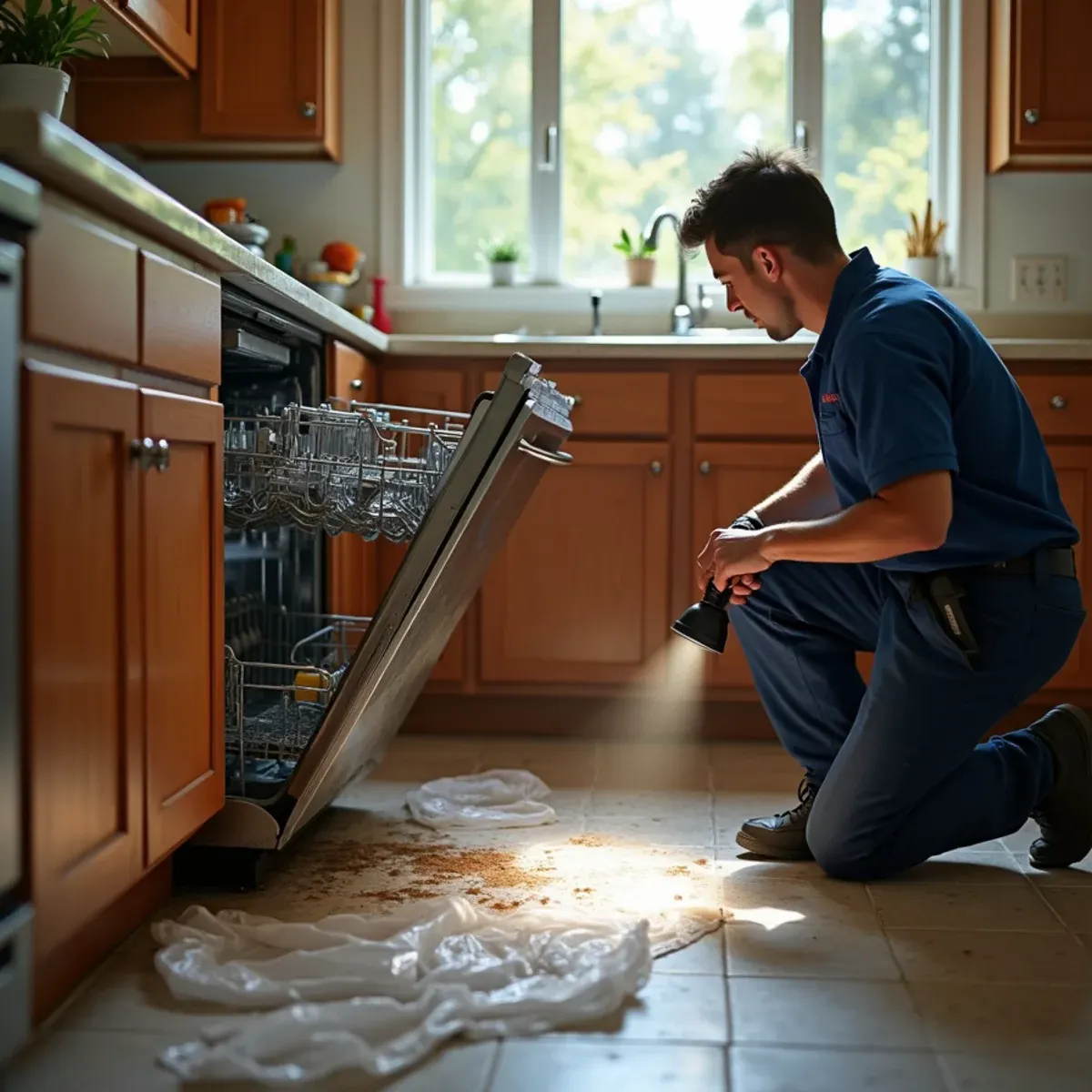
Yes. Dishwasher leaks run backward and sideways under the unit into the cabinet bases and subfloor, which is why the visible floor often looks untouched. A free moisture reading takes twenty minutes and will tell you definitively whether anything behind or beneath is wet.
Often only the affected base or toe-kick, not the whole box. Particleboard bottoms that have swollen and delaminated have to be replaced, but the cabinet frame, doors, and countertop can usually stay. We repair at the smallest reasonable scope.
Yes, all five ZIP codes — 92840, 92841, 92843, 92844, and 92845 — for both residential and commercial properties. Response time runs about twenty-five to thirty-five minutes depending on where in the city.