
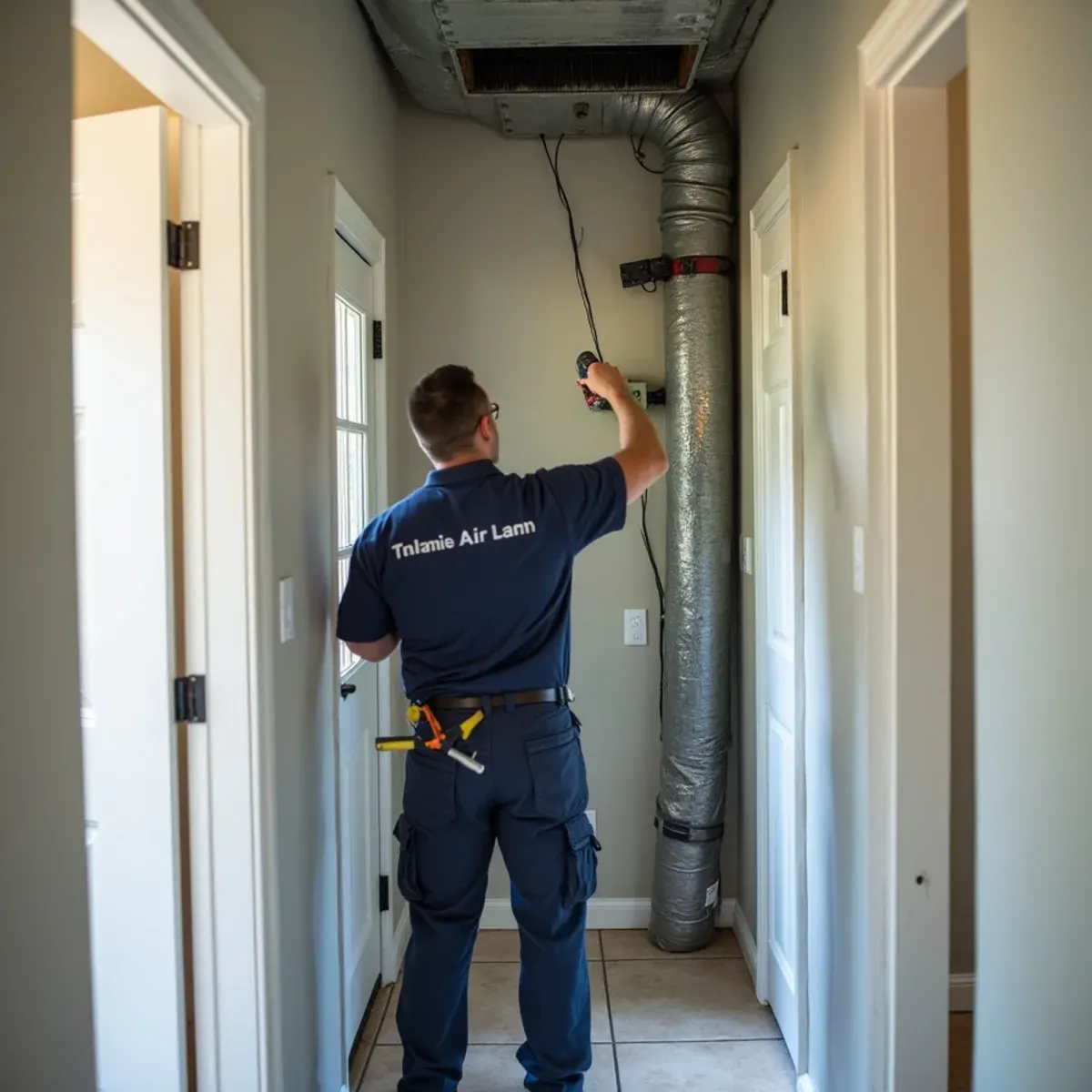
In a manufactured home the ducting is not overhead. The main trunk runs under your feet inside the floor cavity, the registers are in the floor, and a crossover duct links the two halves down in the belly. That changes everything about this work. Water from a supply failure or a sewer backup lands in the belly wrap, and the wrap is built to hold, not to drain. What it holds sits against the trunk insulation and the particleboard decking for weeks or months.
Stanton carries a large share of manufactured and mobile homes along with older apartment buildings, packed into one of the denser small cities in the county. Coach spacing is tight and equipment has to come in on foot down the lane. The site-built pockets and the apartments are the conventional version of this job, with attic flex, a furnace closet, a coil and filters. The mobile homes are not, and companies that only ever work slab tracts tend to quote them wrong.
What Stanton Changes About Air Ducts & HVAC
1Floor registers tell you what is below
Pull a floor register in a coach and look with a mirror and a light. Standing water, a rusted boot, swollen particleboard at the edge of the opening, that is the trunk telling you the belly is wet. It is a two-minute check that gets skipped constantly, and it is the difference between finding the problem today and chasing an odor for six months.
2The crossover duct under the home
On a double-wide a flexible crossover connects the two halves underneath the floor. It is usually the lowest point in the whole system, often already sagging, sometimes torn open by rodents. When water gets into the belly, that is where it collects. Cleaning it is rarely worth it. The part is inexpensive, and replacing it while the belly is open is faster than trying to salvage it.
3Belly wrap has to be closed properly again
Any underfloor work means cutting the wrap. Closing it back with tape alone leaves a moisture path and an open invitation for rodents. It gets patched with the right material, supported so it does not sag into a pocket, and the insulation replaced where it was compressed or soaked. That step is what separates a repair that holds from one that smells again next winter.
How the Work Runs
The method is the same one we use on every air ducts & hvac job, documented to the IICRC S500:2025 standard. Here it is in short — the full air duct cleaning & hvac restoration process explains each stage in detail.
- Inspect before we quote
- Contain and seal the system
- Clean or replace the ducting
- Clean the air handler and coil
- Replace filters and treat surfaces
- Seal, balance, and verify
The Stanton Background Worth Knowing
Mobile and manufactured homes need a genuinely different restoration approach, and the reason is what they are built from. The floor system is typically particleboard or OSB over a wood frame with insulation and a vapor barrier belly wrap underneath — and particleboard exposed to water swells, loses structural integrity, and does not recover. It cannot be dried back to serviceable the way plywood often can.
There is more on the housing stock, drainage and plumbing history of this city on our water damage restoration in Stanton page.
Stanton at a glance
- Dominant construction era
- 1950–1975
- Foundation type
- mixed on grade
- Supply piping found here
- galvanized steel, copper, manufactured-home PEX and poly
- Drain line materials
- cast iron
- Terrain and water table
- flat, moderate water table
- Most common local failure
- underfloor leaks in manufactured homes, sealed inside the belly wrap where they cannot evaporate
- Highest-value local prevention
- checking for soft spots underfoot, because a manufactured-home floor gives no other warning
What It Costs in Stanton
We do not quote a number over the phone before seeing the property — anyone who does is guessing. The variables that actually move the price on a air ducts & hvac job are cleaning versus replacing flex duct, number of supply runs and returns, what kind of contamination it is, and they are broken down in full on the air duct cleaning & hvac restoration page. The assessment and the written estimate are free anywhere in Stanton, day or night, with no obligation.
Air Ducts & HVAC Questions from Stanton Homeowners
Not the same way. The trunk is in the floor rather than the attic, it is often sheet metal with mastic joints and fiberglass wrapped around it, and there is no attic to work from. We access through the floor registers and from underneath with the belly open. Where insulation is saturated or the decking around a boot has swollen, we replace sections instead of pretending that cleaning solved it.
Fair question, and often it is an upsell. The honest answer depends on whether contamination actually reached the system. If the HVAC ran during the loss or the demolition, if water got into the attic where the ducting lives, or if the loss involved sewage or fire, the system is in scope. If none of that happened, it probably is not. We run a camera and show you before you decide anything.
It depends on where the moisture is. If the inner liner got damp and the fiberglass behind it stayed dry, cleaning and drying the run works. If water got through a torn jacket into the insulation, that fiberglass is porous, it holds moisture and growth, and there is no reliable way to clean it or verify it is clean. Those runs get replaced. We show you which is which rather than guessing on your behalf.
Yes, and we say so explicitly because a lot of companies will not. Manufactured homes need a different approach — opening the belly wrap to dry the floor cavity, removing saturated insulation, and honestly assessing particleboard decking, which usually cannot be dried back to serviceable.