
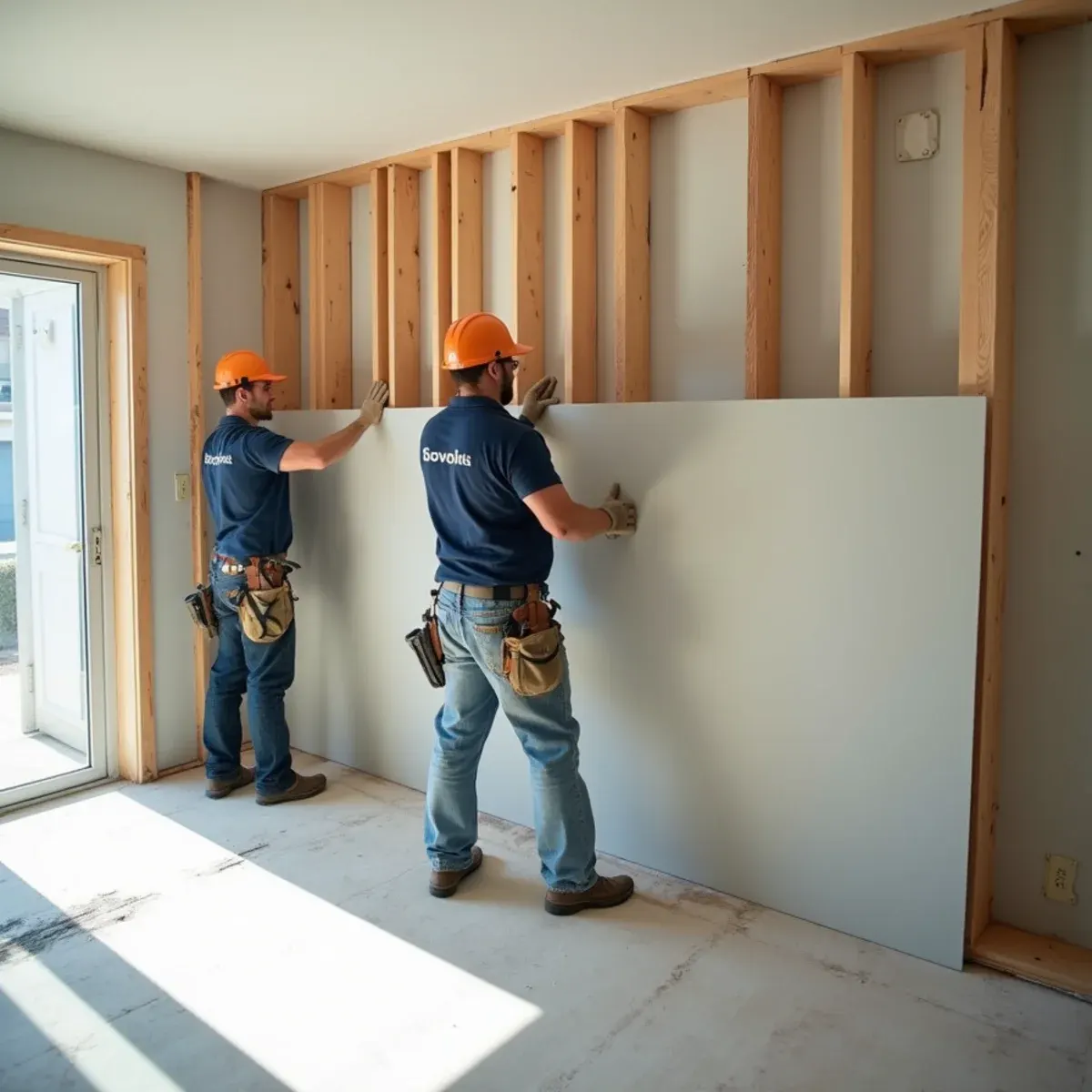
The call usually comes from a facility manager at four in the morning. A sprinkler head let go over a racked aisle off Norwalk Boulevard, or a rooftop line split above a suspended ceiling in an office build-out, and now there's an inch of water across forty thousand square feet of sealed concrete with product sitting on it. Santa Fe Springs is one of the most industrial cities in this part of Los Angeles County, and most of our reconstruction here is warehouse, manufacturing and tenant-improvement work rather than kitchens and baths.
What gets rebuilt is different too. Acoustic ceiling grid and tile by the thousands of square feet. Metal-stud office partitions inside a tilt-up shell. Batt or blanket insulation, sealed or epoxy floor coating that has to be recoated in a way that matches an aisle nobody can close for a week, and sprinkler components a licensed fire contractor has to sign off on. There are residential pockets here too — Los Nietos, the older streets near Florence — and those get handled as houses, with residential finishes and residential permits.
What Santa Fe Springs Changes About Repair & Reconstruction
1Rebuilding around an operating facility
We almost never get an empty building. Reconstruction here happens with forklifts running two aisles over, so we hard-partition the work zone, keep dust out of production, and phase the ceiling and floor work into shifts your operation can absorb. Where a section has to close, we tell you exactly which days and hold to it, because your scheduling depends on ours.
2Fire sprinkler work needs the right license
A discharged head or a failed riser is fire-life-safety equipment, and putting the system back is licensed work with its own inspection. We coordinate the fire contractor's repair and the required sign-off alongside the ceiling and finish rebuild, so the grid doesn't go up before the piping is approved and you're not paying to open it twice.
3Documentation your carrier and landlord both need
Commercial claims here usually involve a tenant, a building owner and sometimes a lender, and each wants proof of what was damaged, what was removed and what was replaced. We keep moisture logs, photo documentation and a line-item scope on the same estimating platform the adjuster uses, so the improvements-and-betterments question between you and your landlord has a paper trail behind it.
How the Work Runs
The method is the same one we use on every repair & reconstruction job, documented to the IICRC S500:2025 standard. Here it is in short — the full water damage repair & reconstruction process explains each stage in detail.
- Scope and estimate while mitigation finishes
- Agree the scope with you and the carrier
- Material selection
- Rough work and inspections
- Finishes
- Walkthrough and warranty
The Santa Fe Springs Background Worth Knowing
The water sitting in a wet-pipe sprinkler system has been there for years. It is stagnant, it has been in contact with black steel and scale that whole time, and some systems carry corrosion inhibitors or antifreeze as well. When a head discharges, that is what lands on your floor and soaks into your product. Under IICRC S500:2025 water gets categorized on the evidence in front of us, and sprinkler discharge that has run across a warehouse floor almost never stays in Category 1. That decision drives what we dry in place, what comes out, and how the crew works.
There is more on the housing stock, drainage and plumbing history of this city on our water damage restoration in Santa Fe Springs page.
Santa Fe Springs at a glance
- Dominant construction era
- 1950–1975
- Foundation type
- slab on grade
- Supply piping found here
- galvanized steel, copper, commercial-grade systems
- Drain line materials
- cast iron, commercial waste lines
- Terrain and water table
- flat, moderate water table
- Most common local failure
- fire-sprinkler discharge and commercial supply failures across large open-plan warehouse and manufacturing floors
- Highest-value local prevention
- keeping current building access and shutoff information on file before an after-hours failure
What It Costs in Santa Fe Springs
We do not quote a number over the phone before seeing the property — anyone who does is guessing. The variables that actually move the price on a repair & reconstruction job are how much came out during mitigation, finish level and material availability, texture and finish matching difficulty, and they are broken down in full on the water damage repair & reconstruction page. The assessment and the written estimate are free anywhere in Santa Fe Springs, day or night, with no obligation.
Repair & Reconstruction Questions from Santa Fe Springs Homeowners
Less than you'd think, usually. Sprinkler water is clean at the head but picks up scale and pipe residue, so the affected racking area, ceiling tile and any wet insulation come out while the rest of the building stays in production behind hard containment. The parts that force a real closure are floor coating recoats, which need cure time, and any structural or electrical work above an aisle. We identify those zones on day one and schedule them into your slowest shift.
Both, under one contract. The same team that documented and dried your loss handles the rebuild — drywall, texture, flooring, cabinetry, trim, and paint — so you are not managing multiple contractors or explaining the scope twice.
A single-room repair is typically one to two weeks after drying finishes. Kitchen or multi-room rebuilds run three to six weeks, and jobs requiring permits and inspections take longer because of the inspection windows. You get a written schedule before work starts.
No. Water that has sat in a wet-pipe system for years picks up scale, rust and whatever inhibitors are in the system, and once it runs across a warehouse floor it collects everything on that floor too. We categorize on the evidence per IICRC S500:2025, and sprinkler discharge almost always lands past Category 1. That affects what gets dried in place, what gets removed, and what protective equipment the crew works in.