
Pico Rivera occupies a strip of ground between two flood-control channels — the San Gabriel River on one side, the Rio Hondo on the other — and that position defines almost everything about how water behaves here. The table sits shallow. During a sustained wet stretch the ground saturates faster than in cities a few miles east, and it stays saturated longer. On the postwar slab tract that makes up most of the city, that produces a symptom people reasonably mistake for a plumbing leak: damp flooring, a musty closet, adhesive letting go.
Often it isn't a leak at all. It's vapor coming up through a 1950s slab poured with little or no vapor barrier, driven by groundwater below it. The readings look different from a supply failure — broad, even, low-grade moisture across a large area rather than a hot point that spreads outward — and telling those two apart is the main thing our inspection does in this city. We also isolate at the meter, because plenty of houses here do have failing galvanized alongside the vapor issue.
What Pico Rivera Changes About Inspection & Leak Detection
1Vapor drive versus an actual leak
A 1950s slab in Pico Rivera often has no meaningful vapor barrier under it, and with the table this shallow, moisture moves up through the concrete continuously. It reads as broad, even dampness across a room. A supply leak reads as a warm concentrated point with a wet halo. Same wet floor, completely different fix, and jackhammering the wrong one helps nobody.
2Sustained storms saturate the ground quickly
One heavy afternoon is usually fine here. Four days of rain is when we get calls, because the ground between the channels has nowhere left to put water. That's when perimeter moisture starts appearing in garages, in additions built on a lower slab, and at the base of exterior walls. We inspect after the storm and again once things settle, since the readings change.
3Downspouts and area drains near the foundation
On the compact lots through the Rivera district and North Pico Rivera, downspouts often discharge a foot from the stucco. With ground already saturated, that water has nowhere to go but straight down alongside the footing. Extending a downspout is a cheap fix that changes readings measurably by the next storm, and we'll say so in the findings when we see it.
How the Work Runs
The method is the same one we use on every inspection & leak detection job, documented to the IICRC S500:2025 standard. Here it is in short — the full water damage inspection & leak detection process explains each stage in detail.
- Talk through the history
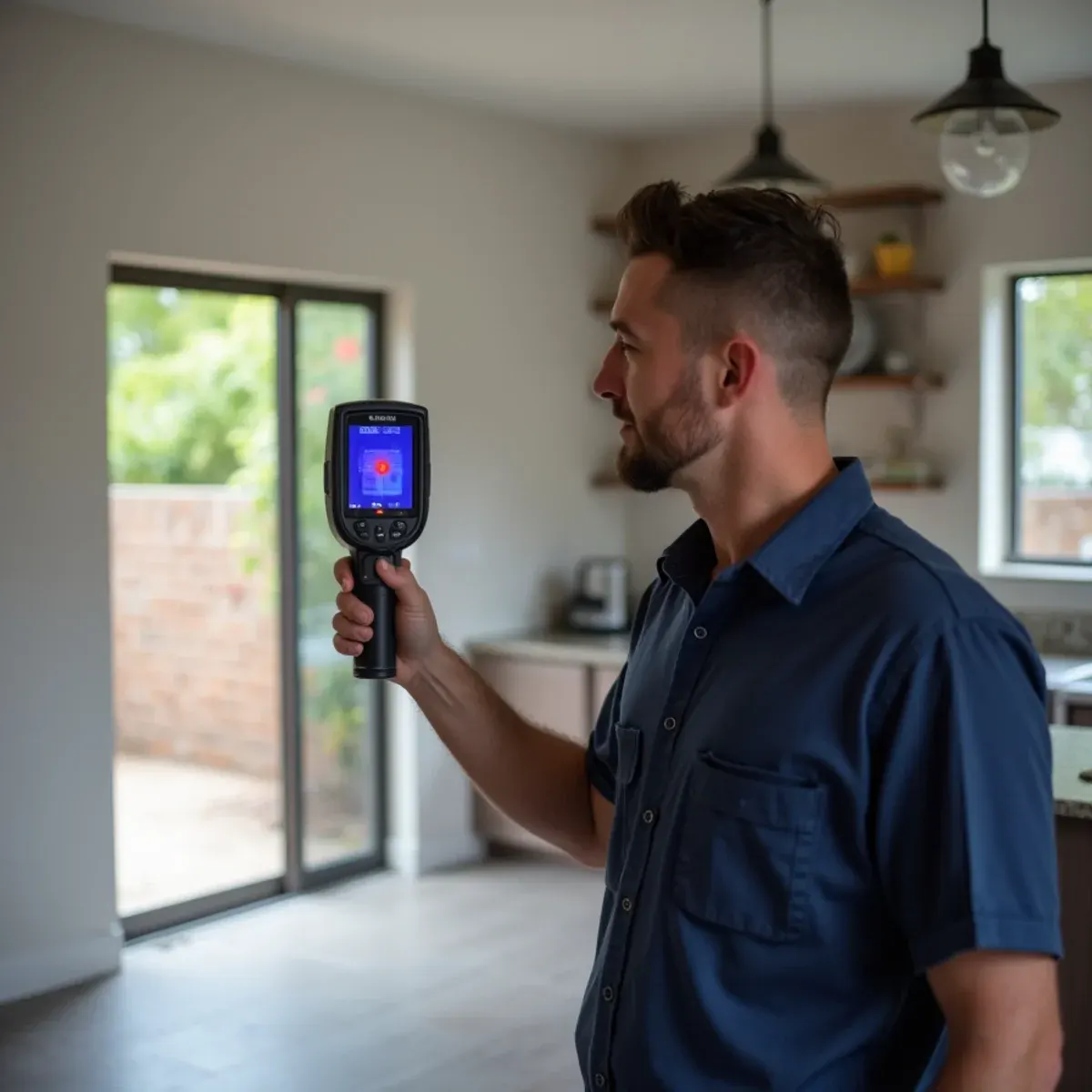
- Thermal imaging survey
- Confirm with moisture meters
- Supply-side isolation testing
- Written findings with images
- Options, not a sales pitch
The Pico Rivera Background Worth Knowing
On a hillside, storm water leaves. In Pico Rivera it soaks in, and when the soil is already near capacity it stops soaking in and simply stands. That is why a yard here can hold water two days after the rain stops while a yard up in the Whittier hills is dry by morning. The lawn is not draining badly. The ground underneath it is full. Once that happens, every path water can take toward your house becomes the path it takes: the garage threshold, the slider track, the gap where a patio slab has settled back toward the wall.
There is more on the housing stock, drainage and plumbing history of this city on our water damage restoration in Pico Rivera page.
Pico Rivera at a glance
- Dominant construction era
- 1945–1965
- Foundation type
- slab on grade
- Supply piping found here
- original galvanized steel, copper
- Drain line materials
- cast iron
- Terrain and water table
- flat, shallow water table
- Most common local failure
- ground saturating fast during sustained storms because the water table between two channels sits high
- Highest-value local prevention
- clearing area drains and confirming downspouts discharge well away from the foundation
What It Costs in Pico Rivera
We do not quote a number over the phone before seeing the property — anyone who does is guessing. The variables that actually move the price on a inspection & leak detection job are standard moisture inspection — no charge, electronic slab leak location, pre-purchase moisture survey, and they are broken down in full on the water damage inspection & leak detection page. The assessment and the written estimate are free anywhere in Pico Rivera, day or night, with no obligation.
Inspection & Leak Detection Questions from Pico Rivera Homeowners
That combination points away from a supply leak and toward the slab itself. Between the San Gabriel River and the Rio Hondo, groundwater sits close enough that vapor moves steadily up through mid-century concrete, and flooring adhesives and laminates fail from underneath without water ever appearing on the surface. We take slab moisture readings across the room and compare them against the meter test. If the meter is still and the readings are broad and even, it's vapor, not a pipe.
The standard moisture inspection is — thermal imaging, moisture mapping, and written findings, with no obligation. Specialized services like electronic slab leak location, a full pre-purchase survey, or lab sampling carry a fee, and we tell you the number before we start.
Twenty to forty minutes for a targeted check of a specific concern. A comprehensive whole-home survey for a real estate transaction runs about ninety minutes to two hours.
Not in the way people picture it. The channels are engineered, and what we actually see is a groundwater and surface drainage problem rather than a channel overtopping. Because the water table between the two runs high and the ground is flat, soil here reaches saturation faster than it does a few miles inland. Once it does, storm water stops soaking in and starts looking for the lowest opening in your house, which is almost always the garage.