
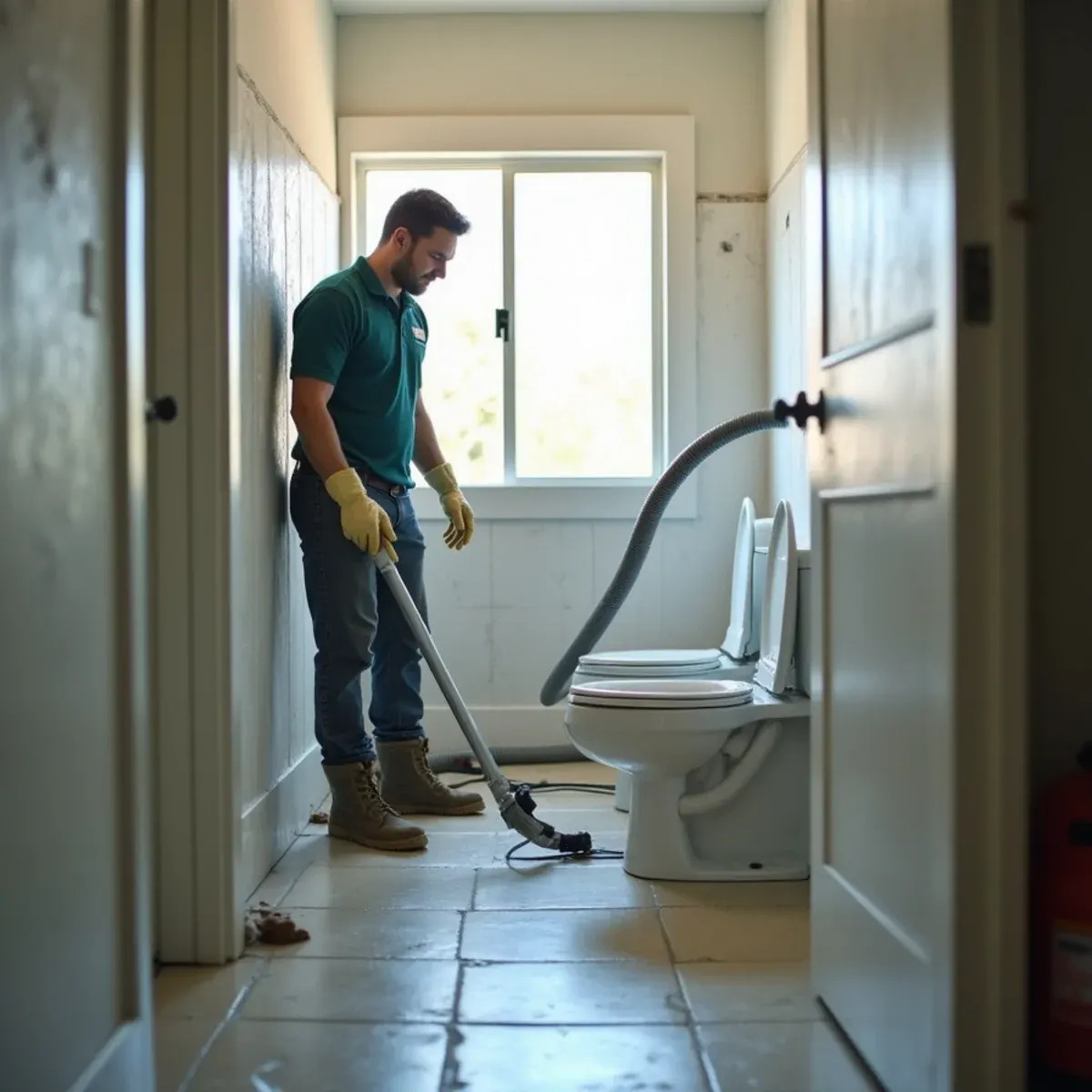
A manufactured home floor is not a house floor, and that is the single most important fact about toilet overflows in Stanton. Under the vinyl or laminate there is particleboard decking, and under that a belly wrap, a sealed membrane slung beneath the joists to hold insulation in place. Particleboard swells and loses structural strength once it is wet, particularly in the ring right around the closet flange where it has already been cut. Anything that gets past the decking lands in the belly wrap, which was designed to keep water out from below and consequently keeps it in from above.
Stanton is dense, and a large share of its housing is manufactured and mobile homes standing alongside older apartment buildings from the 1950s through the 1970s. Inside the parks, the spacing between coaches limits where the truck and equipment can go, so we plan the hose route before extraction starts rather than discovering the problem at the far end of the driveway. The underfloor work usually means opening the wrap at the low point, draining it, pulling the wet insulation and drying the cavity with it left open until readings hold. Closing it back over damp insulation just restarts the clock.
What Stanton Changes About Toilet Overflow
1Particleboard decking around the closet flange
The decking is at its weakest exactly where the toilet sits, because the opening for the flange was cut through it. Repeated wetting there softens the material until the flange loses its anchorage and the toilet begins to rock, which breaks the wax seal and puts more water in the same spot. We check for give around the base before resetting anything, and say plainly when the decking has to be replaced.
2Belly wraps hold water for months
Water sealed inside a belly wrap does not evaporate and does not show on the floor above. It saturates the insulation, condenses against the underside of the decking, and often gives no odor into the living space until mold is well established. Any overflow that got past the decking means the wrap needs opening and inspection, even if the bathroom floor now reads dry.
3Park spacing limits equipment staging
Coach-to-coach clearance in Stanton's parks is tight, and awnings, carports and shared utility runs narrow it further. Long hose runs cost lift on the extractor, and generator or dehumidifier placement has to keep a neighbor's walkway clear. We scout the approach on arrival and set up once, rather than dragging equipment through somebody's yard twice at eleven at night.
How the Work Runs
The method is the same one we use on every toilet overflow job, documented to the IICRC S500:2025 standard. Here it is in short — the full toilet overflow cleanup process explains each stage in detail.
- Stop the water, stabilize the room
- Determine the category before scoping
- Extract, then remove only what must go
- Pull the toilet, inspect the flange
- Dry the subfloor and the ceiling below
- Disinfect to category, verify, reset
The Stanton Background Worth Knowing
Mobile and manufactured homes need a genuinely different restoration approach, and the reason is what they are built from. The floor system is typically particleboard or OSB over a wood frame with insulation and a vapor barrier belly wrap underneath — and particleboard exposed to water swells, loses structural integrity, and does not recover. It cannot be dried back to serviceable the way plywood often can.
There is more on the housing stock, drainage and plumbing history of this city on our water damage restoration in Stanton page.
Stanton at a glance
- Dominant construction era
- 1950–1975
- Foundation type
- mixed on grade
- Supply piping found here
- galvanized steel, copper, manufactured-home PEX and poly
- Drain line materials
- cast iron
- Terrain and water table
- flat, moderate water table
- Most common local failure
- underfloor leaks in manufactured homes, sealed inside the belly wrap where they cannot evaporate
- Highest-value local prevention
- checking for soft spots underfoot, because a manufactured-home floor gives no other warning
What It Costs in Stanton
We do not quote a number over the phone before seeing the property — anyone who does is guessing. The variables that actually move the price on a toilet overflow job are the category of the water, how far it traveled from the base, what your floor is built from, and they are broken down in full on the toilet overflow cleanup page. The assessment and the written estimate are free anywhere in Stanton, day or night, with no obligation.
Toilet Overflow Questions from Stanton Homeowners
It usually means the particleboard decking has taken on water and lost strength, and that the belly wrap underneath is holding some of it. Soft decking will not keep the closet flange anchored, so the toilet rocks and the seal fails again. In a Stanton coach we open the wrap from below, drain and dry the cavity, replace the wet insulation, and cut out the compromised decking rather than resetting a fixture onto a floor that cannot hold it.
Clear water lowers the health risk, not the drying requirement. Clean water still soaks into carpet pad, particle board, and the cut edge of subfloor around the flange, and it still causes swelling and mold growth if it stays. What clean water does change is the scope: no containment, no PPE, usually no demolition. If it stayed on sealed tile and you got it up quickly, you may genuinely be fine. If it reached anything porous, it needs real drying.
Three checks. Did the water rise in the bowl without anyone flushing it? Does another fixture gurgle, drain slowly, or fill up when you run water elsewhere in the house? Is there visible soil or a sewer odor in what came out? Any one of those points at the main line. A stuck fill valve, by contrast, gives you clear water, a bowl that overflows steadily, and a tank you can hear running continuously.
Yes, and we say so explicitly because a lot of companies will not. Manufactured homes need a different approach — opening the belly wrap to dry the floor cavity, removing saturated insulation, and honestly assessing particleboard decking, which usually cannot be dried back to serviceable.