
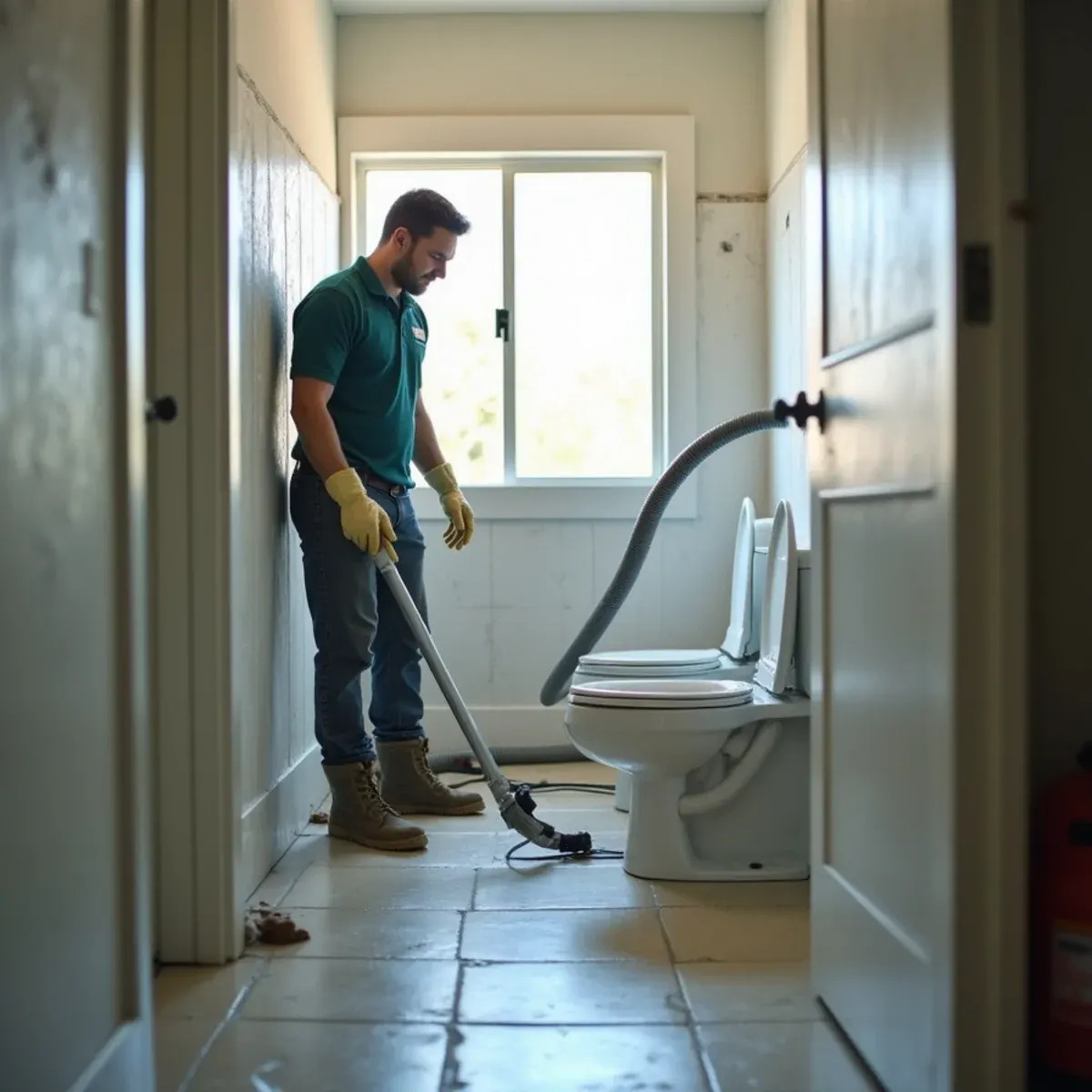
A typical block in Paramount puts houses within a few feet of a machine shop, a trucking yard or a distribution building. The city was assembled from the old Hynes and Clearwater dairy communities and grew into one of the more industrially dense places around, with tightly packed homes squeezed between commercial corridors. We get called to both sides of that fence, sometimes in the same week, and a toilet overflow in a house and one in a plant restroom are not the same job.
The residential half is 1945 to 1965 slab on small lots with almost no permeable ground between the street and the door, and the Los Angeles River channel runs the western edge. The commercial half is employee and public restrooms with far heavier use, floor drains, and sealed concrete that sends water sideways under partition walls instead of absorbing it. Different categories, different PPE, different documentation, different clock — one of them can't stop production while we work.
What Paramount Changes About Toilet Overflow
1Commercial restrooms default to Category 3
A shared employee restroom serving dozens of people a day is not a home bathroom. Even a clean overflow there picks up biological load fast, and a line backup carries the whole building's contents across the floor. We treat these as Category 3 unless the evidence says otherwise, which means containment, PPE, removal of porous material and documented disinfection before anyone reoccupies the space.
2Water travels under partition walls
Restrooms in Paramount's older industrial buildings sit on sealed slab with metal partitions and hollow stud walls behind the tile. Water crosses under those walls into adjacent offices, break rooms and storage without ever pooling visibly. We pull base and check the far side of every shared wall rather than trusting a floor that looks dry from the doorway.
3Houses packed against commercial neighbors
On the residential side, lots are small and structures sit close. An overflow in a rear-addition bathroom can reach a property-line wall or a garage converted to living space. Those conversions rarely have proper subfloor detailing, so water gets under the finish and stays there. We check every converted space on the property, not only the room that flooded.
How the Work Runs
The method is the same one we use on every toilet overflow job, documented to the IICRC S500:2025 standard. Here it is in short — the full toilet overflow cleanup process explains each stage in detail.
- Stop the water, stabilize the room
- Determine the category before scoping
- Extract, then remove only what must go
- Pull the toilet, inspect the flange
- Dry the subfloor and the ceiling below
- Disinfect to category, verify, reset
The Paramount Background Worth Knowing
On a typical Paramount lot, the house, the driveway, the walkways and the rear slab cover most of the parcel. What is left is a narrow side yard, and everything that lands on the roof and the paving is supposed to leave through a couple of small area drains. That system has no margin. When a grate silts up, when a downspout dumps straight onto paving, or when the outlet at the curb has been crushed by a parked truck, the water has no soil to soak into and nowhere else to be. It ponds against the slab edge and comes in at the lowest threshold, which is usually a garage or a side door.
There is more on the housing stock, drainage and plumbing history of this city on our water damage restoration in Paramount page.
Paramount at a glance
- Dominant construction era
- 1945–1965
- Foundation type
- slab on grade
- Supply piping found here
- original galvanized steel, copper
- Drain line materials
- cast iron
- Terrain and water table
- flat, moderate water table
- Most common local failure
- residential and commercial losses on the same block, needing very different handling
- Highest-value local prevention
- clearing area drains before the season on lots with very little permeable ground
What It Costs in Paramount
We do not quote a number over the phone before seeing the property — anyone who does is guessing. The variables that actually move the price on a toilet overflow job are the category of the water, how far it traveled from the base, what your floor is built from, and they are broken down in full on the toilet overflow cleanup page. The assessment and the written estimate are free anywhere in Paramount, day or night, with no obligation.
Toilet Overflow Questions from Paramount Homeowners
Sometimes, depending on where the water went and what category it is. If it's confined to the restroom and the wall behind it, we build containment, run negative air and keep the rest of the floor operating. If waste reached a break room, a food area or an occupied office, that space comes out of service until it's cleaned and verified. We define that boundary on the first walkthrough, and we can work off-hours.
Clear water lowers the health risk, not the drying requirement. Clean water still soaks into carpet pad, particle board, and the cut edge of subfloor around the flange, and it still causes swelling and mold growth if it stays. What clean water does change is the scope: no containment, no PPE, usually no demolition. If it stayed on sealed tile and you got it up quickly, you may genuinely be fine. If it reached anything porous, it needs real drying.
Three checks. Did the water rise in the bowl without anyone flushing it? Does another fixture gurgle, drain slowly, or fill up when you run water elsewhere in the house? Is there visible soil or a sewer odor in what came out? Any one of those points at the main line. A stuck fill valve, by contrast, gives you clear water, a bowl that overflows steadily, and a tank you can hear running continuously.
Almost certainly your area drains. Paramount lots have very little permeable ground, so everything that falls on the roof and the paving has to leave through a couple of small drains. If a grate silts up or the outlet is crushed, the water ponds against the slab and enters at the lowest threshold, which is usually the garage. Rodding the drains and checking the outlet before the season costs far less than drying the garage wall afterward.